Thursday, March 22, 2012

Egad! The Snow Mow!

I cannot believe it!  Our gardener is out today mowing our lawns despite the icy snow covering!  I hear his mower grinding and clacking over the crunchy surface.  God bless, Mr. Le!  He's got the same work ethic as USPS -- for a lot less pay.
Can you even wrap your mind around the fact that it's March 22 and we're still getting snow in the PNW?  What a winter!  This has been a serious setback for my efforts to convince certain peoples of Midwestern habitation to move northwestward to a more tranquil clime.  I hear it's in the 70's and 80's out in the middle lands.  Phooey.

But, talk to me in August, when they'll be sweltering and we'll be living la vita bella in our own lush, green wonderland of pleasantly-warm.  [Cue maniacal laughter.]

Oppressed By the Russians!

Well, by one particular Russian, at least.  And all his vile creations.  Does anybody really like Dr. ZhivagoReally?  What do you like about it?  It cannot be the characters, plot, themes, or writing style -- which are, consecutively, repulsive, onerous, banal, and plodding.  My theories on this mystery have been pared down to two possibilities:  First, nobody, from the lowliest undergrad to the most exalted on the Pulitzer Prize committee, has actually read Dr. Zhivago -- it's just been a collectively perpetuated fraud, held together by a web of mutual fear of "readers" and "enthusiasts" that someone, somewhere might find them uncultured.  Second, there are a whole lot of people out there who lack basic literary taste or the ability to think critically and for themselves when it comes to the accepted contemporary canon.

But, I am ready and waiting to be illuminated.  I am only about 44% of the way through -- they're heading to the Urals and everyone is digging out the train.  Jason laughs at my increasing frustration and traumatized disbelief that something so wretched could be so celebrated.  Says he, "Just watch -- you'll get to the end and it will all be so masterful that you'll close the book and just say, 'Wow!'"  He, of course, says this simply to annoy or encourage me (not sure which); he has not read the book.  Look, I am willing to be proven wrong about this novel.  Truly.  I have nothing invested in proclaiming its worthlessness.  Should Jason's facetious prediction actually come true, no one could be more ready to admit she was wrong than I.

343 pages left (and I don't care; I am not reading Yuri's poetry at the end; no! No! NO!) -- and I'm determined to finish this book if it kills me or, which seems more likely, causes a severe and lasting depression of spirit.  How many pages of Jane Austen and P.G. Wodehouse are necessary to ameliorate the effects of too many pages spent with these dreary, tedious Russian people?  I may well be re-reading Brit Lit favorites far into 2013.

Thursday, March 15, 2012

Say What You Want About Newt, But I Think That When It Comes to Supporters, He Has the Edge!

Came across this interesting video from Newt's recent campaign stops in Illinois.  I think the lady they interviewed at 50 seconds in has the right stuff.  "Newt speaks for me," she says.  If Newt is in it to win it, he might want to hire her to speak for him!


View more videos at: http://nbcchicago.com.

Nice job, Sis!

Monday, March 12, 2012

Back to the Grind (I Like SBC's House Blend on Medium; How About You?)

It was a nice week-and-a-half.  Such craziness as our whirlwind of a February was surely made our break even more welcome than usual.  We're on year-round "school" in these parts: 3 weeks on; 1 week off.  But, because we left town for Sadie's birthday, we extended the three weeks into three and a half, and took a longer break.  Homeschooling is great for traveling flexibility.

Highlights of the trip?  Mine were: The Warner Bros. Studio tour; visiting Calvary Chapel Costa Mesa; eating lunch at the Blue Bayou at Disneyland (you know -- the restaurant that overlooks the Pirates of the Caribbean ride).  I'm sure Jason and Sadie have their own.

Here's a funny story from the trip:  We went to church on Sunday, March 4 at Calvary Chapel Costa Mesa, which is the "mothership" of the church we attend here in Kent, WA.  It's a rather famous church, having grown out of a ministry founded by Pastor Chuck Smith in the 1970's (I think) as an outreach to all the hippies bumming around So. Cal. at the time.  That's why our church is a jeans and rock-n-roll type place.  We all grew out of the groovy Jesus Movement.  Of course, nowadays CCCM is a highly respectable looking congregation, and I only saw a couple ushers who looked as if they had not completely disavowed their hairy pasts.  And it's HUGE!  Like Jason said afterward, "It really makes you yearn for and appreciate our much smaller, homier Calvary Chapel South."  Indeed.  We dropped Sadie off in one of their several third grade classes while we went to service in the sanctuary.  When we came back, this is what we learned:

First of all, Sadie participated in the Bible story time and knew all about David's sparing of Saul while he "did his business" in that cave.  Secondly, she got 100% on her Bible quiz and a little jar of Play-doh as a prize.  Lastly, the teacher had said that when they were done with their quizzes, the students could color a Bible scene on a handout or draw whatever they wanted on the back.  So, Sadie drew Venus on a half shell on the back of her coloring page.  Naked, grinning Venus in all her glory.*  In church.  Nice.  Do you think I am taking the Classical aspects of her education too far? 

Anyway, back to the labors of Momcules today.  I'm pretty excited because we're starting something new -- a mother/daughter book club.  So far, it's just us two.  But, maybe we'll encourage some more moms and girls to join us.  Our first book is Louisa May Alcott's Little Women.  I have never read this book -- I kid you not.  I think I tried way back in my halcyon days; but, if I recall correctly, the fact that the March girls called their mother "Marmee" completely turned me off.  But, I'm willing to give it another go.  Sadie is, of course, unenthusiastic.  But, she always is when there's something new a-comin'.  We call her Inertia Girl.

Happy Monday to all!  I'm off to the kitchen for another cup of joe!

*It was quite a charming drawing, by the way.  I think Botticelli himself would have smiled affectionately at her youthful effort.

Thursday, March 08, 2012

Book Notes: March 4-10

I really, really, really love the way that Ross King writes about art and architecture.  I had to keep reminding myself of this, as I struggled through the dense technical descriptions that explained in greater detail than I ever would imagine needing the arduous, grand, nigh miraculous construction of the dome atop the cathedral Santa Maria del Fiore in Florence.  What makes Mr. King's books so special (my favorite of his, so far, is The Judgment of Paris: The Revolutionary Decade That Gave the World Impressionism -- a simply fabulous read -- everything a book of that sort ought to be) is that he marries human interest aspects of the artists to a meticulous understanding of the art they create, which produces the fruit of appreciation in the reader that is both new-found and profound.

The biggest difficulty in writing about Renaissance genius, Filippo Brunelleschi, is that, apart from the inherent trials of the monumental task he undertook and his amazing feats of invention and ingenuity, there is not much else there.  Does that make sense?  I mean, Brunelleschi set out to design and construct a dome for the unfinished cathedral; he did just that.  All in all, he met with few of the derisive and dismissive skeptics and establishments that tend to separate the radically creative artist from the fulfillment of his vision.  Sure, Mr. King does an admirable job in trying to drum up some tension for Brunelleschi in the form of rivals like Lorenzo Ghiberti or Giovanni da Prato; but, these fellows never were able to stand much in Filippo's way.  Nope, he just designed the dome, designed machines to assist in the building of the dome, and supervised it until its completion -- which happened before he died, even.  The book, without notes, is only 167 pages, and it is easy to understand why.  While Mr. King's extensive explanations of physics and geometry leave the architecturally unschooled reader in mouth-gaping awe, ultimately the subject does not afford the same heart-pounding excitement of his other books.

But, I just noticed, while looking up the titles of his other books, that Mr. King has some new books out or coming soon that I have yet to read, so -- yippee!  I look forward to getting my hands on Defiant Spirits and Leonardo and the Last Supper.

Wednesday, February 29, 2012

Books for the Road . . . er, the Air

How hard it is to go on a trip when all I want to do is pet my pony, futz around with my garden, target some wicked-awesome spring cleaning projects, and play guitar!  I don't even have any books I'm terribly excited about for the trip.  Here's what I'm bringing:

Doctor Zhivago by Boris Pasternak:  I do not know why I keep returning to attempts at these Russian doorstops, but there it is.  I always just feel that I ought to have read them, so I keep trying, trying, trying.  This particular translation is supposed to be the bomb-diggety, but I find it awkward and annoying to read (which may actually make it as close as possible to the original Russian -- a language whose inflections and intonations I find grating to the ear and taxing to the soul).  People in Russian novels always seem so heavy -- not physically, but spiritually.  I just think it's a culture beyond my ken.  But, Boris gets to go to Anaheim in my attempt to get more than 60 pages into the thing.

Brunelleschi's Dome by Ross King: I bought this book a couple years ago, after having read and been enchanted by Mr. King's The Judgment of Paris and Michelangelo and the Pope's Ceiling. I wonder if I thumbed through it back then and thought, "Way too much about this dome; not enough about the people and doings of 15th century Florence."  Because, that's what I'm thinking now in reading it.  I can understand that the dome was a marvel of architectural design; but, I just cannot get all that interested in its construction.  Nonetheless, it is coming with my to Cali, just so I can cross it off my list.

The Magician's Book by Laura Miller:  The subtitle on this one is A Skeptic's Adventures in Narnia.  The inside flap reads thus: As a child, Laura Miller read and reread The Lion, The Witch, and the Wardrobe and its sequels countless times, and wanted nothing more than to find her own way to Narnia.  In her skeptical teens, another book's casual reference to the Chronicles' Christian themes left her feeling betrayed and alienated from the stories she had come to know and trust.  I found this interesting, because when I read the Chronicles as a child who was not from a believing household or background, they really freaked me out.  It was as though I knew something important and life-altering was being stated in the books, but I had no way to internalize and process it, so I was scared to death of the Chronicles all throughout childhood (especially The Last Battle) -- even while loving them. This might be a pretty good read, though I find the semi-hysterical tone of the phrase "betrayed and alienated" in the cover flap a bit silly.  But, suppose I had read and loved the His Dark Materials trilogy as a Christian child and then later found out that Philip Pullman was a big atheist who actively tried to subvert authors of faith like C.S. Lewis in his work.  Might I not feel betrayed as well?  So, it comes down south, too, and I'll use it as my reward for slogging through the Russian tome.

Well, you are all welcome to feel sorry for me as I once again am torn from hearth and home to participate in this perpetual wanderlust that fills the souls my husband and daughter.  And if you don't, never fear: I feel sorry enough for myself to fill volumes of lamentations. 

Tuesday, February 28, 2012

Sadie's Second History Report

Every three months, I have Sadie write a short history paper about something or someone she wants to learn more about from the era we are studying in our curriculum.  For her November paper, we had just finished the colonial origins of America and the Revolutionary War.  She chose to write a paper on the inventions of Benjamin Franklin.
Since then, we have covered the people and events of the Civil War.  She has had to read Chasing Lincoln's Killer by James L. Swanson (author of the superb Manhunt: The 12-Day Chase for Lincoln's Killer; the book Sadie read is the younger reader's version of same).  She has memorized The Gettysburg Address.  And she had to write a paper.  She chose to write about Robert E. Lee's horse, Traveller.  Here is her paper:


Traveller: Robert E. Lee’s Famous Horse

By Sadie

Traveller was Robert E. Lee’s horse during the Civil War. He was a American Saddle Bred, a beautiful iron grey color. He was 16 hands high. He was named Traveller because he always wanted to go, go, go. General Lee spelled his horse’s name with two ‘l’s’ because that is the way the British spell it.

Robert E. Lee rode Traveller almost all the war. General Lee did have other horses, but Traveller was his favorite and is the one best remembered. He must have been a very brave and even-tempered horse to have survived all those battles.

After the war, Traveller went with Lee to Washington College, and the boys there plucked his tail for souvenirs of the famous steed. Robert E. Lee died on Wednesday, October 12, 1870. Traveller was used in the funeral procession. Lee’s beloved horse outlived him for a while. In 1871, Traveller stepped on a nail and developed tetanus. Since there was no cure for this, they shot him to relieve him of his misery. Traveller was initially buried behind the main building of the college. But, his bones were unearthed by people unknown and were bleached and put on exhibition in Rochester, New York in 1875 or 1876.

Sources: Wikipedia's Traveller page: http://en.wikipedia.org/wiki/Traveller_(horse)
              Civil War Home's Traveller page: http://www.civilwarhome.com/leeshorses.htm
              Stratford Hall's Website: http://www.stratfordhall.org/learn/lees/leehorses.php
(I know, I hate that it is all from on-line resources, too.  Normally, I would have her check out books from the library; but, a search of our library's catalog revealed no non-fiction accounts of Traveller, and we ran out of time to look for Traveller information tucked into other biographies of Robert E. Lee.  Sadie did a good job of synthesizing the information she found on the Internet, I think.  Of course, I am entirely unbiased.)


Monday, February 27, 2012

Book Notes: February 19-25

Jason rarely asks me how I am enjoying the book I am currently reading.  Unfortunately for him, this does not stop me from telling him.  Often.

So, I kept sighing and grumbling throughout reading Marjorie Garber's The Use and Abuse of Literature.  When those frustrated noises did not elicit a query from Jason, I flat out groused.  "Aargh!"

"What?  What is it?" he looked up, startled, from his Kindle screen.

"This book!  It's driving me nuts!  I just don't get where the author's going with this."

"Well, why don't you read something else?"

But, I can be terribly noble and stubborn about completing insignificant things, so I shook my head.  "Nah.  I'm going to finish it.  But, I can't help wondering whether it's poorly written and constructed, or whether I'm just too dense to get it."

"Well, I'm sure that's not the case.  If there is a book whose point you cannot fathom, I would say it is definitely because it was not written well.  You thrive on tricky texts and idea-rich content."

That's one of the reasons I married this man, folks.  Like Mr. Darcy, he loves me not only for my fine eyes and impertinence, but for the liveliness of my mind.  Not that I was fishing for intellectual reassurance there.  OK, maybe a little.  But, I was feeling vulnerable, because this book was so strange.

Prof. Garber begins her work with the alarming news from a 2002 Census survey that reported that only 45% of respondents had read some fiction in their leisure time (she does not include information about upon what sort of span of time respondents were reflecting -- one year?  one season?  a decade?  a lifetime?), 12% had read some poetry, 4% had read a play.  Ooh goody!  I thought as I checked the book out of the library.  A diatribe against non-reading America and a call to immerse as a nation again in the world of books!  But no.  Not really.

She uses the survey results to launch her theme about the "use and abuse" of literature.  First of all, why in the survey would Agatha Christie's books be considered literature and Gibbon's The Decline and Fall of the Roman Empire not be?  I can get on board with that.  Many works of non-fiction clearly deserve the laudatory designation of literature, and, just as clearly, many works of fiction do not (unlike Prof. Garber, I have no compunction at all in dismissing works based upon my own or putative consideration of their quality.  I have no need to be democratic in my distinctions).

So, then she goes on into the changing meaning over time of the words "literary" and "literature."  Fair enough.  Then, on to the money lines: "But what is the use of literature?"  "Why read literature?"  "Why study literature?"  Ought we to devote time (always a sparse resource) to literature because it is inherently worthy, or because it makes us to be better, richer, more complete in some way?  Is it enough simply to appreciate the artistry without (to use a quote I love) "dissecting the butterfly's wing?"  These are the questions that must confront at some point the aware reader.  So, I looked forward to the rest of the book.

And, in parts, it was quite good.  Unfortunately, those parts were separated by a meandering sort of verbosity that it was almost like an Easter egg hunt to pull the colored treasures from amidst the weeds.  Chapter the second, "Use and Abuse," was a chore and dived far deeper into the battle between literary critics and non-critics who wrote about literature than I wished to go.  And so it went on.  Important and new things to consider mixed in with sigh-and-grumble-inducing sidebars.  The tone was an odd mixture of breezy, casual contemporary and overly academic.

Here are some more chapter titles and my snapshot impressions from the ideas therein:
"The Pleasures of the Canon" -- it's not enough to read the great books; you must study them and consider their sources and allusions for full appreciation; memorization cannot hurt, either
"What Isn't Literature" -- watch what you condemn today as unworthy of pursuit; it may be tomorrow's classic work
"What's Love Got to Do with It?" -- is loving books enough to fully appreciate them?  How important to literary criticism is the actual love of the act of reading?  Not all that important, apparently.
"So You Want to Read a Poem" -- I don't.
"Why Literature is Always Contemporary" -- probably my favorite idea in the book; books are always read in the present and always read for the first time, because the reader herself is an active part in the process of literature
"Truth and Lie in a Literary Sense" -- our collective, human desire that the most extraordinary and beautiful or gut-wrenching and horrific situations somehow "be real" is at the core of most non-fiction literary hoaxes
"Mixed Metaphors" -- I ended up skipping over most of this chapter, as it was mainly about poetry, which I find, with few exceptions, wholly annoying
"The Impossibility of Closure" -- writing good endings is hard; but, ending my reading of this book was easy.

There is a little feeling of betrayal when you have enjoyed one book by an author, only to be disappointed by his or her next offering.  I used Prof. Garber's Shakespeare After All when I took a course on Shakespeare many years ago.  I found it very readable and helpful and thoroughly enjoyed her analyses of the plays.  I do not know what I was expecting with The Use and Abuse of Literature.  I guess I was thinking there would be more than just the modicum of pleasure I received.  I could write more, but I have already spent more time than I had planned on this book, and will happily return it to the library this afternoon.

Monday, February 20, 2012

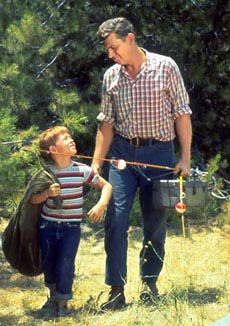
Welcome to Mayberry!

It is official: My husband was the most adorable 9-year-old boy ever.  This is an unbiased opinion based upon historical evidence in the form of his diary from 1987, which we rediscovered and read last night.

First of all, what kind of little boy writes every day in a diary for six months?  He basically stopped because he had filled up the whole thing.  (Leading me to hope, with cause, for more undiscovered volumes coming to light in the future.)

And what kind of little boy writes so well every day?  And about the most wide-eyed and sweet things you can imagine filling a young boy's mind?  And his parents didn't even know he kept a diary, so that means there were no admonishing words every night to remind him to record his day's doings.  He just did it on his own!  What a guy!  I think I fell a little more in love with him yesterday, just from knowing more about him as a child, and knowing that he could produce such a masterpiece of late-20th-century Americana.

And I fell in love with his childhood.  Sioux Falls, SD in the late 1980's may not have been Mayberry exactly, but it was full of wholesome diversions in which young Jason took part and then dutifully recorded.  The only things missing were fishin' trips to the old crick; but, I'm guessing that had more to do with Jason's lifelong aversion to fish than to any lack of opportunity.  It's all here: his frequent trips to the video arcade (complete with recorded high scores on "Paperboy" and "Elevator Action"; his excursions to play pool or ride go-carts with his grandpa (or, occasionally, "grampa"); his obsession with the Minnesota Twins (whom they played; which team won; their current ALC standing); riding bikes with friends or parents; going to the Y; charming angst about completing "Book-It" reading; programming an elaborate sports report into his dad's new computer (the one with the color monitor, no less!); interacting with various visiting family members; getting kicked out of the Pizza Inn with his sister and their friends ("don't worry, everybody already knows about that."); the getting and playing with of G.I Joe action figures; playing board games; snuggling with parents; typical hyperbolic statements about food (e.g. "Ate bacon and eggs at grampa's -- it was the best breakfast ever!"); doing homework for his ULE program ("fun!"); going to church; studying for his CCD class; and so on.  The minutia of his life as a fourth grader is just fascinating.  And it is fun to see now the glimpses of the nine-year-old in the person of the man I have loved for 18 years.

And it filled me with a sense of yearning, too.  I thought, more than once, in reading the journal: So, this is what a happy childhood is like.  Which makes me sound like an ungrateful wretch, I know.  But, I couldn't help but think about what my diaries from when I was nine would be like (and I kept them sporadically, but I am unsure if any remain).  When I turned nine, my parents divorced.  And, you see, they were both really decent people whom I adored.  I was an only child, and my parents were my life.  And, when they divorced, well, that was that for the wide-eyed innocence part of my childhood.  No event -- whether momentous or trivial -- of my young life would be experienced with unmitigated joy again.  Christmas?  Yeah, try waking up to one Christmas with your dad and then having to pack it all up and go to your mom's by midday (and then have your mom yell at your dad for bringing you over later than she wanted).  Horse show?  Yeah, that's fun -- with one parent who indulges you in your equine love and the other who resents it.  School play?  Uh-huh -- with which set of parents do you go to dinner and celebrate afterwards?  Any bit of good news makes you stop and consider -- whom do I tell first, Mom or Dad?  Because, when you choose the one, you automatically are not choosing the other.  Hideous burden for a child.  Truly.

Jason, with his intact family and close-knit extended family, had something really special in the 1980's.  He was a remarkable guy, of course; but, it was the safety and security of home that allowed him to be so free in coming into his own.  His is a chronicle of an untroubled mind (other than that dastardly "Book-It" which was the only cloud I can find in an otherwise sunny sky).  I love that little boy in that diary, and I am so grateful that the family and world that produced him was able to meet up with my own and bring me into it.  The good man whom I know, was a simply delightful boy.  In fact, the most adorable 9-year-old boy ever.

One last note from the diary:  On March 7, 1987, the temperature in Sioux Falls was 78°. On March 8, 1987, it was 34°.  Wow!

Thursday, February 16, 2012

Book Notes: January 22-28

At the Museum of Natural History's gift shop in St. Louis, I cracked open the cover of The Wilder Life by Wendy McClure and read, "I was born in 1867 in a log cabin in Wisconsin, and maybe you were, too." There was no way I was not buying this book.

I have started and re-started this write-up several times, because I'm not really sure as to how to go about it.  First of all, this book is very funny in places.  I variously chortled, giggled, and guffawed through the first 2/3.  But, you really have to have read and loved the "Little House" books to get the author's premise.  This book, though it mentions frequently the TV series, is not really about that beardless Pa on the prairie and his telegenic posse.  This is about pig bladder balloons, button lamps, and Ma's delaine.  If none of those things rings a bell for you, then a lot of the humor might be lost on you, poor soul.  I have never seen the TV show, Little House on the Prairie; not even one episode.*

But, oh, I have read the books.  And re-read the books.  And visited some of the Laura sites (though not as many as Ms. McClure).  When, on page four, she writes, " . . . and after Ma bakes the bread she makes a button lamp, because do you remember the button lamp, in the saucer, with the little square of calico that she twists up and greases into a wick?  Shall we go on?" my immediate reaction was, "Yes!  Yes!  And then Pa says his usual thing about 'leaving it to the Scotch,' which he says whenever Ma pulls something truly magnificent out from under her bonnet and saves the day.  And, yes, Wendy McClure, we shall go on."  And on we went.

I, too, was a middle-class suburban kid in the 1970's and 1980's for whom Laura's life held endless fascination and more than a little envy.  Much like Ms McClure's lists on pages 6 & 7, I too, longed  to make candy out of maple syrup in the snow, eat salt pork, milk a cow, tend a garden, churn butter and make little pats of it with designs on the top, hear my Pa play the fiddle to drown out the howling winter wind (I lived in Southern California) and then to lull me to sleep.  I wanted cousins who had exciting stories about family dogs barring paths to wells to protect them from panthers.  I wanted to be excited when Pa brought home a bear and a pig at the same time.  I wanted to feed the smoke log with green woodchips to help smoke enough meat to keep our family fed through the winter.  Heck, I longed for winter -- even a Long Winter -- to add some variety to the endless sunny heat of my lame-o childhood environment.  I think, though, what I wanted most, was that sense of family togetherness -- that idea that nothing was going to tear my family apart.  The Ingallses stayed together through multiple moves, tragic illness, the death of a child, gut-wrenching lost crops and subsequent poverty, unexpected visits by Indians and wolves, and nigh starvation.  My parents couldn't keep our family together with a cushy house in the 'burbs and two stable, benefit-rich, and well-paid jobs in education.  It seemed a better deal to put up with the crazy, unpredictable, often scary, always free world of life on the edge of civilization with your family than to be an only child shuttled back-and-forth between two households in an utterly predictable, blandly constrained, but affluent world.  I wanted to let my bonnet hang low and run home to our dugout with wildflowers for Ma into the big bear hug of my Pa.  I would even have put up with priggish Mary and banal, yet needy, Carrie to have had that life in that world.  And, the first chapters of The Wilder Life are full of similar longing from the author.

So, she sets out to see if the reality is anything close to her imaginings. She bakes Long Winter Bread, finds a butter churn and acts accordingly, tries some maple syrup snow candy.  She visits Lake Pepin, various Minnesota sites, the Kansas prairie.  She makes it down to Mansfield, MO -- which is one of my favorite places to visit.  Though not one of the books is set there, it is where Laura remembered her childhood and set out with her daughter, Rose's, help to record and refine those old stories into the masterpiece series that we know today.  Laura artifacts abound: Pa's fiddle, the bread plate from the first four years, clothes, books, photographs.  Truly a must-see for LIW fans.  Ms McClure also makes it up to DeSmet, SD, the setting of the last four books. 

In between, Ms McClure does some other things, and one of those things is to attend a homesteading demonstration weekend on a working farm in Illinois.  Here is where my sympathy with the author turned a bit sour.  It turned out that a church group booked space for this same weekend that she attended with her boyfriend.  This church happened to be one of those rather obsessed with apocalyptic times.  They were there to learn how to rebuild civilization after the cataclysmic events of the future came to be.  They were into preserving butter in a way that sounded disgusting.

Now, I am a Christian believer.  I do believe that there will be an end of days, as the Bible warns of.  I do believe that Jesus will return; that He will reign one thousand years; that a final showdown will occur between Good and Evil.  I just don't live my life around that, because I am secure in His promise that, no matter what, He is with me and will bring me to Him.  So, I don't get hung up on End Times.  I certainly will not worry about rebuilding civilization.  And, were I to survive well into the tribulation, I think my last concern would be preserved butter.  I'm sure I would have been a little uncomfortable with the church group.  Ms McClure is not a believer; so, I can fully understand her unease.  What I cannot forgive (as a reader who has agreed to go along on this journey with her) is her reaction to them.  And her positively un-Ingalls-like bolting in the face of modicum discomfort.

A story about the Ingalls family that is neither recorded in the Little House books, nor in Ms McClure's book, is that the family was not alone in the building in town during the Long Winter.  They had another family living with them -- a very unpleasant family, apparently, who made the endless freezing snow of Mother Nature a thousand fold worse by robbing the family of a convivial homelife.  The Ingalls family did not bolt. Maybe they could not bolt; but, they could have kicked the other family out.  They did not.  And, Ms McClure would have done well to remember the Brewsters in These Happy Golden Years.  Laura slept on the sofa in a two-room shanty with that gawd-awful, knife-wielding Mrs. Brewster for two months without bolting.  Ms McClure and her feckless boyfriend totally bolted.  First they engaged in silly, over-the-top drama -- like secret notebook messages surreptitiously passed about how terrible these church people were (doing things like *gasp* saying a long grace before dinner; talking about their faith in Jesus; actually using the phrase "end times" -- iiieeee! the horror!).  In fact, Wendy and Chris were so tolerant of others' beliefs that they ran away from the homesteading weekend as soon as possible; because, God forbid anyone ever be exposed to others with differing ideas for more than an hour or two.  I sort of lost respect for her from that moment onward.  I mean, if you're going to the trouble of writing a book about experiencing a Wilder life, be prepared to take one for the team, eh?

I just want to add here that I do not see the Little House books as Christian religious texts.  Some reviewers over at Amazon said that the foul language sometimes used by the author was a degradation to the good, Christian values as extolled in the LIW books.  No doubt, a true and real faith in God permeates the series; however, they are not Christian primers.  They are primers on Americanism.  Neither Laura in her older years nor Rose ever, I think, was a particularly intense Christian.  But, they believed in America and the sort of can-do deity that is particular to America.  Ma and Pa were, I think, rather religious Christians; but, speaking as a child raised in a non-believing household, their religiosity was never so overt as to interrupt my perusal of the series.  That is, the books were written for young Americans to understand and reclaim what it means to be American; not by Christians trying to declaim and instill a Christian worldview.  Which is probably why Ms McClure liked the books in the first place. 

At the very end, she visits the Farmer Boy House up in upstate New York.  Truly an odyssey of sorts, as this rebuilt homage is far off the beaten prairie path.  I am most envious of her travels to the Farmer Boy House, as that is the setting of my favorite book in the series.  Pancakes!  Popcorn and milk!  Fried apples and onions!  A potato baked in a field at dawn!  For a gal who likes her food, Farmer Boy is a dreamland of delight.  And that, of course, is the point made by Barbara Walker who wrote the Little House Cookbook and reiterated by Wendy McClure: Farmer Boy is Laura's dreamworld of abundance and stability as imagined in the childhood of her husband, Almanzo.  She places all of her dormant longings for that sort of "land o' milk and honey" onto her reconstruction of his early life. While she certainly seemed to have loved her ever-westward expanding childhood, there was a little part of her that thought that maybe it might not have been so bad to live on a prosperous farm and eat doughnuts whenever she pleased. 

Would I recommend this book?  Yes, I think I would recommend it to anyone who was or is thoroughly enthralled by the book series.  Though I was a bit out of sympathy with the author by the end -- she and I have come to different conclusions about LIW World -- it is still a pretty fun read.  I mean, anyone who has coffee-mill bread and button lamps inextricably linked in their minds is a person whose voice deserves a hearing.  And much of the book will charm you, even if you would have totally stuck it out at the homesteading weekend retreat.

(*Digression:  When I was a kid and my mom wanted me out of her hair, she would beg me to watch LHOTP on TV.  "No!  No!" I would protest with horror, "I could never watch that!  Pa doesn't even have a beard!"  Years later, in the early days of our marriage when we worked very different shifts and Jason had a lot of unsupervised TV time, he started watching the TV show.  Then, when I would come home, he would quiz me about various foreign ideas presented in the series.  One about Almanzo was very offensive, but now I cannot remember what it was . . . in other words, that just strengthened my resolve never to view that abomination.  I've kept it for 37 years.)

Monday, February 13, 2012

How Sarah Palin Earned My Vote in the WA Primary

Basically by being awesome and by our having a bunch of losers on the primary ticket.  I have decided to write her in.  I know it's a futile gesture.  I don't care.  I know she does not want the nomination.  Too bad for her.  James A. Garfield didn't want it, either.  Not that what ultimately happened to poor James A. ought ever ultimately happen to Gov. Palin -- forbid it, Almighty God! -- but, if the nominating process took a turn toward what happened at the 1880 Republican Convention . . . well, that would be über-sweet!  Admit it.  Dontcha think to yourself in your deepest, most secret thoughts, after this handful of primaries:  This is the GOP field?  Seriously?

No one speaks about issues and ideas that are important to me as well as Gov. Palin.  Well, maybe Marco Rubio . . . but I cannot tell whether it's his words or his drop-dead gorgeousness that moves me more. (Just kidding!  Maybe.)  Anyway, did you see and hear Sarah's speech at CPAC?  Phenomenal.  You just come away from hearing her speak with that knowledge, deep down in your gut, that she gets America, that she loves America, and -- chances are -- she probably would like you, if she got to know you.  These are three things I have never thought to be true of Pres. Obama.  He does not get America; I truly doubt whether he loves America qua America; and I'm pretty sure that he would not like me or my family or anything we believe in or work for (other than the income tax bill we dutifully pay every year -- that, I am sure, he likes very much). 


When I think about how this good, insanely-intelligent, patriotic woman has been maligned by media elites and party elites, it drives me nuts.  How hard on her family, had she chosen to run for President!  How hard on the country that she has chosen not to!  I was so excited for this race.  I was geared up to support whole-heartedly any good candidate -- though I always had my fingers crossed that that candidate would be Sarah P.  Now, February's not even finished, but I am.  Finished with this lot of lame-o's, I mean. 1 wooden technocrat + 1 repugnant D.C. legislator +1 dorky D.C. legislator = my writing in "Sarah Palin" when WA's primary comes to be*.  Of course, in November, I'll vote for whomever the Republican nominee is.  I mean, even though it will be one of these uninspiring gents, I will still agree with him more than I ever will with any Democrat, especially with Pres. Obama.  But, how disheartening to know already that I'll have to settle again.  Pbbbblt!

*Pace, Ms. Coulter, Ms. Spumoni, and half the good folks at Ricochet.  I love and/or respect you all; but, I'm still writing in Sarah Palin.

Update: Criminey!  The primary has been cancelled in WA by the state legislature.  There will still be caucuses; but, we will be on vacation, so I cannot even go and be grouchy at a caucus (because I SO would).  Well, this pretty much makes this whole post moot.  But, I will leave it posted, because I am still quite annoyed, and it was a good venting exercise.  God help us.

Wednesday, February 08, 2012

Surprise! It's Raining!

OK, so this is so a summer rainstorm
and not a winter PNW rainstorm. 
But, what a gorgeous photo, eh?
 After almost a week of sunny, sunny sun, the sound of raindrops on my window pane is startling.  But nice.  It is, after all, only February, and I likes me rain.  But, for all you people out there (and you know who you are) who think you could never survive the wet and gloomy winters of the PNW, it just shows to go ya:  you never can tell.  Would a little 60-degrees-and-sunny week at the beginning of February be enough to get you through the onslaught of gravitationally directed dihydrogen-monoxide molecules that fills most days between October and May?  Because, we get these little surprise weeks quite often, you know.  Little treats from heaven where we can stretch out in the sun and pick up some Vitamin A before scurrying back inside for the next three months of inclementation.  At least we get a lot of reading done, up here in the PNW.  And we all have grease-streaked towels set aside in the garage to wipe down our bikes after rainy rides.  Can't stop us noways, nohow.

Book Notes: February 5-11

I am ecstatic to report that I have at last finished George Eliot's lugubrious tome, Middlemarch.  Or have I?  It could well be that in some alternate reality or dimension I am still slogging through this Victorian monstrosity at glacial speeds.  But, in this current cosmic slice, I do believe I have finished.  And that is a good thing.

OK, so the tone of that first paragraph might lead you to believe that I hated this book.  But, no, I really did not.  I do not know if I exactly liked it; but, certainly not hate.  Hate is reserved for really gawd-awful books like A Prayer for Owen Meany.  And Middlemarch is not bad.  It may even have been a masterpiece if the author had had the self-discipline to lop off about 200 pages.

The Mill on the Floss is an Eliot novel that I love.  Silas Marner is an Eliot novel that I did not love.  I guess I always thought that Middlemarch would be the tie-breaker that would firmly place me in or out of the Eliot camp.  But, novels, like the life that they tend to imitate, are rarely so clear-cut.  All-in-all, I am glad to have read it.  And, I cannot imagine ever wanting to revisit it again.

It seemed to take Eliot quite a ways into the narrative before she found comfort and assurance in her authorial voice.  She seems to have been overwriting through much of the early setting and staging of the novel.  I'm not sure for what she was compensating, but as a writer who tends toward overwriting herself, I could sympathize, though not condone.  It did not help that many of the plot points were absolutely uninteresting to me -- such as Mr. Brooke's foray into politics and the Reform Bill.  I never quite connected with Dorothea Brooke, who always seemed to walk the line of too-good and annoying without ever coming into clearer definition as a human being.  The marriage of Lydgate and Rosamond was painful to witness; and the only cheering aspect of the story was when Eliot mercifully brought us back into the company of the Garths -- especially the delightful redemption of Fred Vincy and his romance with Mary Garth.  Those were the only true and beautiful parts in a novel that just seemed to try too hard.  Most of it is quite the bummer, with a slightly redeeming finale to cap it off.

I do have to comment with great admiration on the meticulous structure of the plot, though.  It could have been cleaner in its foundation, but all the joists and hinges fit seamlessly and swung easily through to the nigh-breathtaking conclusion.  So, kudos to George on that.

Read Middlemarch if you have about ten to twelve hours to spare.  It's 800+ pages of Victorian verbosity that will leave you slightly edified and greatly fatigued.

Thursday, January 19, 2012

Book Notes: January 15-21

In the very early days of our marriage, I declared to Jason that we should have a little bunny for our apartment.  He reluctantly agreed, and we brought home a speckle-headed Holland Lop that we named Specklehead.  Then, a few days later, I said that it is not good for rabbit to be alone, and could we not just buy him a little friend?  So, back to the pet store we went and brought home with us a big, black Holland Lop that we named Al.  Al had distinctly amorous intentions toward little Specklehead, but, as we were hip, swinging city dwellers in Southern California, we just attibuted his lustful advances to the fey zeitgeist of the time and laughed it off.  It will not surprise Bob Tarte -- or anyone else who reads this -- that, a few months later, Specklehead had a litter of kits.  And, it will surely not surprise anyone that, within six months, we had seventeen rabbits living on our apartment porch.  Jason was bitter.

How bitter, I did not realize until I got Sadie a little, brown Holland Lop for Christmas in 2009.  "Oh, don't get a rabbit," Jason moaned when he saw me looking at breeders on-line.  For some reason, I thought he was comically grousing and did not take it seriously.  But, when Kona the Bun chewed all the buttons off of his TV remote control by January 2010, I learned how seriously he had meant his original protest.  And that led to a serious row.

Last summer, I approached this fiery volcano of anti-bunny sentiment with a bold plan.  If, I said, we could get Kona a little friend -- and neuter him (Kona was already spayed) -- I would happily move the rabbits outside, and they would never again cross his threshold or nibble on his entertainment enablers.  To my surprise and gratification, he agreed.  Mr. B was located, purchased, and shorn of his manhood; placed in a roomy hutch-with-a-run combo in the backyard within the confines of an arranged, but celibate, marriage, he and Kona got along swimmingly from the first and have lived in happy, mutual-face-licking harmony ever since.

This is a long way of introducing a book filled to the brim with charm, humor, and poignancy. Bob Tarte's foray in the perils of pet ownership really began with the acquisition at his wife's behest of a rascally rabbit named Binky.  Fast forward through the addition of parakeets, parrots, and dove and even more rabbits, and Mr. Tarte arrives at his book's eponymous position: Enslaved by Ducks.

Truly, if you like animals or have ever had a pet outside the cat-and-dog realm, I cannot think how you would not be enamored of this book.  If you have a reluctant -- nay, embittered and oppressed -- spouse whom you have lured into your animal-keeping web, then you must read this book.  It is told almost exclusively from Mr. Tarte's point of view, as he drags his feet and mutters under his breath down the road to lagomorph lodging and fowl husbandry.

But, my favorite person in the book is Bob's wife, Linda. She is the one who oh-so-gently pushes and advocates for the expansion of their animal overlords.  She is the one who constantly uses the phrase that I thought was mine exclusively: a little friend.  Every animal needs a little friend; and, spineless but resentful Bob eventually bows to her will. 

Linda never really comes out of her shadowy supporting role in Enslaved by Ducks.  When I first started reading the book, I thought that her desire for animals was a substitution for a longing for children.  Dammit, Bob, I thought; get on the ball and give this poor lady some babies before she overruns your house with rabbit pellets.  Then, in further reading, it dawned upon me that this couple was a lot older than I had originally thought.  Linda seems to have already had children by a previous marriage.  So, I let Bob off the hook there.  What the reader does find out of Linda just makes her seem like the sweetest lady ever -- with a generous, loving nature that seems simply to need a much larger outlet than even her doting, grousing husband.  I think that, despite the abundant birds and buns, Mr. Tarte lucked out.

Anyway, lots of laugh-out-loud moments and some poignant parts make for an altogether satisfying and undemanding read. Quack!

Monday, January 16, 2012

Book Notes: January 8-14 (B)

Infuriating book!  I was met to the left and to the right on every page, it seemed, by ideas and actions with which I strenuously disagreed!

Scott Miller's The President and the Assassin: McKinley, Terror, and Empire at the Dawn of the American Century is a skillfully-woven tale that, indeed, incorporates the threads of socialist/anarchist terrorism, the burgeoning American imperialism, and the presidency and assassination of William McKinley at the turn to the 20th century -- or, as Miller terms it, "the dawn of the American century."

All in all, I am more glad to have read the book than I was ever glad during the reading of the book.  The whole Spanish-American War was depressing, and the anarchists at home and abroad who fulminated so obnoxiously against decency, morality, and civilization were disgusting. But, the history is sound, and I now know more than I ever thought I would about the birth of American empire and the utter contemptibility of Emma Goldman, Albert Parsons, et al.

I could go on and on about how much I hated the anarchists, but maybe some other time in some other post.  I just saw the anarchist symbol spray painted on the stone address marker of a house on our street last week, and that, combined with my already hostile view of all graffiti and people who constantly bitch, made me not in the least charitably inclined toward those vile turn-of-the-century malcontents while reading The President and the Assassin.

A completely satisfying book, overall; having read it, I came away thinking that I've gotten as good a grip on the events and personalities that led to the assassination of a decent man and an earnest president as ever I'll find in a single volume.  Now, I have read books on every presidential assassination except for John F. Kennedy's.  And, somehow, his -- the most controversial and conspiracy-theory laden of all -- is the one least interesting to me.

Thursday, January 12, 2012

A Little Moral Lesson in Latin

I printed this story from the National Latin Exam's site.  It was part of last year's exam for beginning students of Latin, of which I am one.  Last night, I had a jolly time translating it and answering the questions.  It's a cute story, so I thought I'd post it here, with my translation.

A Slave, a Cook, and Their Master
Rūfus erat servus bonus et in agrīs semper labōrābat. Nunc servus post magnam vīllam cum equīs habitat. Dominus et līberī in magnā vīllā habitant. Dominus est poēta optimus et multam pecūniam habet. Rūfus equōs dominī cūrat. Sed dominus est vir sevērus et Rūfum nōn laudat. Dominus in culīnam intrat et clāmat, “Parā mihi cēnam!” Coquus est in culīnā et cibum parat. Coquus magnam cēnam laetē parat. Cēna est optima. Rūfus ad iānuam culīnae ambulat et cibum videt.

Servus Rūfus cibum nōn habet. Rūfus culīnam intrāre timet. Coquus rogat, “Exspectāsne, Rūfe, cibum?”  “Ubi est cēna mea?” dominus in trīclīniō clāmat.
Coquus dominō cēnam dat.
Dominus clāmat, “Da mihi vīnum!”
“Quis est in culīnā?” dominus coquum rogat. 
“Rūfus ad iānuam cibum exspectat,” coquus respondet.
“Vocā Rūfum!” dominus clāmat. “Nōs servīs cibum iam dedimus!”

Dum dominus cēnam cōnsūmit, coquus Rūfum vocat. Dominus multum cibum habet sed Rūfus nūllum cibum habet.
Dominus clāmat, “Cūr octō equōs meōs in agrīs nōn cūrās? Cūr cibum exspectās? Nōs servīs cibum iam dedimus.”
Rūfus respondet, “Quod ego equam gravidam heri cūrābam,cēnam nōn habēbam. Hodiē ego equōs īnfirmōs cūrābam et iterum nōn ēdī.”
“Sed quis octō equōs meōs nunc cūrat?” dominus rogat.
“Hodiē sunt decem equī, domine,” Rūfus respondet. “Heri equa geminōs peperit. Geminī erant īnfirmī et ego eōs cūrābam. Hodiē decem equōs pulchrōs habēs!”
“Tū es bonus servus!” dominus clāmat. “Tū numerum equōrum meōrum auxistī. Ego tibi cibum laetē dō, quod tū bene labōrās.”

My Translation:
Rufus was a good servant and was always working in the fields.  Now, he lives behind the large estate house with the horses.  The lord and his books live inside the large house.  The lord is a great poet/playwright and has a lot of money.  Rufus cares for the lord's horses, but the lord is a severe man and does not praise Rufus.

The lord enters the kitchen and yells, "Prepare me dinner!"  The cook is in the kitchen and prepares the food.  The cook happily prepares a large meal -- the meal is the best!  Rufus walks to the kitchen doorway and looks at the food.

The servant, Rufus, does not have food; he is afraid to enter the kitchen.  The cook asks, "Are you waiting for food, Rufus?"

"Where is my dinner?" the lord yells from the dining room.  The cook gives the lord his dinner.

The lord yells, "Give me wine!" "Who is in the kitchen?" the lord asks the cook.

"Rufus is waiting for food in the doorway," the cook replies.

"Call Rufus in here!," the lord yells.  "We have already given our servants food."

While the lord is eating his meal, the cook calls Rufus.  The lord has a lot of food, but Rufus has no food.

The lord yells, "Why did you leave my eight horses in the fields without care? Why do you wait for food?  We have already given our servants food."

Rufus replies, "When I was caring yesterday for a pregnant mare, I did not have dinner. Today, I had to care for weak horses, and again I did not eat."

"But who is caring for my eight horses now?" the lord asks.

"Today, you have ten horses, master," Rufus replies.  "Yesterday your mare gave birth to twins.  The twins were so weak that I had to care for them.  Today, you have ten beautiful horses!"

"You are a good servant!" the lord exclaims. "You have increased the number of my horses.  I will happily give my food to you, because you have done good work."

Question 40 on this exam was as follows:

40. The lesson illustrated by this story is A) good work brings rewards B) secrets are hard to keep C) beware of strangers bearing gifts D) a simple life is best

I think we can all agree that it is "A."  Now, wasn't that a cute story?  Didn't you like how the lord was always yelling?

Tuesday, January 10, 2012

Book Notes: January 8-14(A)

Alan Jacobs is one of my favorite American writers.  His biography of C.S. Lewis, The Narnian, is a thorough delight, and his exploration of the curse of Adam, Original Sin: A Cultural History, is as engaging as it is informative. When I saw this latest book, The Pleasures of Reading in an Age of Distraction, I ordered it immediately, without really reading to see what it was about.  Alan Jacobs writing about reading?  My cup runneth over! 

Let's see:  I found this slender volume a quick and enjoyable enough read; but, I do not think that it was written for me.  It really is about reading in this age of manifold distractions; but, I do not have that problem.  In fact, I am sure my husband would say that he wishes I were more able to be distracted from reading.  In the chapter, "Quiet, Please," Mr. Jacobs writes about the trials of the intellectually ambitious lower classes in England who wished to better themselves through books, and how difficult it was even to find a quiet space to absorb the written word.  Mr. Jacobs quotes as follows: So many [scholarship boys from poor families] learned the early habit of working with the wireless on and the family talking, of building a cone of silence around themselves. I could completely relate to that.  My cones of silence are wide and tall and virtually soundproof when I'm lost in a good book.  So, a distracted reader I am not.

Mr. Jacobs is also adamant that our reading choices not be directed by prescript Lists and Authorities that tell us what we must read to be cultured, intelligent, and whole.  He stresses the direction of Whim -- our internal resonance with the materials that fill our soul -- over that of Authority.  Very well and good.  I read almost exclusively by Whim; however, I keep revisiting books and genres that I think I ought to like or at least be familiar with, even though they drive me nuts (I'm thinking here mostly of that ponderous and portentous collection of pressed wood pulp that is Russian Literature*).  Ought I to give these trials and forays up once and for all, Mr. Jacobs?  Not so fast.  He later writes about the need to continually revisit books you could not at first get a handle of until you have that lightbulb-over-the-head moment and get them.  I shudder that he used as an example of such readerly tenacity his struggle over the years to appreciate the great G.K. Chesterton.  How could anyone have to force themselves to read Gilbert Keith?  Especially someone who loves C.S. Lewis as much as Mr. Jacobs obviously does?  I cannot dwell upon that without getting a wee bit depressed, so I'll trot along to the happy conclusion that, all of a sudden, while re-reading The Man Who Was Thursday, Mr. Jacobs got it.  Well, at least sort of.  So, I guess I cannot justify throwing Fyodor, Leo, and Boris into the recycling bin quite yet.  Though I want to.  Only like all the time.

Speaking of recycling bin, I was a little sad that Mr. Jacobs's effusions on the pleasures of reading did not include the pleasures of reading book books.  He seems a devotee of Kindle, and he also seems to spend a lot of reading time looking at other various screens.  One of the great pleasures of reading is the physical book, I think.  Not that I haven't waxed rhapsodic on this enough, but I just want to state once more for the record that nothing, nothing could ever replace for me the pleasure of holding a physical book.  The position of my hands when I read is one of comfort and joy, and not one that I can duplicate with one hand behind a screen and the other on the page-forward button.

There are some funny parts where Mr. Jacobs quotes Harold Bloom (disapprovingly, yet lovingly) as that eminent critic gleefully bashes the Harry Potter phenomenon.  And there is some very good stuff about engaging with books through marginalia.  The chapter, "Judge, Jury, and Executioner," was convicting to me, because I have nothing but absolute confidence in my own ability to judge and make pronouncements about what books are worthy, and Mr. Jacobs seems to imply that I ought not be so full of myself.  He also wants me to slow down when I read; but, I do not see that happening.  I savor what needs savoring (and mark what needs revisiting), but whole works are seldom so full of the tasty bits.

So, The Pleasures of Reading in an Age of Distraction, was not a book written for me.  And it is not the book I was expecting it to be, but that is not the author's fault.  What I was really hoping for was the kind of book that leads me to want to read what the author loves.  I wanted to know what this very good and thoughtful writer, Alan Jacobs, reads that transports him beyond the wily fingers of distraction.  But, I did not get a sense of that at all.  In fact, he seemed almost hesitant to write about the books that fulfill his Whim, lest he shuffle unwittingly in the realm of Authority.  Maybe it is because I am older than the college students who often seek his guidance, but I do not think he could unduly influence me.  I just want to read about what he likes to read, and then, maybe, find someone whose work I had not heard of or yet considered.  That's all.

*This does not include Chekhov, to whom I am devoted. 

Monday, January 09, 2012

Another Reason Homeschooling Rules!

Sadie was up before I was this morning to read the next book in the Sisters Grimm series.  I wandered into her bedroom to check on her about half and hour ago and got the "Sshh!" with the raised index finger before I could say much of anything.  I backed out silently.  Just passed by her door a minute ago, and she is hunched, crossed-legged on her bed, still reading away.  And, this can be the Monday morning routine because we homeschool.  Why not let her revel in the realms of imagination fully, blissfully before coming back down to common earth to do math and cursive and Latin?*  Don't you remember -- you bibliophiles out there who had to "go to school" -- those days when you were cruelly ripped from your journeys of fancy and plopped unceremoniously in front of a bowl of Cheerios, then marched off to the dull greyness of institutionalized education?  I surely do.  Nothing is as magic as time truly lost in a book -- that time we carve out for ourselves to read simply because we want to.  Now, to a certain extent, Sadie can continue the magic as long as she needs to, without any artificial timetable imposed.  We're living the dream, baby!

*Not that there is anything "common earth" about Latin, which is the most awesome subject ever!

Book Notes: January 1-7

 American Massacre: The Tragedy at Mountain Meadows, September 1857 by Sally Denton was a compelling read about an horrific chapter in early LDS history.  A wagon train of about 140 emigrants from Arkansas was passing through Utah territory en route to California when, in a shocking and senseless attack, a group of Mormon militia (some disguised as Indians) slaughtered nearly all of them -- sparing only around 17 children under the age of eight.  Almost as impossible to fathom as this massacre was the incredible early history of the LDS church as written by Ms. Denton.  If you have a generally favorable view of Mormons, as I do, you will realize when reading this book, how different that religion is as practiced today from its founding.  Brigham Young comes off as a real piece of work -- manipulative, paranoid, slick, and shady.  Every religion (every culture or political cult, as well) has incidents in its past both painful and embarrassing.  That the LDS church has emerged from the murky cultishness of its 19th century roots and is now a mainstream part of American life is a testament to a people of general good-will and strong virtue.  I disagree with much of their religion (obviously, as I am an orthodox Christian), but I cannot disagree with the utter pleasure I have had in the company of most of the adherents to that religion.  I just felt like I had to add that, in case anyone passing along in the cyber-realms would think that my looking askance at the founding of the LDS church was an indictment of the church as it stands and functions today.

Destiny of the Republic: A Tale of Madness, Medicine, and the Murder of a President by Candice Millard was my first finished read of 2012 -- and what a great way to start off the new year!  Do you know anything at all about the too short presidency of James A. Garfield?  I did not.  Nor did I know anything about the man himself.  This book is not a complete biography by any means.  It follows a brief, pre-presidential sketch with the excruciatingly drawn-out tale of his demise.  But, there is enough here of the man Garfield to make a sensitive reader weep buckets at those "saddest words of tongue or pen": what might have been.  My dad suspected elements of hagiography, but I think not.  It is possible that such a man as Mr. Garfield could become president of a grateful nation almost entirely through no effort or desire of his own, simply on the strength of his own virtues as recognized by an eager country, right?  At least, I want and need to believe that it is possible.  And what a man!  The villainy of the piece is distritbuted between the would-be assassin -- insane and unscrupulous self-aggrandizing nomad, Charles Guiteau, and the team of doctors -- led by the overly-confident, backward-looking, self-aggrandizing celebrity surgeon D. Willard Bliss -- who actually had the greater hand in his death.  Interwoven in the tale is Alexander Graham Bell's quest to invent a non-invasive method for detecting the location of a bullet inside a body.  This book is a pleasure to read.  I wept buckets.  I'll be keeping my fingers crossed that the GOP convention of 2012 has the same unexpected and highly delightful results as that of 1880 -- that is, pulling out of the shadows a man or woman of true integrity and vision to lead the ticket, for the destiny of our republic.

Monday, January 02, 2012

Imaginary Jesus

"Can I ask you a question?"

I sighed and closed my Bible. "Yeah."

"Why does your Jesus still wear a robe?"

"What do you mean?"  I looked at Jesus, who had reentered the cafe.  He flashed me a quick grin, which I took to mean he had taken care of the parking ticket, and sat down at a table across the cafe, by the window.  Meaning I was stuck here with Pete the Christian.

"What I mean is, here's God, the creator of the universe.  He becomes a human being and lives on Earth for thirty-three years.  He completely assimilates to human  culture.  Wears our clothes.  Wears a body like ours.  Eats our food.  But, here he is, two thousand years later, and he's still wearing robes and a sash.  Seems like he might put on a pair of jeans every once in a while.  They're great inventions, jeans."

I watched Jesus thoughtfully.  "That is weird.  I guess I never thought about it."

Pete leaned in close, and I could smell the overpowering aroma on his breath when he said, "Let's go ask him about it."

Matt Mikalatos, author and protagonist of the "not-quite-true story," Imaginary Jesus, then walks across the Red and Black Cafe in downtown Portland, with the rough and tumble Pete, to confront his Jesus -- a sash-and-robe wearing, perpetually bemused sort of deity with impeccable personal hygiene.  It's only when Pete punches this Jesus in the face, and Jesus skedaddles out of that cafe at godspeed, that Matt begins to wonder if he really is the real Jesus.  Pete ought to know; he is the Apostle Peter, and he's met the real Jesus.  So, the two give merry chase to the impostor at the very beginning of this gem of a book that confronts in an hilarious and heartfelt way the believer's lifelong quest to get past the constructs and wish-fulfillments that are our imaginary Jesuses and to the reality of the Christ.

Mr. Mikalatos has covered nearly all the imaginary Jesus bases here.  You'll find, among many others,  Political Jesus, Testosterone Jesus, Magic 8 Ball Jesus, Works-Only Jesus (no mouth), Faith-Only Jesus (no arms), Free Will Jesus, Meticulous Jesus, Hip & Groovy Portland Jesus, and you even catch a glimpse of shadowy Mormon Jesus in the conversations between Matt and LDS Elders Laurel and Hardy (he thanks them in his acknowledgements, so I'm not sure whether they are realio-trulio or an extended joke -- but, either way, how delicious!).  Of course, he missed my favorite imaginary Jesus, Justine-Centric Jesus, which is the one I conjure all the time who is almost exclusively interested in me -- my comforts, my troubles, my petty concerns, and, lastly, a wee little bit my salvation.  But, all these artificial filters through which we pour our own prejudices, pleasures, and world-views to get a handle on a integrated picture of a tame Jesus are as amusing as they are convicting.

The work of two men kept running through my mind as I read Imaginary Jesus (it took me less than three hours in one evening -- quite the speedy read!).  The first was my beloved and revered G.K. Chesterton, who is the father of Christian paradox and has given me the gift of reconciling the often disparate notions of the Trinity.  This is the ability to say, "Yes, that is True, and that is True as well," when grappling with the Infinite and Holy mystery.  And, the second man was the singer/songwriter Bob Bennett, who has written one of the best songs about this Glorious Paradox of Christ called "Both Things."

Oh we are living in our contradiction/But our questions are always "either/or"
To this convenient fragment of fiction/God answers with "both, and" and "more"

Whether Lamb of God at Eastertide/Or the Savior that Christmas brings
Jesus the same yesterday, today, and forever/ Is Both Things
~from Christmastide, 2009

Christ is our Both, And, and More.  And the imaginary Jesuses we construct -- and I think we all do, because we must -- because we are, on this side of the veil, human and frail and finite and fickle -- cannot diminish Him, but can be impediments to getting nearer to the One we need.  But can an imaginary Jesus serve a purpose, or is he just an illusion of the devil?  I think, and I write this tentatively, because I am unsure; but, I think that there is a purpose to imaginary Jesuses, simply because they can be little scratches that open the path to the heart of Christ.  They become dangerous only when they become the end of our search, not the beginning.  Because, if your Jesus is a holy, white flame whose name you can barely whisper because you are face-forward on your knees before Him, then that is a true part of Jesus, but not the real Jesus.  And, if your Jesus is a warm embrace whose name you cannot refrain from repeating in delirious joy, then that is a true part of Jesus, but not the real Jesus.   The challenge and charge of our lives, I think, is to recognize when we have distorted Him into someone He is not, or into someone that only captures part of the Truth.  And then, to fall anew upon His grace that is our only hope of communion with Him -- world without end.  Amen.