Short takes I would tweet, if I still indulged . . .
#2: Today I bought meat from a guy who came and randomly knocked on my door. Was this a wise thing to do?
#3: Things Sadie loves: centaurs, going to the dentist, @clumsylovers music. Could be worse!
Monday, April 19, 2010


Thursday, April 15, 2010
If I Still Twittered (#1)
If I still Twittered, I might just now have posted something like this:
Ya gotta love Barnabas -- probably the only place on earth you can still call and get a busy signal! LOL!
Ya gotta love Barnabas -- probably the only place on earth you can still call and get a busy signal! LOL!
Wednesday, April 14, 2010
Negative Capability
Carolyn Arends thinks her fans are pretty smart. An implied compliment to herself? She posted a provocative quote on her blog last December and urged discussion. Well, it took me until April to formulate my thoughts coherently enough to reply. Here is her original post:
 December 18, 2009 - 12:52pm
Thought for The Day: Yancey on "Negative Capability"
I'm reading a brilliant Philip Yancey article from FIRST THINGS Magazine entitled "What Art Can and Can't Do". (Thanks to Spencer Capier for sending me the link.)
These lines in particular struck me:
Keats said that literature sometimes demands of us Negative Capability: the ability to accept multiplicity, mystery and doubt without reaching out for the illusory comforts of certainty and fact. Faith, too, demands a kind of Negative Capability, and that does not always sit well with many of the folk who distribute Christian art and many of the folk who consume it.
What do you think of the idea of "Negative Capability"? Do you believe faith demands it? Do you seek it out or avoid it in books, music and visual arts?
Let's Discuss!
CA
My response:
Ambitious of you to post such provocation right before Christmas! I've been thinking upon this idea of Negative Capability ever since.
First thought:
I once heard Dinesh D'Souza debating Christopher Hitchens on a talk radio show. A caller, who self-identified as atheist, offered up a general observation that Christians of his acquaintance were far more open to discussing theological and philosophical issues with him and had more of an open attitude toward hearing his point of view than his atheistic friends seemed to have for Christians. Dinesh gave a very interesting commentary to that, which I immediately recalled upon reading your post. He said that religious believers in general, and Christians especially, possess that sort of openness to entertaining the doubts and disbelief of others, because to be a believer is to live constantly with the shadow of doubt. Ah, I thought, very Chestertonian of him! He went on to say that an atheist can live a life untouched by the burden of faith, but no Christian has ever lived without the burden of doubt -- of varying degrees. Therefore, while an atheist may think that someone is a moonbat for finding faith, the believer will never think someone out of his senses for not finding it. To that extent, a foundation for even getting to the point of faith must be Keats's Negative Capability.
Second thought:
When it comes to the realm of faith, is Keats's Negative Capability really a Positive Capability? That is, with faith, "the ability to accept multiplicity, mystery and doubt" leads to "comforts of certainty and fact" that are hardly illusory. In the Christian tradition, believers say life is a big, crazy mess, we cannot understand why some things happen, we are caught up in mysteries we cannot begin to fathom, and yet, we have a peace that passes all understanding and treasure stored up where moth and rust will not destroy it, nor thieves steal it away. I think that in Philip Yancey's summation is a wee bit of intellectual snobbery -- that "folk" who enjoy reveling in the certainties of Christ are somehow missing the deeper journey. Tell the mother at our church watching her 5-year-old daughter battle a brain tumor the mother knows will take a miracle for her to survive that she is not in touch with "multiplicity, mystery and doubt" of the Christian journey just because she chooses to lean upon something greater still -- the promises of a God who did not spare His own Son. Tell her her comfort is illusory; tell her the facts are imagined. I think that the opposite of Yancey's statement is more often true -- Christian artists get the most approving reviews from critics when they examine the darkness; but, the light is just as real and maybe harder to exploit for art's sake. Like P.J. O'Rourke wrote so long ago: "Being gloomy is easier than being cheerful. Anybody can say 'I've got cancer' and get a rise out of a crowd. But how many of us can do five minutes of good stand-up comedy?"
Third thought:
Do I seek out art that rests upon my "ability to accept multiplicity, mystery and doubt without reaching out for the illusory comforts of certainty and fact"? An interesting question. Overall, yes, of course! But, one thing that I do not like in art is gratuitous obscurity -- creators who throw in red herrings or strange symbolism that do not add to the piece of work as a whole. That is just intellectual masturbation, and it produces the same effect as the physical kind. In visual art, I think about my favorite artist, Manet -- his paintings of women in particular have narratives that are open to interpretation; however, there is nothing superfluous in their execution. Jane Austen, in a different way, also leaves much of the internal workings of her characters undisclosed; yet, in her economy of words there is no essential point left out. I've noticed that the less an artist can convey his meaning in the work of art itself, the more he talks and talks and talks about the meaning. That is why modern painters talk endlessly about their canvases -- they cannot stand on their own. If I walk away from a piece of art -- whether book, movie, painting, song -- shaking my head and wondering what the point was, then that to me is bad art. True art -- that is good art -- should have some sort of apparent meaning. It need not answer every question it asks, but it should at least inspire some consistent questions.
OK, there's more, but I've written enough. This was such a great and probing post, Carolyn! Thank you! I'm sure I'll keep thinking about this the rest of my life and tweaking my conclusions.
And now, what do you think?
Wednesday, April 07, 2010
Why I Believe in Unicorns (A Christian Manifesto)
 The greatest thing about my name is that the people you meet and the friends you make seldom know more than one "Justine," so you immediately achieve that Cher-like status of being referred to solely by your first name. The second great thing about "Justine" is that it means "just one; seeker of the just." My father will tell you that they named me well. I hate true injustice more than just about anything. The third great thing about being named "Justine" is that I get to share this appellation with the great saint pictured at your left. Yeah, that's right, the chick with the unicorn. I love her for her purity and chastity -- two undervalued traits in modern society -- and, yes, I love her for the unicorn with whom she is often portrayed. Because I believe in unicorns. Does that surprise you?
There are more things in heaven and earth, Horatio, than are dreamt of in your philosophy. Shakespeare wrote it; MacDonald believed it; Chesterton explained and justified it; Lewis and Tolkein invited us into its world. It is the sense of mystery and delight -- the sheer unboundedness of an infinitely creative God -- that cries out that yes, yes, of course there is more that is than is seen. More than we can even begin to believe could be. From this wellspring of a complete and utter trust in my unfathomable Creator, I have found the courage to believe in magic.
If you think about it, there is no better way to explain the Creation story than magic. Good and orthodox souls may be reaching for the smelling salts right now, but I think that is more from our modern distance from and misunderstanding of deep, ancient magic. When we hear magic, we think of one of two things usually: either the dark forces of magic -- the demonic -- or the fake illusions of showmen -- the dishonest. But, I ask you to look at the Creation story with fresh, unprejudiced eyes. God, from Nothing, creates Everything, except Himself, for He is, was, and always will be. It comes from Him, but it is not of Him; God is separate from His creation that exists from His words and breath. What could that be other than primary, true magic? You could call it the Almighty Power of God -- which it is. You could call it Unlimited Creative Mind of God -- which it is. Whatever you call it, it functions like magic. God is magical, not because magic created Him, but because He created magic.
And so, when I was a little girl, I believed in magic, and I believed in God. Then, as a jaded young adult, I believed in neither magic nor God. Now, as a grown woman, I have become, as C.S. Lewis advised in his dedication of The Lion, the Witch, and the Wardrobe, "old enough to start reading fairy tales again," and have found to my wonderment that I believe in a mystical, magical, biblical, orthodox God. In other words, I believe everything in the Bible and then some. I like using the letters from "Bible" as an acronym for Basic Instructions Before Leaving Earth -- this is the least you need to know to get where you want to go. But, to have fun along the way, I highly recommend digging deeper into the mysteries of God and His creation and letting go of your preconceived notions of myth and reality. I guess that I am today where the Irish have been since St. Patrick -- alive to every possibility of an eternal Creator.
How different life is when you stop seeing "everyday." There is no such thing as everyday, because every second of every minute of every hour of every day is an utterly unique and unrepeatable moment in time wherein God is moving. The rosebush in your front garden blooms vivid pink every summer? Be surprised and delighted in it, because a whisper of God could turn those roses white. You're distressed to see silver threads infiltrating your tawny mane as the calendar months fly by? Remember that a chuckle echoing from Heaven could turn them fuschia. And yet, the Most High does not dabble in these eccentricities often. I think in part this is because He treasures His children too much to keep them constantly off-balance (as parents know that their own children are most happy and secure in a routine), and, in part, because He Himself is so harmonious that He delights in the harmony of His creation and only disrupts it for an emergency.
How different life is when you stop seeing "everyday." There is no such thing as everyday, because every second of every minute of every hour of every day is an utterly unique and unrepeatable moment in time wherein God is moving. The rosebush in your front garden blooms vivid pink every summer? Be surprised and delighted in it, because a whisper of God could turn those roses white. You're distressed to see silver threads infiltrating your tawny mane as the calendar months fly by? Remember that a chuckle echoing from Heaven could turn them fuschia. And yet, the Most High does not dabble in these eccentricities often. I think in part this is because He treasures His children too much to keep them constantly off-balance (as parents know that their own children are most happy and secure in a routine), and, in part, because He Himself is so harmonious that He delights in the harmony of His creation and only disrupts it for an emergency.
It could also be, as Chesterton wrote about the perceived inexorability of sunrise, that "perhaps God is strong enough to exult in monotony. It is possible that God says every morning, 'Do it again' to the sun; and every evening, 'Do it again' to the moon. It may not be automatic necessity that makes all daisies alike; it may be that God makes every daisy separately, but has never got tired of making them. . . . The repetition in Nature may not be a mere recurrence; it may be a theatrical encore." (Orthodoxy, Chap. 4, "The Ethics of Elfland") Whatever His reasons, remembering that He can alter this lifescape with the ease of a painter flicking his paintbrush on a canvas ought to be a constant source of wonder.
And so, the magical world may not be fantasy after all. The older I get, the more I read and think upon it, the more I become convinced that Narnia is much closer to reality than The Origin of Species. No one has ever seen the unbroken record of human evolution; but, thousands have seen faeries. No one has ever seen inantimate matter spring to life in a petrie dish; but, painters and poets remember that St. George slew a dragon. No one has ever seen the Big Bang; but, millions have felt the rush of the Holy Spirit within their breasts.
One of my favorite essays by G.K. Chesterton is "The Dragon's Grandmother" from the collection Tremendous Trifles. This is a short manifesto on the importance of fairy stories as illustrated by Chesterton's encounter with a man who, amazingly, not only believes that fairy tales cannot have happened (which Chesterton dismisses in and of itself as a "crazy" but "common" notion), but also believes that fairy tales ought not to be told to children. The land of folk-lore, Chesterton says, rests on the premise that "the soul is sane, but that the universe is wild and full of marvels." To take this glorious realm of possibility out of the hands of children is to bind them and handicap them -- if not bodily, then mentally and spiritually. The wisdom of Chesterton in making this bold assertion is borne out in studies that have shown that children exposed to magical kingdoms and faerie hollows are more likely to come to embrace the Creator of all. Opening their minds to the idea that what is seen is not all of what is real first starts in the nursery with Anderson and Grimm.
There is a wonderful audio series for children called Classical Kids. It presents some of the greatest music that Western civilization has conceived in a story format that entertains and enchants children of any age. One in the series is a selection of medieval tunes called Song of the Unicorn. On this disc, a priest says, "Not believe in unicorns, my child? It is a small mind, indeed, that does not have room for a unicorn or two."
My prayer for Christians everywhere is that we find in our faith in the Risen Lord the opportunity to find also room for a unicorn or two -- that is, for every blessing and mystery God has prepared. It is a richer world when the "single-horned prince of purity" enters in, when a circle of mushrooms becomes the faeries' playground, and when there is a pot of gold at the end of every rainbow.
Friday, March 26, 2010
How to Be Very, Very Unpopular, Part 1: Disenfranchise Me! And You, Too!
"I'd rather entrust the government of the United States to the first 400 people listed in the Boston telephone directory than to the faculty of Harvard University." ~ William F. Buckley
As long as we're tearing up the Constitution and inventing a fun, new batch of unfunded, unfounded rights and goodies for the American people to be "given" by the Feds (who have nothing to give but debt and despair), I have a modest proposal of my own: Disenfranchise everyone! At least for federal offices -- representatives, senators, and the presidency. Consider this: In a year of economic devastation, Barack Obama raised $745 million and John McCain raised a little over $100 million. When you add in all the money raised by senators and reps, that is well over $1 billion in money raised simply to influence politics. How much better would it have been for the country for people to have kept their money and used it for their families, churches, charities and communities? $1 billion frittered away in ephemeral advertising and campaign rallies versus $1 billion poured into things that really matter day-to-day for people -- what a concept!
Was it in 1996 that I read in a column by genius economist and all-around hunk Walter E. Williams that, really, who is President ought not to matter so much in a nation of laws not of men? It ought not to be this do-or-die situation where the average citizen feels (as I did in 2004 and 2008) that the entire trajectory of the country rests on the shoulders of whatever man ascends to the highest office. If we hold fast to the Constitution and the powers limited therein, a Democrat or Republican as Commander-in-Chief ought to be able to sway the direction only in the most minute of ways. Of course, over the last century at least, this has not been the case. As the federal government has assumed unto itself more and more power -- aided and abetted by the Supreme Court in most cases -- people have to deal with its assertion of control and influence over their lives to a greater and greater degree. And so, when a federal election comes along, they fight for their values with the most facile tool they have -- money.
So, here is a radical idea that will never take, but I have ruminated upon often in my moments of leisure: Eliminate federal elections. Instead, have the seats in both houses of Congress and the presidency filled in a way similar to jury duty, except with a few more restrictions. Here is how I have fine-tuned my idea to work:
Every American citizen between the ages of 50 and 70 who owns his own residence and has never been convicted of a felony is in the pool to fill federal offices, which are randomly drawn and filled at the appropriate time allotted -- i.e. Reps every 2 years; Senators every 6 years; President every 4 years. Why the ages of 50 to 70? Because by the age of 50 you ought to have accomplished something with your life -- held a job, had a family, functioned as a citizen -- and your children should pretty much be grown and gone from home to function on their own. After the age of 70, you deserve the right to rest from your labors and not have to deal with the hassles of possible government service. Why the stipulation of owning your residence? Because if, between the ages of 50 and 70, you have not assumed the responsibility of property ownership, then you probably are not either mentally or morally capable of voting upon legislation that affects your fellow citizens. Our founders understood that, to appreciate liberty you need a sense of responsibility -- a stake in the system, as it were -- and that property ownership is one of the easiest objective ways to measure that sense. And why no felons? Well, I would think that is pretty obvious.
The benefits of this change would be two-fold. The first would be the tremendous amount of private and public resources saved when you need not fund expensive elections. Think about that. States and cities could still have elections, but not the feds. This would in turn bolster federalism -- the idea that states' rights are important and competition between the states is the lifeblood of a free republic. Also, and perhaps most deliciously, you would eliminate career politicians at the federal level. Savor that a moment. Term limits wouldn't be an issue, because all the legislators and the chief executive would rotate out like clockwork, bringing new faces, blood, and ideas into those stodgy halls at their appointed times.
I like to think of President Washington's serving out the two terms that he felt obligated to fulfill, all the while dreaming of the day he could scurry back to Mount Vernon to live out his life in peace as a gentleman farmer. I would like to think of a future time when Joe Smith -- Boeing engineer, father of two college students, resident of Bellevue, WA -- opens his mailbox and groans, "Oh gawd! I have to go serve as President for four years. Crikey!" You know, just like how we all respond to jury duty summons! It makes me, I confess, a little giddy.
When Sarah Palin was selected by John McCain for the 2008 GOP ticket, I read a great essay about her appeal by Bill Whittle on NRO Weekend (Spet. 5, 2008) with this money quote:
She is so absolutely, remarkably, spectacularly ordinary. I think the magic of Sarah Palin speaks to a belief that so many of us share: the sense that we personally know five people in our immediate circle who would make a better president than the menagerie of candidates the major parties routinely offer. Sarah Palin has erupted from this collective American Dream — the idea that, given nothing but classic American values like hard work, integrity, and tough-minded optimism you can actually do what happens in the movies: become Leader of the Free World, the President of the United States of America. (Or, well, you know, vice president.)
While I do understand that Sarah Palin's intelligence and charisma are far above "ordinary," it is her background that is so resoundingly sane and wholesome and relatable. Millions upon millions of Americans live the pre-2008 Sarah Palin life every day. And, Mr. Whittle is right: I personally know about 15 people who could serve this nation better than the scalawags and hooligans currently ensconced. I think that, with a random drawing of citizens using the current restrictions I have envisioned, we would have a far less likely chance of getting real stinkers in office. And, if they are extremely odiferous, they will be gone before they can do much damage. No random pick of 435 people would give us all at once a Nancy Pelosi, a Debbie Wasserman-Schultz, an Alan Grayson, a Patrick Kennedy, and a Barney Frank -- not even in CA, FL, RI and MA respectively is the general, functioning citizen that insane, inept, or disgusting -- and even if the odds were beat, they would all be gone in 2 years. Our Republic can stand 2 years of just about anything. And no bill written by normal, reasonably competent American citizens would resemble the Frankenbill passed last Sunday in the House and signed by the Feckless One.
To anyone who might make the argument that ending federal elections would keep the political cream from rising to the top, I answer, "Good!" Look at the political cream now, and tell me you do not long for some skim milk. Except, it wouldn't be skim milk; it would be a colorful array of citizen legislators and a perfectly ordinary, beautiful, sensible Commander-in-Chief. As much as I appreciate Sarah Palin and will work for her and donate to her should she decide to run for President, I would be just as happy to see good, ol' Joe Smith from Bellevue rotated into the White House in January 2013, much to his annoyance and consternation. And then to see him rotated back out in 2017 to the joy of his beautiful wife, Helen and his employers at Boeing. Our founders never intended that "politician" should ever be a career in these United States.
Friday, March 19, 2010
Remember When?
Calling clogged lines to your congressman . . . Writing e-mails that receive automated replies . . . Signing petition after petition . . . Contributing to Republicans' campaign chests . . . Marching and marching and marching on D.C. . . . We who love liberty are doing what we can, but . . . Remember when Americans made their objections to intrusive government known in far more effective ways? For instance:
[Laura's husband] Almanzo's knee-jerk reaction against government interference in people's lives was told humorously in a story that [his daughter] Rose related to Mark Sullivan, a literary friend. Because of the thin clay subsoil and hilly terrain on Rocky Ridge it was impossible to plow most of the acreage. Nevertheless, her father did like to turn up an acre or so of relatively level land for oats or millet for bird feed, and he also liked to grow a little popcorn for the family. One day, while he was plowing with old Buck, his thirty-year-old Morgan, a young agent from the Department of Agriculture parked alongside the road and walked into the field to ask some questions about his farm operation. When he informed Almanzo that federal regulations prohibited him from planting more than two acres of oats, the farmer retorted that if the fellow did not immediately leave his property, he was going to go get his shotgun. The agent, who was writing this down, offered Almanzo an opportunity to change his words for the record. At that point the old man made his meaning perfectly clear, in Rose's telling of the story. He said, "God damn you, you get to hell off my land and you do it now. I'll plant whatever I damn please on my own farm, and if you're on it when I get to my gun, by God I'll fill you with buckshot." (from Becoming Laura Ingalls Wilder: The Woman Behind the Legend, University of Missouri Press, 1998; p. 199)
A little less talk, a little more buckshot, please! Of course, in our time this little exchange would probably have ended up more like Ruby Ridge than Rocky Ridge.
God bless the folks rallying tomorrow at the Capitol. And may this anger, this outrage, this indignation, this feeling that we have all been violated at the intimate core of our American sense of self-governance not abate until every one of these scumbag pols is voted out of office. They ought to be tarred and feathered and run out of D.C., but I'll settle for seeing them pack their bags and whimper off into oblivion.
It is far beyond the time to ditch those who think that they get to rule the people in favor of electing representatives who believe that, in America, the people rule. Elections have consequences; so ought not doing the will of those who elected you.
"Democracy is the theory that the common people know what they want, and deserve to get it good and hard." And we are, Mr. Mencken, we are.
[Laura's husband] Almanzo's knee-jerk reaction against government interference in people's lives was told humorously in a story that [his daughter] Rose related to Mark Sullivan, a literary friend. Because of the thin clay subsoil and hilly terrain on Rocky Ridge it was impossible to plow most of the acreage. Nevertheless, her father did like to turn up an acre or so of relatively level land for oats or millet for bird feed, and he also liked to grow a little popcorn for the family. One day, while he was plowing with old Buck, his thirty-year-old Morgan, a young agent from the Department of Agriculture parked alongside the road and walked into the field to ask some questions about his farm operation. When he informed Almanzo that federal regulations prohibited him from planting more than two acres of oats, the farmer retorted that if the fellow did not immediately leave his property, he was going to go get his shotgun. The agent, who was writing this down, offered Almanzo an opportunity to change his words for the record. At that point the old man made his meaning perfectly clear, in Rose's telling of the story. He said, "God damn you, you get to hell off my land and you do it now. I'll plant whatever I damn please on my own farm, and if you're on it when I get to my gun, by God I'll fill you with buckshot." (from Becoming Laura Ingalls Wilder: The Woman Behind the Legend, University of Missouri Press, 1998; p. 199)
A little less talk, a little more buckshot, please! Of course, in our time this little exchange would probably have ended up more like Ruby Ridge than Rocky Ridge.
God bless the folks rallying tomorrow at the Capitol. And may this anger, this outrage, this indignation, this feeling that we have all been violated at the intimate core of our American sense of self-governance not abate until every one of these scumbag pols is voted out of office. They ought to be tarred and feathered and run out of D.C., but I'll settle for seeing them pack their bags and whimper off into oblivion.
It is far beyond the time to ditch those who think that they get to rule the people in favor of electing representatives who believe that, in America, the people rule. Elections have consequences; so ought not doing the will of those who elected you.
"Democracy is the theory that the common people know what they want, and deserve to get it good and hard." And we are, Mr. Mencken, we are.
Friday, February 19, 2010
Why Mythology Matters
 We went to see Percy Jackson and the Olympians: The Lightning Thief last Saturday. You see, Sadie is currently fascinated by centaurs. When I heard a review of this movie that said that Pierce Brosnan plays one of these dual-natured beasts, well, I immediately told Jason that we had to go see it. It was truly a romp in the tradition of Harry Potter or even, to a lesser extent, the Narnia flicks. There is something infinitely satisfying about seeing fantasy films wherein your average kid encounters the extraordinary and supernatural and deals rather nonchalantly with the highjinks that ensue. I guess it is just because kids are like that -- they do not spend an over amount of time analyzing the impossible. If you've been around children at all, you know that, yeah, they just adjust to unforeseen situations with an alacrity that baffles adults. And that is why kids' fantasy is thoroughly enjoyable.
I've heard that some children have been scared by parts of this movie -- specifically the ones taken from Greek mythology dealing with Hades, the underworld, Medusa, the Hydra, etc. Sadie was not. I guess that is because she's been spending a lot of time lately immersed in Greek mythology. I cannot get the kid to read the Ramona Quimby books by Beverly Cleary, but she has no problem spending hour after hour poring over her D'Aulaire's. What a goofball!
I, too, have a soft spot for Greek mythology. One of the first movies I remember really loving was that great cheeseball concoction Clash of the Titans. Aw yeah! I remember talking that one over on the playground in first grade. And the D'Aulaire's Sadie so loves in none other than my childhood copy. Ah, the pagan gods . . . who doesn't love them?
Well, Sam over at Christianity Today's movie site doesn't. He wrote, in the comments section for the review of Percy Jackson and the Olympians, "i cant believe this movie is rated so highly on a Christian website when it promotes pagan gods. Americanized "Christianity" at its finest [sic]" Thank you, Sam, for not being shy. Is his point valid? Ought we to take this fanciful intermingling of modern life and mythology more seriously than I have? Is there really some sort of danger in exposing not only my mind, but my daughter's as well, to pagan perdition?
I think not, and here is why: The Greek gods and goddesses are so obviously humans imbued with immortality and supernatural powers. This is what happens when men sit down and try to come up with reasons for . . . well, for everything -- the universe, earthquakes, heartache, crop failure, love, etc. When you want to imagine what happens after you die, it is far easier to imagine a place of darkness and dreariness than a place of eternal light and peace. Were you to look for a prime cause, how easy it is to imagine someone just like you -- except bigger and more powerful -- moving the things in your life for his own amusement! The gods and goddesses of ancient Greece are fascinating and amusing because mankind is.
BUT, contrast that with what has been revealed about the nature of the everlasting God. What won over the pagan world to Christianity was not that preachers like Paul offered a monotheistic version of Zeus or Jupiter, nor a new sort of godless philosophy, but that they told people about a God of whose nature they could hardly fathom. A God who made a perfect world and placed man into it, but chose, though it would cause Him the pain of betrayal to give His children free will. A God who put into motion from the moment of that betrayal a plan to rescue those children. A God who pulled an obscure idol worshipper close to Himself and promised that through him He would form a mighty nation, through which salvation would come. A God who not only led this nation out of captivity like a blazing banner of glory, but tended to their needs with the care of a Father. A God who, after years and years of human waiting, until only the most faithful still turned their eyes to His promises, put on the most defenseless flesh of all and stepped into time in the guise of an unborn child. And that God who became Baby, Boy and Man walked this earth with a pulsating, tangible love that changed utterly the people who encountered it. And that God willingly laid down His life in the most excrutiating manner possible, just so He could could finish that glorious plan of redemption and bring His children home. And, lastly, a God who has given His Spirit to bolster and comfort the redeemed until He returns in glory.
Now, seriously, you've read Greek mythology. They were pretty self-serving and unconcerned with people (unless they wanted to come down and create some demi-gods). They sat up there on Mt. Olympus and watched and hassled the folks down on earth at their leisure. They got into fights and formed fickle alliances. They were always kidnapping each other or nymphs or people and never gave the slightest care. They are utterly hilarious to read about, but would you want to live under them?
I know that when Paul preached Jesus to the Athenians in Acts, they had, by then, abandoned the old gods. Worse for them, they had embraced instead philosophy. Never let philosophy lead you away from theology. They had made an altar to the "Unknown God." Paul made certain that they got to know Him pretty well. Imagine, though, if Paul had had the privilege of converting the ancient pagans. Don't you think they would have had such relief to come to know the true God?
So, mythology matters because it makes an excellent foil to Christianity. I cannot imagine that it could ever truly pollute the mind of anyone, especially a child who knows as many Bible verses as Sadie does. And, mythology matters because it is part both of who we are today and from where our Western culture came. And, mythology matters because it is a heck of a lot of fun -- the stories are great, the characters -- human and divine -- unforgettable. If you like Greek myths at all, I highly recommend Percy Jackson and the Olympians: The Lightning Thief. A great premise that is almost completely realized in cinematic form. I'm looking forward to the sequels.
A note: Something that confused me during the movie is that one of the main characters is a daughter of Athena -- who was one of the virgin goddesses. How this came to be was not explained in the movie, but I have since found that the books upon which the film was based said that Athena's children were born the same way she was -- fully formed from her brow, as she was from her father, Zeus's.
Another note: Perseus slew Medusa back in the day. In this movie, for some unexplained reason, she is again alive with her snaky head, turning folks into stone. I have not yet discovered how they finagle this one.
Monday, February 15, 2010
Four Great Presidents and One Sexy, Sexy Beast of an Awesome President
 In honor of Presidents Day* -- a lamer, lukewarm version of the two-days of celebration February used to hold to recognize the birthdays of Presidents Washington (2/22) and Lincoln (2/12) -- in other words, a perfect holiday for our lamer, lukewarm America -- I'll recap the whos and whys of my five personal favorite men to have ever held the highest office in the land.
(In Least to Greatest Order of Favoritude)
5. George Washington: So beloved was General Washington, his countrymen wanted to make him king; he refused, which is enough reason to rank him highly. How many other men who have held this office would have done the same? Hopefully, most; but Washington set the precedent. He also set the precedent of only serving two terms -- one adhered to by his successors in spirit until FDR's four-term hubris necessitated the legal imperative of the 22nd amendment to the Constitution. It was a touch of the hand of God that our first president was as gracious and good an example of leadership as ever one could meet in this fallen world.
4. Theodore Roosevelt: There is such a spirit of energy and insouciance about #26 -- that sort of can-do, devil-may-care attitude that surrounded America (and Western Europe) before WWI -- and that makes me like TR in spite of myself. He facilitated the building of America's canal in Panama -- bringing to fulfillment a trade boon long desired. He had a high-spirited daughter who nearly drove him bonkers -- that resonates in this household. He had weird furniture; I'm pretty sure I once saw a photo of his den with a table that had rhinoceros legs -- Sarah Palin approved! He said "Bully!" a lot. While I don't like the fact that he expanded federal power in general, I do like some of his conservationist tendencies, like the National Parks. And he's much better than that wretched, over-blown cousin of his -- the excerable FDR!
3. Ronald Reagan: This will shock you, dear reader, but some people still don't like President Reagan! I know, I'm stunned as well. The cure for these poor folks is to go and visit the Ronald Reagan Presidential Library in Simi Valley, California. You cannot walk the buildings and grounds there and not be moved. The freestanding chunk of the Berlin Wall ought to be enough to remind you of a time when we were not, as a nation, afraid to assert moral authority and superiority. I never appreciated him enough when he was prez; I'm making up for it now.
2. Calvin Coolidge: Silent Cal took over after a scandal-ridden Harding died and led with quiet integrity during one of the biggest expansions of the U.S. economy. Refreshingly reticent for a politician, he made his few words pack a great punch, such as "I choose not to run for president in 1928." Did he see what was coming in October 1929? I think that, had he been in office instead of regrettable Hoover, we'd have been spared the Great Depression and the even more loathsome FDR.
1. Grover Cleveland: My favorite of all presidents! This man ought to be the model for every person who aspires to hold the highest office of the land. He had profound integrity; i.e., he did what was right, not what was politically expedient. He was fearless, modest, hardworking, honest, understated, clear in thought and pure vision, without ever overreaching his Constitutional powers -- and is largely forgotten today by a thankless country. The best thing you can do this Presidents Day is to make a donation to fund the Grover Cleveland Library and Museum in Buffalo, NY.

I'll still say it: Sexy, sexy beast!
*No possessive, right? Just plural? Or, is it plural possessive? That's how Comcast's homepage has it, but I do not trust their writers -- "trading jibes" -- sheesh. My calendar has just the plural, but who knows? So confusing!
Wednesday, February 03, 2010
Reducing My Cyber Footprint
 Well, it's the beginning of February, and I have already accomplished one of my New Year's Resolutions: I have reduced my cyber footprint.
That's the buzz-phrase now, isn't it? The über-pious Greenies implore us to reduce our carbon footprint, so I'm holding my breath as much as possible. My favorite sign that I've seen from a Tea Party demonstration was the one that read: Reduce your government footprint. Amen! I wanted in on the trend. So, I decided in 2009 that I was going to reduce my cyber footprint in 2010. And I have. Significantly.
The first thing I did was cancel my MySpace page. I hadn't logged in since 2007, so that was a no-brainer. The second thing was to deactivate my Facebook page. This was a little more tricky, since I did not want suddenly to disappear from my friends' Friends Lists and then have that awkward discussion of "Why did you 'unfriend' me?" So, I put out a warning the night before that "it's not you; it's me" and cancelled the next day. Hallelujah! I hated Facebook with purple passion. Mostly because I felt pressured to be friends with people about whose day-to-day thoughts and activities I really do not care -- e.g. cousins by marriage. Also, Facebook would not let me join Carolyn Arends's Fan Page, so what good is it, anyway? Buh-bye, Facebook!
Thought long and hard about quitting Twitter, too. If anything, Twitter is the most obnoxious method of self-aggrandizement of them all; however, I really like quickly catching up with the people I follow and having immediate links to their own posts or webpages they find interesting. I tried to add individual Twitter accounts to my browser's "favorites," but that is too messy. In the end, I decided just never to post there again and encourage people to "unfollow" me. Hopefully, that will work.
The biggest plus of all this reducing is that Jason now has fewer things to tease me about. And, as I am a highly dorky and teasable person, that is a benefit, indeed!
Thursday, January 21, 2010
Poor Richard! Austen, Shakespeare, Tey, and The Legacy of Richard III


But, sometimes the opposite is true, and the dead are besmirched and defamed for no reason other than to promote the interests of those still living. And, I fear that this latter occurrence has plagued the memory -- both cultural and historical -- of England's favorite villain king, Richard III.
We all know Richard III, don't we? Hunched in back, disfigured in limb, monstrous in mind, ruthless in action. He murdered his two nephews, you know, to ensure his succession to the crown. And set up his brother, Clarence, for a fall, too. And killed off his wife, Anne, for kicks. Anyone who had the misfortune to cross his hobbling, goblin-gaited path was most likely going to meet his Maker within . . . well, within the Act, because this is the Richard of Shakespeare's delightful, eponymous play.
I love Richard III. I think that it is, perhaps, my favorite of the Bard's. I know, I know, an odd choice. But, it is as splendid an example of political subversion as ever tread the boards. And yet, it is always classified as one of the history plays.
Is it history? Josephine Tey wrote a mystery novel that lays out in a readable, conversational way the case that it is not. My father was recently reminded of this 1951 novel by reading a review of it by Jo Ann Skousen in the current issue of Liberty. His enthusiasm in recollection was such that he badgered me repeatedly in our conversations to read The Daughter of Time. How could I hold out against such urging? I checked it out from the library.
"Truth is the daughter of time," is the proverb that introduces this most unusual of murder mysteries. Because, while there are murders a-plenty the background of the story, the main crime to be solved is the assassination of character. That assassination took place 500 years in the past, and the case is investigated by a British officer of Scotland Yard who is recuperating from a devastating injury and an American scholar "apprentice." Inspector Alan Grant has a penchant for deducing personalities from portraits. That is, he believes -- with some justification -- that he has an intuitive eye for reading occupational tendencies on the faces of men. When a friend who visits him in the hospital brings with her a sheaf of historical portraits to amuse him with scandalous characters of yesteryear, Grant's attention is riveted by that of Richard III, the last York king. In his features Inspector Grant sees goodness and conscientiousness and concern and sadness, but no hint of the malevolence and psychopathy that our persistent cultural memory of this briefest of regents connotes.

On this hunch alone, Inspector Grant begins a grand work of armchair detection. In his immobile state, he enlists every visitor to his bedside to help him in uncovering more and more pieces of the puzzle. Either he is much mistaken in his reading of Richard's character, or our historical characterization of this monarch has been scandalously false. With an almost charming hubris, Grant tends toward the latter (without which, I suppose Ms. Tey's book could not have been written). And, what do you know? His researchers start to bring evidence to support his theory!
OK, so Josephine Tey's book is a wee on the nose. I do not know if I agree fully with her story structure. But, the story of the end of the War of the Roses, Richard's ascension, and Henry Tudor's usurpation (or, if you buy the common Tudor version of history, switch Richard's action with Henry's) is fascinating on every level. And, when the stones of Tudor mythology are overturned, there is a lot of nasty business writhing about underneath.

The upshot hypothesis of Daughter of Time is that Richard was pretty darn good -- as both a person and a monarch -- and Henry Tudor -- later Henry VII -- was about as bad as can be; but, with the complicity of generations of historians, we attribute all of his bad behavior to Richard in as neat an act of historical fudging as ever was perpetrated. Tey asserts, through her Alan Grant, that the Princes in the Tower -- that pairing which brings to the mind's eye the most pathetic of scenes -- were alive and well throughout Richard's two-year reign. They had already be declared illegitimate, owing to their father's undissolved previous marriage, and unable to ascend to the throne in Parliament's Titulus Regius that gave the crown to Richard. Their mother lived in court with Richard; their sisters did as well. These all argue in favor of Richard's owing them nothing but kindness and condescension. Henry Tudor, on the other hand, had the Titulus Regius utterly destroyed upon his victorious entry into London after killing Richard at the battle of Bosworth. He did this to make his wife a legitimate child of Edward IV (Richard's older brother) and to invalidate Richard's reign. Unfortunately, by doing this, he made young Edward and his brother Richard both heirs to the throne before him. His only way to retain the crown was to do away with the boys and attribute the heinous act to Richard. And, Tey as well as others before her, believe that this convenient rewriting of history is exactly what he did.
Of course, for any authoritative accounting of English history, we must turn to Jane Austen, who wrote at the age of sixteen, The History of England: From the Reign of Henry the 4th to the Death of Charles the 1st. What had she to say about the mystery of Richard III?
"The Character of this Prince has been in general very severely treated by Historians, but as he was a York, I am rather inclined to suppose him a very respectable Man. It has indeed been confidently asserted that he killed his two Nephews & his Wife, but it has also been declared that he did not kill his two Nephews, which I am inclined to beleive true; & if this is the case, it may also be affirmed that he did not kill his Wife, for if Perkin Warbeck was really the Duke of York, why might not Lambert Simnel be the Widow of Richard.* Whether innocent or guilty, he did not reign long in peace, for Henry Tudor E. of Richmond as great a villain as ever lived, made a great fuss about getting the Crown & having killed the King at the battle of Bosworth, he succeeded to it."
As The Daughter of Time makes clear at the end, the rehabilitation of Richard did not start with Josephine Tey. Not by any means. After the hundred years of the House of Tudor and their state-sanctioned historians, the Stuarts brought with them a new accounting of Richard III. Buck in the 17th, Walpole in the 18th (whom Jane Austen probably read), and Markham in the 19th had all written histories of the Richard-era that pointed out the treachery of Henry VII. But these restorations of character have all been overshadowed by one writer whose portrayal of Richard III has remained the culturally definitive one: William Shakespeare.
 Was Shakespeare taken in by Tudor pet Thomas More's The History of Richard III? At first glance, it would appear that he was. Every bit of back-stairs gossip that More printed as truth made it into Shakespeare's Richard III. Yet, when I wrote earlier that the play is a splendid example of political subversion, I was hinting at something of which I have become convinced: Shakespeare wasn't buying the official line on Richard III. Because, you see, we love the Richard of Richard III; and we're supposed to loathe him.
 Was Shakespeare taken in by Tudor pet Thomas More's The History of Richard III? At first glance, it would appear that he was. Every bit of back-stairs gossip that More printed as truth made it into Shakespeare's Richard III. Yet, when I wrote earlier that the play is a splendid example of political subversion, I was hinting at something of which I have become convinced: Shakespeare wasn't buying the official line on Richard III. Because, you see, we love the Richard of Richard III; and we're supposed to loathe him.
Every wicked act of which Richard was accused by the Tudors is paraded for our appalled observation. His schemes to plant seeds of doubt in the mind of his brother, Edward IV, about their middle brother, the Duke of Clarence, lead to Clarence's execution. He not only trumps up charges of illegitimacy against his young nephews, he has them murdered for good measure. He seduces the horrified Anne at the beginning of the play, only to have her offed with an aura of implacable insouciance later on when he decides to wed his niece. Good ol' Hastings is dragged out for a swift death when Richard accuses his mistress of using witchcraft to wither his deformed arm. His constant cries of "Off with his head!" are amusingly reminiscent of Carroll's The Queen of Hearts. He is seriously a bad dude. In short, this presentation is everything that the government censors of Elizabethan England could want in a play that ends with the glorious ascension of the Queen's grandfather.
Yet, amazingly, we are on Richard's side. He winks at us and smirks with us and invites the audience to approve of and delight in how nimbly he deals with the fools that surround him. He seduces us. We cheer him on. Seriously, you start to think that, perhaps, those little princes had it coming to them. Anne was such a whiner, really. Clarence was a bumbler; Hastings and Buckingham were so blah -- who needs 'em anyway? Give us Richard!
Now, you could say, "Well, that's how he's played. That's the actor's invention." Yes, maybe; but, you see, I read this play long before I ever saw it acted on stage or screen, and that was my reaction to Richard from the beginning. So, I cannot help but think that Shakespeare -- always the most keen observer of human nature -- wrote him that way. He is irredeemable in a way that few Shakespearean villains are; yet, unlike, say, Iago from Othello, he does not make us shudder with revulsion. And that is because I think that Shakespeare wrote the play as a fantasy, rather than as a history. History is full of people and their multiple motives, their complex actions, and the complicated consequences thereof. Richard III is a Tudor fantasy play, in which Henry VII rides in on the last act to deliver England from a monster. But the catch is that Shakespeare's Richard is not a monster, at all. Monsters threaten real people. Richard III's only real person is Richard; the rest are cardboard characters. Iago is a monster because Othello and Desdemona are heart-breakingly real.
So, I am convinced that William Shakespeare somehow knew that More's Richard was a load of bunk; and he decided to use that bunk as the basis for a superb bit of theatrical subversion. Any artist of his caliber would chafe under the censorship of a repressive government; but, in a totalitarian regime there was not much you could do about that, presuming, of course, that you valued your head. So, the sublimity of "pulling one over" on the tattle-tales and spies must have given our Bill the greatest satisfaction. Unfortunately, his portrayal was taken as gospel by many who lacked imagination and a good sense of humor, and Richard III's character was killed off more surely than ever his beloved wife, Anne, was.
"History is written by the victors," goes one old saw. True, that. But, Shakespeare himself echoes Tey's cited proverb by saying, “Time's glory is to calm contending kings, to unmask falsehood and bring truth to light.” Not even the authority of the most venerable or vocal of historians can hide truth forever. The lessons of Richard of York are multiple: question the official line -- especially if it was written by people who stand to profit from your gullibility; human history is far more complex than a listing of good guys and bad guys; do not allow artistic license to stand in for objective reality. Moreover, the real tragedy of Richard III is not only that a people were robbed of good governance by the perfidy of a pretender, but also that a gentle soul has been adrift in a perditious posterity because of it. Poor Richard!
*These two pretenders to the throne threatened Henry VII's claim during his reign. Warbeck claimed to be Edward IV's younger son, Richard. Simnel claimed to be the son of Edward IV's brother, the Duke of Clarence.
Mentioned in this post:
Mentioned in this post:
Tuesday, January 12, 2010
Oh Deer!
Nature is too much with me, late and soon


Eating and pooping, deer lay waste my garden
Little reason have I to give them pardon
Yet their wild grace begets a mollifying boon . . .
Not sure whether to feel honored or merely dismissed that the neighborhood deer feel so at home in our backyard:
Wednesday, December 30, 2009
The Best of 2009
Let other pens dwell on guilt and misery and the worst of this fairly wretched year; I not only quit such odious subjects as soon as I can, I seldom bring them up in the first place. A partial, prejudiced and completely random list . . .
Best Trip: June 2009 -- St. Lou and Chi-Town to see Flicka and Dad
Best New Restaurant: A Terrible Beauty (Irish) in Renton, WA
Best Roger Kimball Read: The Rape of the Masters . . . wait . . . Tenured Radicals . . . wait . . . The Lives of the Mind . . . yikes! They're all good!
Best Sunday School Lesson: The Good Samaritan (I don't think the kids ever were as enraptured during Bible story time as when I gave my dramatic interpretation of this parable)
Best New Kitchen Discovery: King Arthur Flour (Thanks, Vermont! I owe you for this and vermonster)
Best New Album: Love Was Here First by Carolyn Arends (with Make Yourself Known by The Clumsy Lovers coming in a close second)
Best New Christmas Album: Christmastide by Bob Bennett
Best Online Store From Which to Buy Great Music and Books: Feed the Lake
Best Airline: Alaska Airlines (funny how that keeps its #1 spot year after year . . .)
Best Completely Addictive Mid-Afternoon Snack: New York Style Focaccia Sticks
Best Blogger & Friend Returning from Nearly Two Years of Silence to the World Wide Web: Flicka Spumoni
Best Newly Discovered Political Blog: Conservatives 4 Palin
Best Children's Book Series: Ivy and Bean Books by Annie Barrows (Chronicle Books)
Best Quote I Heard this Year: When the Father laughs at the Son and the Son laughs back at the Father, that laughter gives pleasure, that pleasure gives joy, that joy gives love, and that love is the Holy Spirit. -- Meister Eckhart (read in Tony Hendra's Father Joe)
Best Chesterton-Oriented Happening: Seattle's hosting the American Chesterton Society's annual conference (though, my being asked to write a review of Orthodoxy comes pretty close, as well)
Best Three Year Old: Rylee
Best Six-and-a-Half Year Old: Sadie
Best Beer: Harp
Best Wine: Chateau St. Michelle's Riesling
Best Bread: Mantovana
Best Big Purchase: My purple bike!
Best Little Purchase: Love Was Here First by Carolyn Arends
Best Play: Around the World in 80 Days (Taproot Theatre)
Best Thing I Saw Sadie Do: Learn to ride horses this summer
Best Thing I Heard Rylee Do: Sing her ABC's
Best Movie I Saw in the Theater: Up!
Best Movie I Saw on Video: Ghost Town
Best New Acquaintance of 2009: Flicka's Mom (everything she writes there is right, you know)
Best New (to me) Read About Jane: A Fine Brush on Ivory by Richard Jenkyns
Best New Joke About Justine for Family and Friends to Re-Visit Year After Year for the Rest of Her Life: My tragi-comedic inability to comprehend the workings of a candy thermometer.
Best New (to me) Author Who is Luckily Outrageously Prolific Thereby Giving Me the Delightful Anticipation of Many Happy Reading Hours: P.G. Wodehouse (Thanks, Roger Kimball!) (from Jason -- with sarcasm: Thanks, Roger Kimball.)
Best Hopes for 2010: The love of Jesus changing every heart and manifesting itself in every life across this planet (most important); continued health and safety of family and friends (almost as important); a new Congress (least important, but, unfortunately, still important).
Best Trip: June 2009 -- St. Lou and Chi-Town to see Flicka and Dad
Best New Restaurant: A Terrible Beauty (Irish) in Renton, WA
Best Roger Kimball Read: The Rape of the Masters . . . wait . . . Tenured Radicals . . . wait . . . The Lives of the Mind . . . yikes! They're all good!
Best Sunday School Lesson: The Good Samaritan (I don't think the kids ever were as enraptured during Bible story time as when I gave my dramatic interpretation of this parable)
Best New Kitchen Discovery: King Arthur Flour (Thanks, Vermont! I owe you for this and vermonster)
Best New Album: Love Was Here First by Carolyn Arends (with Make Yourself Known by The Clumsy Lovers coming in a close second)
Best New Christmas Album: Christmastide by Bob Bennett
Best Online Store From Which to Buy Great Music and Books: Feed the Lake
Best Airline: Alaska Airlines (funny how that keeps its #1 spot year after year . . .)
Best Completely Addictive Mid-Afternoon Snack: New York Style Focaccia Sticks
Best Blogger & Friend Returning from Nearly Two Years of Silence to the World Wide Web: Flicka Spumoni
Best Newly Discovered Political Blog: Conservatives 4 Palin
Best Children's Book Series: Ivy and Bean Books by Annie Barrows (Chronicle Books)
Best Quote I Heard this Year: When the Father laughs at the Son and the Son laughs back at the Father, that laughter gives pleasure, that pleasure gives joy, that joy gives love, and that love is the Holy Spirit. -- Meister Eckhart (read in Tony Hendra's Father Joe)
Best Chesterton-Oriented Happening: Seattle's hosting the American Chesterton Society's annual conference (though, my being asked to write a review of Orthodoxy comes pretty close, as well)
Best Three Year Old: Rylee
Best Six-and-a-Half Year Old: Sadie
Best Beer: Harp
Best Wine: Chateau St. Michelle's Riesling
Best Bread: Mantovana
Best Big Purchase: My purple bike!
Best Little Purchase: Love Was Here First by Carolyn Arends
Best Play: Around the World in 80 Days (Taproot Theatre)
Best Thing I Saw Sadie Do: Learn to ride horses this summer
Best Thing I Heard Rylee Do: Sing her ABC's
Best Movie I Saw in the Theater: Up!
Best Movie I Saw on Video: Ghost Town
Best New Acquaintance of 2009: Flicka's Mom (everything she writes there is right, you know)
Best New (to me) Read About Jane: A Fine Brush on Ivory by Richard Jenkyns
Best New Joke About Justine for Family and Friends to Re-Visit Year After Year for the Rest of Her Life: My tragi-comedic inability to comprehend the workings of a candy thermometer.
Best New (to me) Author Who is Luckily Outrageously Prolific Thereby Giving Me the Delightful Anticipation of Many Happy Reading Hours: P.G. Wodehouse (Thanks, Roger Kimball!) (from Jason -- with sarcasm: Thanks, Roger Kimball.)
Best Hopes for 2010: The love of Jesus changing every heart and manifesting itself in every life across this planet (most important); continued health and safety of family and friends (almost as important); a new Congress (least important, but, unfortunately, still important).
Friday, December 25, 2009
Merry Christmas!
I love Christmas! Here are some photos to share the love with family and friends who stop by:
In early December we whisked Sadie away on a surprise 3-day trip to Disneyland Parks in Anaheim, CA!

Happy girl by the RR tracks -- the DISNEYLAND RR tracks!

Waiting in line for "California Screamin'" at Disney's California Adventure Park. She's finally tall enough to tackle this most exhilerating of roller coasters.

A meeting with "Christmas in Hawaii" Donald at Disney's California Adventure.


A must-have hug between Sadie & Tigger = 2 quite wonderful things!

Even the letters in the breezeway betwixt Disneyland and California Adventure were dressed for Christmas!
Then, it was back home for the regular Christmas time stuff:

Sadie sitting on the entryway steps: "Mom, I like these jeans because they make me look like a teenager." God help me.


You may remember Rylee and Sadie's attempt to construct a gingerbread house in 2008.
 Here they attempt a second venture in Ginger Realty.
 This time with far better success.
 "The stockings were hung by the chimney with care . . ."
.JPG) "O Tannenbaum, o Tannenbaum! Wie treu sind deine Blätter!"
"O Tannenbaum, o Tannenbaum! Wie treu sind deine Blätter!" And, of course, Old Saint Nick himself gets a special place at Christmas time.
 The couch is adorned for the season.

We were again blessed by my parents' making the trek westward to spend Christmas with us. Here they and Sadie await eagerly the production of "It's a Wonderful Life: A Live Radio Play" by Taproot Theatre. Such a delightful show!

Sadie cuddles her BIG Christmas present this year -- a Holland Lop bunny named Kona. If you are in need of such a sweet and gentle pet, and you live in Western Washington, be sure to get yours from "The Bunny Whisperer" at Dragonfly Hollands in Snohomish, WA. She raises exceptional bunnies.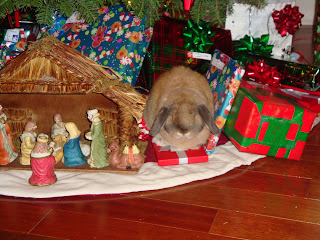 And, who's to say there wasn't a bunny or two in that famous Bethlehem stable?
 "Getting to know you . . . getting to like you, getting to hope you like me . . ."
 A brand-new Ivy and Bean book to read and a lap bunny -- life is good for Christmas Sadie!
How Christmas morning always ends at our house -- everyone quietly and contentedly reading his or her new books. And drinking coffee. And usually listening to some beautiful Christmas music in the background. Merry Christmas!
Tuesday, December 01, 2009
Two Conversations
Rylee and Sadie happen to be adorable and also quite small. They are never trivial.
We were driving to Rylee's house the other day so that she could nap in her own bed -- or, rather, by her door, for that is where she likes to sleep. We passed by the Safeway. Rylee started yelling, "Turn left! Turn left!"
"No," I replied, perplexed, "We're going to your house for night-night."
"Can we go to the grocery store after night-night, 'Tines?" She calls me 'Tines. :-)
"What do you need at the grocery store?" I queried.
"Suckers." Kids are great!
"And how are you going to get these suckers?" I teased. "Do you have some money?"
"No, I don't have any money," Rylee replied. "Do you have money, 'Tines?"
"No, I don't have any money either. How are we going to get some money to go buy suckers?"
Rylee looked quite thoughtful. "Um . . . um . . ." I waited to see what she would say.
Very serious and concerned, Rylee slowly sighed, "I don't know."
And don't you wish you could be three again? Just for one day?
That same night, I was driving Sadie home after a trip to the grocery store where we did not buy suckers, but rather nutritious food like Pirate's Booty. As I was looking straight ahead, my hands ten and two on the steering wheel, cautiously within the speed limit, Sadie said, "Hey, Mom! What does this mean?"
"What does what mean?" I returned, my eyes responsibly glued to the road.
"Well, look, Mom. This." And, I will admit, I quickly flitted my eyes from the road and toward the back seat where I saw Sadie's nimble middle finger boldly extended in my direction. OK, so I laughed. Sue me.
"Where did you see that?" I spluttered.
"Some kid at school got in trouble because of it. He wasn't in my grade -- maybe fourth grade? Anyway, Delaney and Carter both know what it means, but they won't tell me. Why is it bad? What does it mean?"
"I'm not going to tell you. Just don't do it. It is a crude and profane gesture and not something that a lady does."
"Well, I'm not a lady, and I want to know what it means. It's not fair that Delaney and Carter both know and I don't. Tell me."
"No I will not. I hope you will grow up into a lady, someday, and will never use that gesture. You will find out in time what it means, but not from me."
Sadie argued with me the rest of the way home, which, thankfully, only took about five minutes. Once home, I distracted her with candy, and she has not brought it up since. But, don't you wish you could be six again? Just for one day?
We were driving to Rylee's house the other day so that she could nap in her own bed -- or, rather, by her door, for that is where she likes to sleep. We passed by the Safeway. Rylee started yelling, "Turn left! Turn left!"
"No," I replied, perplexed, "We're going to your house for night-night."
"Can we go to the grocery store after night-night, 'Tines?" She calls me 'Tines. :-)
"What do you need at the grocery store?" I queried.
"Suckers." Kids are great!
"And how are you going to get these suckers?" I teased. "Do you have some money?"
"No, I don't have any money," Rylee replied. "Do you have money, 'Tines?"
"No, I don't have any money either. How are we going to get some money to go buy suckers?"
Rylee looked quite thoughtful. "Um . . . um . . ." I waited to see what she would say.
Very serious and concerned, Rylee slowly sighed, "I don't know."
And don't you wish you could be three again? Just for one day?
That same night, I was driving Sadie home after a trip to the grocery store where we did not buy suckers, but rather nutritious food like Pirate's Booty. As I was looking straight ahead, my hands ten and two on the steering wheel, cautiously within the speed limit, Sadie said, "Hey, Mom! What does this mean?"
"What does what mean?" I returned, my eyes responsibly glued to the road.
"Well, look, Mom. This." And, I will admit, I quickly flitted my eyes from the road and toward the back seat where I saw Sadie's nimble middle finger boldly extended in my direction. OK, so I laughed. Sue me.
"Where did you see that?" I spluttered.
"Some kid at school got in trouble because of it. He wasn't in my grade -- maybe fourth grade? Anyway, Delaney and Carter both know what it means, but they won't tell me. Why is it bad? What does it mean?"
"I'm not going to tell you. Just don't do it. It is a crude and profane gesture and not something that a lady does."
"Well, I'm not a lady, and I want to know what it means. It's not fair that Delaney and Carter both know and I don't. Tell me."
"No I will not. I hope you will grow up into a lady, someday, and will never use that gesture. You will find out in time what it means, but not from me."
Sadie argued with me the rest of the way home, which, thankfully, only took about five minutes. Once home, I distracted her with candy, and she has not brought it up since. But, don't you wish you could be six again? Just for one day?
Monday, November 30, 2009
Book Review: The Lives of the Mind
 The Lives the the Mind: The Use and Abuse of Intelligence from Hegel to Wodehouse
Roger Kimball
Ivan R. Dee; Chicago (2002)
"In the faculty of writing nonsense, stupidity is no match for genius." -- Walter Bagehot
Imagine how cool it would be if you had correspondence with a friend who shared your literary tastes and philosophical bent, was far better read than you, and was willing to distill the essentials of such epistemologically convoluted thinkers as Hegel into delightful and digestible essays. Such a friend would be estimable, indeed! And, if you are, as I am, lucky enough to be familiar with the work of The New Criterion's Roger Kimball, then you can have a taste of such a friendship.
Had Mr. Kimball sat down with me precisely in mind as his intended audience, he could scarcely have written a more captivating book. I loved everything about this loosely themed collection of essays on some of the most diabolical, some of the most pertinent, some of the most influential thinkers that have shaped our modern understanding of who and why we are. My husband hates philosophy; I philo it. In fact, sitting about musing on various deep, unanswerable questions, preferably with wine and friends and a fire, while outside raindrops fall from leaden skies to pelt the sodden earth, would be a favorite activity of mine, if I could just find some local friends with whom to share these contemplative confabs. Guess I'll have to import them from Chicago. So, I am all alone with Mr. Kimball, while he schools me on philosophers I have read (Decartes, Kierkegaard, Russell), philosophers of whom I had heard (Hegel, Schopenhauer, Santayana, Schiller), and a few of whom I'd never even heard (Wittgenstein, Stove).
But, Lives of the Mind is much more than essays on those lofty gentlemen. Here is the great political philosopher, Alexis deTocqueville; here is the comic novelist, P.G. Wodehouse; here is the prolific Victorian, Anthony Trollope. Rounding it out is the universally known, but seldom read, Plutarch; the French commentator, Aron; French caricaturist, Damuier; and the delightfully difficult to categorize, Bagehot. Roger Kimball brings to each subject a keen eye for the satirical and a surprisingly wicked wit. When he respects an author, he can make you love them by proxy. See if you do not walk away from this book and immediately start reading Wodehouse. C'mon, I dare you. And even when he is skeptical about the value of certain thinkers, such as, say, Hegel, he is still able to offer a readable critique that is saturated with wry humor. All of this combines to make an exceptionally fun adventure through some of the most opaque minds and obscure meditations that have influenced modern intellectual life.
Since Mr. Kimball loves -- nay, relishes -- language and the art of the aphorism, one of the principal treats of Lives of the Mind is the trove of one- and two-liners he unearths from his subjects, polishes, and displays for the reader's amusement and edification. Sometimes funny, sometimes profound, these observational gems are worth the price of admission. Two of the main beneficiaries of this appreciation are Lichtenberg and Péguy, both of whom might have escaped notice had they not been particularly adept at pontifications of the proverbial sort. My favorite from Charles Péguy is, "He who does not bellow the truth when he knows the truth makes himself the accomplice of liars and forgers." To which Kierkegaard might answer, "Subjectivity is truth!" And there's a whole can of worms. One cannot bellow subjectivity; I prefer truth as truth, not truth as perception. But, to spend a good hour or two wrestling those things to the ground is one of the purest pleasures of reading Mr. Kimball's book.
Wednesday, November 25, 2009
Happy Abstract Compound Noun Based Upon a Transitive Verb and Its Direct Object Day!
Happy Turkey Day!
No, no, no!
Let's not let Thanksgiving get away from us. We have the ubiquitous and banal "Happy Holidays" and Santa Claus for Christmas. We have the Easter Bunny and egg hunts for Resurrection Sunday. We have Halloween. But let us not give up the purity of Thanksgiving by downgrading it to commemorate only the carnal, when we ought to remember the spiritual.
Thanksgiving is an abstract noun -- a noun, like love and peace, that is intangible. It is also a compound noun, made up of two stand-alone words. The second word in the compound is a gerund -- a noun based upon a verb. The verb upon which it is based is a transitive verb -- a verb which needs to be paired with an object in order to make sense. Ain't English fun?
What I am saying here is that there is a lot packed into the abstract, proper noun we have given to a holiday celebrated the fourth Thursday in November across America.
When you give thanks, "give" is the transitive verb, and "thanks" is its direct object. But, implied between them -- though often not stated outright -- is a pesky indirect object. That is the "to whom" of the statement. You simply cannot "give" something without someone on the other end. And it is the indirect object that will be the stumbling block for so many.
You cannot give thanks without have someone to receive them. You do not sit down to write a thank-you note without an intended recipient. You can give chocolate bars out all day, but, unless you find someone to take them, you'll be no poorer in chocolate at the end of the day than you were at the beginning. To some people, this is not a bad proposition. But, in order for words to have meaning, we must know what we mean when we say them. That is why it was so funny to hear Michael Medved interviewing a spokesman from the American Humanist Society on the radio last week.
Mr. Medved asked the man whether he would be celebrating Thanksgiving in a couple days. The man said, yes, of course he would. Mr. Medved then asked him who he would be thanking on the holiday. The man said that he would be giving thanks for his family and his country and all the other warm and fuzzies. Mr. Medved probed him: Yes, but whom will you be thanking? The man was slightly confused and said he was thankful for all those things in his life, but that he wasn't thanking anyone in particular for them. Mr. Medved pressed the point that when you feel thankful, those thanks are meant for a particular person. The humanist answered that a general feeling of thankfulness needed no other entity involved. Mr. Medved, in the interest of pacing, let the matter drop there.
If you are thankful (adjective) you are, quite literally, full of thanks. "Thanks" is another noun based upon a verb. To be full of thanks means that you have had your fill of the action of thanking. Thanking is another transitive verb, this one needs only a direct object -- whom or what are you thanking? Oh, well, I'm not actually thanking anyone -- I am merely giving thanks in a general, non-committal, non-theistic sort of way. Ah, but implied in the verb "to give" is that vexing old indirect object. You can leave him out, but he is there nonetheless. The Pilgrim settlers knew to Whom they gave thanks; Abraham Lincoln knew to Whom he was giving thanks; and, despite the increasing secularization of our society, more than 80% of Americans know to Whom they will give thanks this Thanksgiving Day.
Now, that is not to say that you cannot give thanks to others as well on Thanksgiving Day. You can, if you choose, give thanks to your parents for bringing you into this world; you can give thanks to your wife for cooking a delicious dinner; you can give thanks to your husband for busting his arse day after day to provide for your family. And these are all well and good. But, to pretend that the holiday (contracted from "holy day") of Thanksgiving in America was founded to be anything other than a day set aside so that we can, as a nation, pause together to thank our Creator, Redeemer, and Sustainer for all the nouns that fill our lives -- tangible and intangible -- is to blind ourselves in a highly comical way. I suspect that our humanist friend on the radio did not wish to say that his thanks is given to his friends and family because he, like every human, has eternity written on his heart and knows that -- while thanks for the immediate things of this world can often be given to other people -- the great and good and breathtaking things can only be attributed to God.
So, let us not forget all the meaning crammed into that delightfully complex noun, thanksgiving. And, please, let us not give into the temptation to strip another holiday of its spiritual implications by employing the cute, but carnal, salutation, "Happy Turkey Day!"
No, no, no!
Let's not let Thanksgiving get away from us. We have the ubiquitous and banal "Happy Holidays" and Santa Claus for Christmas. We have the Easter Bunny and egg hunts for Resurrection Sunday. We have Halloween. But let us not give up the purity of Thanksgiving by downgrading it to commemorate only the carnal, when we ought to remember the spiritual.
Thanksgiving is an abstract noun -- a noun, like love and peace, that is intangible. It is also a compound noun, made up of two stand-alone words. The second word in the compound is a gerund -- a noun based upon a verb. The verb upon which it is based is a transitive verb -- a verb which needs to be paired with an object in order to make sense. Ain't English fun?
What I am saying here is that there is a lot packed into the abstract, proper noun we have given to a holiday celebrated the fourth Thursday in November across America.
When you give thanks, "give" is the transitive verb, and "thanks" is its direct object. But, implied between them -- though often not stated outright -- is a pesky indirect object. That is the "to whom" of the statement. You simply cannot "give" something without someone on the other end. And it is the indirect object that will be the stumbling block for so many.
You cannot give thanks without have someone to receive them. You do not sit down to write a thank-you note without an intended recipient. You can give chocolate bars out all day, but, unless you find someone to take them, you'll be no poorer in chocolate at the end of the day than you were at the beginning. To some people, this is not a bad proposition. But, in order for words to have meaning, we must know what we mean when we say them. That is why it was so funny to hear Michael Medved interviewing a spokesman from the American Humanist Society on the radio last week.
Mr. Medved asked the man whether he would be celebrating Thanksgiving in a couple days. The man said, yes, of course he would. Mr. Medved then asked him who he would be thanking on the holiday. The man said that he would be giving thanks for his family and his country and all the other warm and fuzzies. Mr. Medved probed him: Yes, but whom will you be thanking? The man was slightly confused and said he was thankful for all those things in his life, but that he wasn't thanking anyone in particular for them. Mr. Medved pressed the point that when you feel thankful, those thanks are meant for a particular person. The humanist answered that a general feeling of thankfulness needed no other entity involved. Mr. Medved, in the interest of pacing, let the matter drop there.
If you are thankful (adjective) you are, quite literally, full of thanks. "Thanks" is another noun based upon a verb. To be full of thanks means that you have had your fill of the action of thanking. Thanking is another transitive verb, this one needs only a direct object -- whom or what are you thanking? Oh, well, I'm not actually thanking anyone -- I am merely giving thanks in a general, non-committal, non-theistic sort of way. Ah, but implied in the verb "to give" is that vexing old indirect object. You can leave him out, but he is there nonetheless. The Pilgrim settlers knew to Whom they gave thanks; Abraham Lincoln knew to Whom he was giving thanks; and, despite the increasing secularization of our society, more than 80% of Americans know to Whom they will give thanks this Thanksgiving Day.
Now, that is not to say that you cannot give thanks to others as well on Thanksgiving Day. You can, if you choose, give thanks to your parents for bringing you into this world; you can give thanks to your wife for cooking a delicious dinner; you can give thanks to your husband for busting his arse day after day to provide for your family. And these are all well and good. But, to pretend that the holiday (contracted from "holy day") of Thanksgiving in America was founded to be anything other than a day set aside so that we can, as a nation, pause together to thank our Creator, Redeemer, and Sustainer for all the nouns that fill our lives -- tangible and intangible -- is to blind ourselves in a highly comical way. I suspect that our humanist friend on the radio did not wish to say that his thanks is given to his friends and family because he, like every human, has eternity written on his heart and knows that -- while thanks for the immediate things of this world can often be given to other people -- the great and good and breathtaking things can only be attributed to God.
So, let us not forget all the meaning crammed into that delightfully complex noun, thanksgiving. And, please, let us not give into the temptation to strip another holiday of its spiritual implications by employing the cute, but carnal, salutation, "Happy Turkey Day!"
Monday, November 23, 2009
Book Review: Going Rogue: An American Life
 1 Kings 19 tells the story of the prophet Elijah's fleeing that stinking heathen queen Jezebel. He ended up in that great, vague biblical setting of testing and redemption -- the wilderness, plopped himself under a broom tree, and, with typical Old Testament histrionics, prayed that he might die. Angels came to comfort him. And, just like sympathetic church ladies would thousands of years in the future for their suffering co-congregants, they brought him cake. Thus, the lesson of this story is, when you've used up your last strength running for your life, battling an antagonistic foe, hitting dead ends, and even when you have given up hope, cake helps. At birthdays and weddings, at funerals and during illnesses, at the end of one dream or at the kindling of a new one, cake has a role to play.
Sarah Palin understands the significance and salutary effects of cake. Were it only for that reason, I would like her.
But, there are many, many more reasons to like this former governor of the Last Frontier State. I will confess that I went into reading Going Rogue: An American Life already knowing several of those reasons. I finished the book knowing myriad more. So, like most reviews I write (or anyone else writes, for that matter), this comes from a partial and prejudiced point of view. I am a Palinista -- or, at least, a junior one. The Governor speaks to the issues about which I care and takes stances with which I agree. I voted for her in 2008 (and that old guy she was running with), and I would vote for her again, gladly. And yet, I do not think that this book was written for me.
Michael Medved recently stated on his radio show that the reason Sarah Palin wrote this book was that "she needed the money." Well, I am sure she could use the money. With five kids and a stack of legal bills from defending herself against frivolous ethics complaints filed during her governorship, who couldn't use an extra mil or two? But, I respectfully disagree with Mr. Medved. Gov. Palin has enough speaking requests with large price tags attached lined up to fulfill years of time and generate heaps of income. She did not "need" to write this book. I think that she wrote it to retake command of the narrative of her life, which was ripped from her during the scurrilous media feeding frenzy that surrounded this formerly obscure politician who dared to treat her running mate's opponent as the rather silly, grandiose, empty suit that he unfortunately is.
All of a sudden, this popular governor, this cheerful can-do woman of strength and character forged in the rugged beauty of our largest state, this wife of one and mother of five who was recruited for local office when she was in her late twenties and built a reputation for practical, ethical leadership among her constituents that led to an improbable -- yet gratifyingly American -- rise to the highest executive office to correct a state riddled with corruption and pork, this spitfire, this plain-speaker, this startlingly clear communicator was being portrayed by openly hostile news writers and broadcasters as a brainless, corrupt, hickish, diva-ish, incompetent, mean-spirited, unmotherly, uncaring, Bible-thumping-flat-earth-believing, manipulative philistine. Sheesh. Do you remember watching that media circus unfold? It was not a great moment for the fourth estate, to put it mildly. But anybody with any sort of curiosity could have sorted through the muck to find the truth. I was one of those who did. But, like I said, this book was not written for me.
So, what about the book itself? You know I like the lady; what did I think of the book? Well, I read close to 100 books a year, and very few come from the bestsellers lists. While everyone else is talking about the latest schmaltzy weeper from Oprah's book club, I'm digging up Isabel Paterson novels from inter-library loan. Autobiographies are a tough sell for me. I can count on one hand the number I have read and liked. An autobiography of a current political figure? Get outta here, and don't show your face until you've brought me some Roger Kimball or Alan Jacobs as a peace offering! And yet, I ordered Going Rogue on the first day that I could. I figured that, because I like Gov. Palin so much, it could be like eating Turkish Delight -- the way you imagine Turkish Delight will taste when you are a nine-year-old reading The Lion, the Witch, and the Wardrobe; not the way it actually tastes when you finally get a hold of some as an adult (which is bloody awful, in my opinion). Or, it could be horrible -- too ambitious, too imitative, overly-stylized, long on policy, short on personality -- making all the mistakes the McCain campaign did when they tried to turn Sarah Palin into a GOP-droid.
I am happy to report, this book is the former. In fact, I stayed up until 4:00 AM this morning to finish it, so engrossed was I. Sarah Palin has a keen sense of who she is and what she has to offer, and that comes through so clearly in this book. I know that she had a collaborator named Lynn Vincent who helped her organize and format her story; but, I think, I really do think, that the voice is all Sarah Palin's. It rings true. There is really a sense that she is talking to you -- not crafting a great work of literature for posterity and fame, but just telling you her story -- with humor, warmth, grace and humility. It is an easy read, not a deep read, by any means. Should Sarah Palin never again run for or get elected to office, it will likely fade away, lost in the mists of time and relegated to the musty shelves of antiquarian booksellers. But, I am glad to have read it. It sets out in plain language who she is, where she came from, what she's accomplished, and what she believes. It is refreshingly energetic and optimistic -- were she given the chance, Sarah Palin could soothe the wounds of this battered land with the balm of her upbeat common sense -- and, quite amazingly, free from rancor. She treats far more gently and compassionately than I would the people who have made her life miserable for the past two years. And I guess that is because, in the realest and truest sense, her life has not been miserable at all. No matter what has been thrown at her, she just stands firm in her faith and with her family and friends, and does the right thing. From the advance reviews I had read, I expected at least a bit of a self-pity party; instead, she lives out 2 Corinthians 4:8-10.
More than any other political figure, Sarah Palin invokes the name, message, leadership, and influence of Ronald Reagan. Good choice, indeed. We're big President Reagan fans in this house. But, I would like to offer up that, to me, the political figure Gov. Palin most evokes is Grover Cleveland, our nation's most unjustly neglected president, and my personal favorite. In her record of public service before the hoopla of her national candidacy, Sarah Palin had the quiet, solid fidelity to conviction that characterized the honest leadership of President Cleveland. Rising from a modest background, unable to afford university (he "read law" with a firm to become a lawyer), recruited into politics as sheriff of Buffalo, NY, mayor of same (known as "The Wasilla of New York" in the late 1800's -- OK, I made that up), governor of New York, president of the United States -- the only one to serve two non-consecutive terms. His motto when governor was "Public Office is a Public Trust." He was known as "Grover the Good." He cut taxes and spending. As one of his biographers, Allan Nevins, wrote in 1932, "He had no endowments that thousands of men do not have. He possessed honesty, courage, firmness, independence, and common sense. But, he possessed them in a degree that others did not." Time will tell whether Governor Palin can parallel his success; I have every confidence that she can, if she so chooses.
Michael Medved, whom I love, but who has been driving me crazy with his dismissive comments about Gov. Palin lately, expressed his disappointment that this book was vague and short on policy. Again, I would say that Going Rogue, while a gratifying read for her supporters, was written for one main purpose: reclaiming the life narrative of Sarah Palin. She does that admirably -- addressing just about every rumor and falsehood that I can recall recoiling from during her vice presidential campaign. Her candor is remarkable -- she does not shy away from the horrible things said about her daughters and her marriage and her sweet baby, Trig. She is so patient in revisiting ground that must be terribly painful for her, simply to set the record straight. She is rightly proud of what she was able to accomplish in her short term as governor of Alaska. In fact, she goes quite in depth into Alaskan policies and politics -- spelling out in a clear and concise way (if not exactly spellbinding for this Outsider) the rigmarole of the Alaskan pipeline, butting heads with oil companies, crafting the ACES proposal to incentivize more petroleum exploration and development, and so on. Should she ever wish to write a book-length treatment of public policy proposals, I am sure she would write a readable and reasoned one; this book was never meant to be that.
The wretchedly run McCain campaign is too frustrating for words. I wish Gov. Palin had "gone rogue" from day one. Her take on that debacle is all there, and far too generous in spirit, in my opinion. But, to me, it was most heartbreaking to read about her decision to resign from the governorship of Alaska. She was basically railroaded out of office by a system that allows ethics violation charges to be brought against the executive branch of state government without any penalty to the filer should the accusations prove false. Every charge brought against Governor Palin was dismissed. Every charge. And yet, she had to defend herself out of her own pocket and eventually racked up half a million dollars in legal bills. And, what seems to have hurt her even more personally, these frivolous suits were wasting the time and money of Alaskan taxpayers. She has a grave feeling of responsibility in how she uses other people's money that you frankly do not see a lot of in politics today. And yet, your heart breaks for the state of Alaska when you realize that they had to lose such a dedicated and devoted public servant -- whose love for her state shines out of every page of this book -- because of the politics of personal destruction.
In the arctic north, you cannot sit still for a moment. You have to build that fire, or you'll freeze to death and even your dog will abandon you. Ask Jack London. And Sarah Palin seems to have that restless spirit in abundance. She ends her book with a chapter on "the way forward," in which she gives a brief overview of what is becoming her trademark brand of common sense conservatism. She looks toward America's future with optimism; I look torward her future with anticipation. I can hardly wait to see what she'll do next.
On the day she announced her upcoming resignation from the governorship at the end of July 2009, after the press conference, in her kitchen with her close friends and family, after closing one chapter in her life and looking forward, always forward, with excitement to the next adventure life had in store for her, she ate some cake. Elijah would be proud.
Subscribe to:
Posts (Atom)