Thursday, January 21, 2010

Poor Richard! Austen, Shakespeare, Tey, and The Legacy of Richard III

Folks who like to paint Jane Austen as a heartless shrew often point to the end of Chapter 6 in Persuasion, wherein the Musgrove family lament the loss of "poor Richard" -- brother and son lost at sea some years before. Sharp of understanding and wit, Miss Austen goes on to write that "the Musgroves had had the ill fortune of a very troublesome, hopeless son; and the good fortune to lose him before his twentieth year . . . he had, in fact, though his sisters were now doing all they could for him, by calling him 'poor Richard,' been nothing better than a thick-headed, unfeeling, unprofitable Dick Musgrove, who had never done any thing to entitle himself to more than the abbreviation of his name, living or dead." People are weenies; Jane Austen rules; and this depiction is not only hilarious, it is a spot-on portrait of the white-washing of character and consequence we give to the dead.

But, sometimes the opposite is true, and the dead are besmirched and defamed for no reason other than to promote the interests of those still living. And, I fear that this latter occurrence has plagued the memory -- both cultural and historical -- of England's favorite villain king, Richard III.

We all know Richard III, don't we? Hunched in back, disfigured in limb, monstrous in mind, ruthless in action. He murdered his two nephews, you know, to ensure his succession to the crown. And set up his brother, Clarence, for a fall, too. And killed off his wife, Anne, for kicks. Anyone who had the misfortune to cross his hobbling, goblin-gaited path was most likely going to meet his Maker within . . . well, within the Act, because this is the Richard of Shakespeare's delightful, eponymous play.

I love Richard III. I think that it is, perhaps, my favorite of the Bard's. I know, I know, an odd choice. But, it is as splendid an example of political subversion as ever tread the boards. And yet, it is always classified as one of the history plays.

Is it history? Josephine Tey wrote a mystery novel that lays out in a readable, conversational way the case that it is not. My father was recently reminded of this 1951 novel by reading a review of it by Jo Ann Skousen in the current issue of Liberty. His enthusiasm in recollection was such that he badgered me repeatedly in our conversations to read The Daughter of Time. How could I hold out against such urging? I checked it out from the library.

"Truth is the daughter of time," is the proverb that introduces this most unusual of murder mysteries. Because, while there are murders a-plenty the background of the story, the main crime to be solved is the assassination of character. That assassination took place 500 years in the past, and the case is investigated by a British officer of Scotland Yard who is recuperating from a devastating injury and an American scholar "apprentice." Inspector Alan Grant has a penchant for deducing personalities from portraits. That is, he believes -- with some justification -- that he has an intuitive eye for reading occupational tendencies on the faces of men. When a friend who visits him in the hospital brings with her a sheaf of historical portraits to amuse him with scandalous characters of yesteryear, Grant's attention is riveted by that of Richard III, the last York king. In his features Inspector Grant sees goodness and conscientiousness and concern and sadness, but no hint of the malevolence and psychopathy that our persistent cultural memory of this briefest of regents connotes.

On this hunch alone, Inspector Grant begins a grand work of armchair detection. In his immobile state, he enlists every visitor to his bedside to help him in uncovering more and more pieces of the puzzle. Either he is much mistaken in his reading of Richard's character, or our historical characterization of this monarch has been scandalously false. With an almost charming hubris, Grant tends toward the latter (without which, I suppose Ms. Tey's book could not have been written). And, what do you know? His researchers start to bring evidence to support his theory!

OK, so Josephine Tey's book is a wee on the nose. I do not know if I agree fully with her story structure. But, the story of the end of the War of the Roses, Richard's ascension, and Henry Tudor's usurpation (or, if you buy the common Tudor version of history, switch Richard's action with Henry's) is fascinating on every level. And, when the stones of Tudor mythology are overturned, there is a lot of nasty business writhing about underneath.


The upshot hypothesis of Daughter of Time is that Richard was pretty darn good -- as both a person and a monarch -- and Henry Tudor -- later Henry VII -- was about as bad as can be; but, with the complicity of generations of historians, we attribute all of his bad behavior to Richard in as neat an act of historical fudging as ever was perpetrated. Tey asserts, through her Alan Grant, that the Princes in the Tower -- that pairing which brings to the mind's eye the most pathetic of scenes -- were alive and well throughout Richard's two-year reign. They had already be declared illegitimate, owing to their father's undissolved previous marriage, and unable to ascend to the throne in Parliament's Titulus Regius that gave the crown to Richard. Their mother lived in court with Richard; their sisters did as well. These all argue in favor of Richard's owing them nothing but kindness and condescension. Henry Tudor, on the other hand, had the Titulus Regius utterly destroyed upon his victorious entry into London after killing Richard at the battle of Bosworth. He did this to make his wife a legitimate child of Edward IV (Richard's older brother) and to invalidate Richard's reign. Unfortunately, by doing this, he made young Edward and his brother Richard both heirs to the throne before him. His only way to retain the crown was to do away with the boys and attribute the heinous act to Richard. And, Tey as well as others before her, believe that this convenient rewriting of history is exactly what he did.

Of course, for any authoritative accounting of English history, we must turn to Jane Austen, who wrote at the age of sixteen, The History of England: From the Reign of Henry the 4th to the Death of Charles the 1st. What had she to say about the mystery of Richard III?
"The Character of this Prince has been in general very severely treated by Historians, but as he was a York, I am rather inclined to suppose him a very respectable Man. It has indeed been confidently asserted that he killed his two Nephews & his Wife, but it has also been declared that he did not kill his two Nephews, which I am inclined to beleive true; & if this is the case, it may also be affirmed that he did not kill his Wife, for if Perkin Warbeck was really the Duke of York, why might not Lambert Simnel be the Widow of Richard.* Whether innocent or guilty, he did not reign long in peace, for Henry Tudor E. of Richmond as great a villain as ever lived, made a great fuss about getting the Crown & having killed the King at the battle of Bosworth, he succeeded to it."

As The Daughter of Time makes clear at the end, the rehabilitation of Richard did not start with Josephine Tey. Not by any means. After the hundred years of the House of Tudor and their state-sanctioned historians, the Stuarts brought with them a new accounting of Richard III. Buck in the 17th, Walpole in the 18th (whom Jane Austen probably read), and Markham in the 19th had all written histories of the Richard-era that pointed out the treachery of Henry VII. But these restorations of character have all been overshadowed by one writer whose portrayal of Richard III has remained the culturally definitive one: William Shakespeare.

Was Shakespeare taken in by Tudor pet Thomas More's The History of Richard III? At first glance, it would appear that he was. Every bit of back-stairs gossip that More printed as truth made it into Shakespeare's Richard III. Yet, when I wrote earlier that the play is a splendid example of political subversion, I was hinting at something of which I have become convinced: Shakespeare wasn't buying the official line on Richard III. Because, you see, we love the Richard of Richard III; and we're supposed to loathe him.

Every wicked act of which Richard was accused by the Tudors is paraded for our appalled observation. His schemes to plant seeds of doubt in the mind of his brother, Edward IV, about their middle brother, the Duke of Clarence, lead to Clarence's execution. He not only trumps up charges of illegitimacy against his young nephews, he has them murdered for good measure. He seduces the horrified Anne at the beginning of the play, only to have her offed with an aura of implacable insouciance later on when he decides to wed his niece. Good ol' Hastings is dragged out for a swift death when Richard accuses his mistress of using witchcraft to wither his deformed arm. His constant cries of "Off with his head!" are amusingly reminiscent of Carroll's The Queen of Hearts. He is seriously a bad dude. In short, this presentation is everything that the government censors of Elizabethan England could want in a play that ends with the glorious ascension of the Queen's grandfather.

Yet, amazingly, we are on Richard's side. He winks at us and smirks with us and invites the audience to approve of and delight in how nimbly he deals with the fools that surround him. He seduces us. We cheer him on. Seriously, you start to think that, perhaps, those little princes had it coming to them. Anne was such a whiner, really. Clarence was a bumbler; Hastings and Buckingham were so blah -- who needs 'em anyway? Give us Richard!

Now, you could say, "Well, that's how he's played. That's the actor's invention." Yes, maybe; but, you see, I read this play long before I ever saw it acted on stage or screen, and that was my reaction to Richard from the beginning. So, I cannot help but think that Shakespeare -- always the most keen observer of human nature -- wrote him that way. He is irredeemable in a way that few Shakespearean villains are; yet, unlike, say, Iago from Othello, he does not make us shudder with revulsion. And that is because I think that Shakespeare wrote the play as a fantasy, rather than as a history. History is full of people and their multiple motives, their complex actions, and the complicated consequences thereof. Richard III is a Tudor fantasy play, in which Henry VII rides in on the last act to deliver England from a monster. But the catch is that Shakespeare's Richard is not a monster, at all. Monsters threaten real people. Richard III's only real person is Richard; the rest are cardboard characters. Iago is a monster because Othello and Desdemona are heart-breakingly real.

So, I am convinced that William Shakespeare somehow knew that More's Richard was a load of bunk; and he decided to use that bunk as the basis for a superb bit of theatrical subversion. Any artist of his caliber would chafe under the censorship of a repressive government; but, in a totalitarian regime there was not much you could do about that, presuming, of course, that you valued your head. So, the sublimity of "pulling one over" on the tattle-tales and spies must have given our Bill the greatest satisfaction. Unfortunately, his portrayal was taken as gospel by many who lacked imagination and a good sense of humor, and Richard III's character was killed off more surely than ever his beloved wife, Anne, was.

"History is written by the victors," goes one old saw. True, that. But, Shakespeare himself echoes Tey's cited proverb by saying, “Time's glory is to calm contending kings, to unmask falsehood and bring truth to light.” Not even the authority of the most venerable or vocal of historians can hide truth forever. The lessons of Richard of York are multiple: question the official line -- especially if it was written by people who stand to profit from your gullibility; human history is far more complex than a listing of good guys and bad guys; do not allow artistic license to stand in for objective reality. Moreover, the real tragedy of Richard III is not only that a people were robbed of good governance by the perfidy of a pretender, but also that a gentle soul has been adrift in a perditious posterity because of it. Poor Richard!

*These two pretenders to the throne threatened Henry VII's claim during his reign. Warbeck claimed to be Edward IV's younger son, Richard. Simnel claimed to be the son of Edward IV's brother, the Duke of Clarence.

Mentioned in this post:

Tuesday, January 12, 2010

Oh Deer!

Nature is too much with me, late and soon
Eating and pooping, deer lay waste my garden
Little reason have I to give them pardon
Yet their wild grace begets a mollifying boon . . .

Not sure whether to feel honored or merely dismissed that the neighborhood deer feel so at home in our backyard:


Wednesday, December 30, 2009

The Best of 2009

Let other pens dwell on guilt and misery and the worst of this fairly wretched year; I not only quit such odious subjects as soon as I can, I seldom bring them up in the first place. A partial, prejudiced and completely random list . . .

Best Trip: June 2009 -- St. Lou and Chi-Town to see Flicka and Dad

Best New Restaurant: A Terrible Beauty (Irish) in Renton, WA

Best Roger Kimball Read: The Rape of the Masters . . . wait . . . Tenured Radicals . . . wait . . . The Lives of the Mind . . . yikes! They're all good!

Best Sunday School Lesson: The Good Samaritan (I don't think the kids ever were as enraptured during Bible story time as when I gave my dramatic interpretation of this parable)

Best New Kitchen Discovery: King Arthur Flour (Thanks, Vermont! I owe you for this and vermonster)

Best New Album: Love Was Here First by Carolyn Arends (with Make Yourself Known by The Clumsy Lovers coming in a close second)

Best New Christmas Album: Christmastide by Bob Bennett

Best Online Store From Which to Buy Great Music and Books: Feed the Lake

Best Airline: Alaska Airlines (funny how that keeps its #1 spot year after year . . .)

Best Completely Addictive Mid-Afternoon Snack: New York Style Focaccia Sticks

Best Blogger & Friend Returning from Nearly Two Years of Silence to the World Wide Web: Flicka Spumoni

Best Newly Discovered Political Blog: Conservatives 4 Palin

Best Children's Book Series: Ivy and Bean Books by Annie Barrows (Chronicle Books)

Best Quote I Heard this Year: When the Father laughs at the Son and the Son laughs back at the Father, that laughter gives pleasure, that pleasure gives joy, that joy gives love, and that love is the Holy Spirit. -- Meister Eckhart (read in Tony Hendra's Father Joe)

Best Chesterton-Oriented Happening: Seattle's hosting the American Chesterton Society's annual conference (though, my being asked to write a review of Orthodoxy comes pretty close, as well)

Best Three Year Old: Rylee

Best Six-and-a-Half Year Old: Sadie

Best Beer: Harp

Best Wine: Chateau St. Michelle's Riesling

Best Bread: Mantovana

Best Big Purchase: My purple bike!

Best Little Purchase: Love Was Here First by Carolyn Arends

Best Play: Around the World in 80 Days (Taproot Theatre)

Best Thing I Saw Sadie Do: Learn to ride horses this summer

Best Thing I Heard Rylee Do: Sing her ABC's

Best Movie I Saw in the Theater: Up!

Best Movie I Saw on Video: Ghost Town

Best New Acquaintance of 2009: Flicka's Mom (everything she writes there is right, you know)

Best New (to me) Read About Jane: A Fine Brush on Ivory by Richard Jenkyns

Best New Joke About Justine for Family and Friends to Re-Visit Year After Year for the Rest of Her Life: My tragi-comedic inability to comprehend the workings of a candy thermometer.

Best New (to me) Author Who is Luckily Outrageously Prolific Thereby Giving Me the Delightful Anticipation of Many Happy Reading Hours: P.G. Wodehouse (Thanks, Roger Kimball!) (from Jason -- with sarcasm: Thanks, Roger Kimball.)

Best Hopes for 2010: The love of Jesus changing every heart and manifesting itself in every life across this planet (most important); continued health and safety of family and friends (almost as important); a new Congress (least important, but, unfortunately, still important).

Friday, December 25, 2009

Merry Christmas!

I love Christmas! Here are some photos to share the love with family and friends who stop by:

In early December we whisked Sadie away on a surprise 3-day trip to Disneyland Parks in Anaheim, CA!
Happy girl by the RR tracks -- the DISNEYLAND RR tracks!

Waiting in line for "California Screamin'" at Disney's California Adventure Park. She's finally tall enough to tackle this most exhilerating of roller coasters.

A meeting with "Christmas in Hawaii" Donald at Disney's California Adventure.


A must-have hug between Sadie & Tigger = 2 quite wonderful things!

Even the letters in the breezeway betwixt Disneyland and California Adventure were dressed for Christmas!

Then, it was back home for the regular Christmas time stuff:

Sadie sitting on the entryway steps: "Mom, I like these jeans because they make me look like a teenager." God help me.

You may remember Rylee and Sadie's attempt to construct a gingerbread house in 2008.

Here they attempt a second venture in Ginger Realty.

This time with far better success.

"The stockings were hung by the chimney with care . . ."

"O Tannenbaum, o Tannenbaum! Wie treu sind deine Blätter!"


And, of course, Old Saint Nick himself gets a special place at Christmas time.

The couch is adorned for the season.
We were again blessed by my parents' making the trek westward to spend Christmas with us. Here they and Sadie await eagerly the production of "It's a Wonderful Life: A Live Radio Play" by Taproot Theatre. Such a delightful show!

Sadie cuddles her BIG Christmas present this year -- a Holland Lop bunny named Kona. If you are in need of such a sweet and gentle pet, and you live in Western Washington, be sure to get yours from "The Bunny Whisperer" at Dragonfly Hollands in Snohomish, WA. She raises exceptional bunnies.
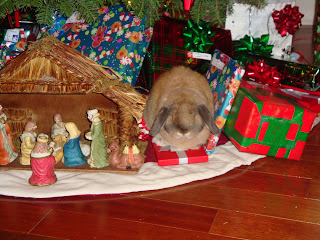
And, who's to say there wasn't a bunny or two in that famous Bethlehem stable?
"Getting to know you . . . getting to like you, getting to hope you like me . . ."
A brand-new Ivy and Bean book to read and a lap bunny -- life is good for Christmas Sadie!

How Christmas morning always ends at our house -- everyone quietly and contentedly reading his or her new books. And drinking coffee. And usually listening to some beautiful Christmas music in the background. Merry Christmas!

Tuesday, December 01, 2009

Two Conversations

Rylee and Sadie happen to be adorable and also quite small. They are never trivial.

We were driving to Rylee's house the other day so that she could nap in her own bed -- or, rather, by her door, for that is where she likes to sleep. We passed by the Safeway. Rylee started yelling, "Turn left! Turn left!"

"No," I replied, perplexed, "We're going to your house for night-night."

"Can we go to the grocery store after night-night, 'Tines?" She calls me 'Tines. :-)

"What do you need at the grocery store?" I queried.

"Suckers." Kids are great!

"And how are you going to get these suckers?" I teased. "Do you have some money?"

"No, I don't have any money," Rylee replied. "Do you have money, 'Tines?"

"No, I don't have any money either. How are we going to get some money to go buy suckers?"

Rylee looked quite thoughtful. "Um . . . um . . ." I waited to see what she would say.

Very serious and concerned, Rylee slowly sighed, "I don't know."

And don't you wish you could be three again? Just for one day?

That same night, I was driving Sadie home after a trip to the grocery store where we did not buy suckers, but rather nutritious food like Pirate's Booty. As I was looking straight ahead, my hands ten and two on the steering wheel, cautiously within the speed limit, Sadie said, "Hey, Mom! What does this mean?"

"What does what mean?" I returned, my eyes responsibly glued to the road.

"Well, look, Mom. This." And, I will admit, I quickly flitted my eyes from the road and toward the back seat where I saw Sadie's nimble middle finger boldly extended in my direction. OK, so I laughed. Sue me.

"Where did you see that?" I spluttered.

"Some kid at school got in trouble because of it. He wasn't in my grade -- maybe fourth grade? Anyway, Delaney and Carter both know what it means, but they won't tell me. Why is it bad? What does it mean?"

"I'm not going to tell you. Just don't do it. It is a crude and profane gesture and not something that a lady does."

"Well, I'm not a lady, and I want to know what it means. It's not fair that Delaney and Carter both know and I don't. Tell me."

"No I will not. I hope you will grow up into a lady, someday, and will never use that gesture. You will find out in time what it means, but not from me."

Sadie argued with me the rest of the way home, which, thankfully, only took about five minutes. Once home, I distracted her with candy, and she has not brought it up since. But, don't you wish you could be six again? Just for one day?

Monday, November 30, 2009

Book Review: The Lives of the Mind

The Lives the the Mind: The Use and Abuse of Intelligence from Hegel to Wodehouse
Roger Kimball
Ivan R. Dee; Chicago (2002)

"In the faculty of writing nonsense, stupidity is no match for genius." -- Walter Bagehot

Imagine how cool it would be if you had correspondence with a friend who shared your literary tastes and philosophical bent, was far better read than you, and was willing to distill the essentials of such epistemologically convoluted thinkers as Hegel into delightful and digestible essays. Such a friend would be estimable, indeed! And, if you are, as I am, lucky enough to be familiar with the work of The New Criterion's Roger Kimball, then you can have a taste of such a friendship.

Had Mr. Kimball sat down with me precisely in mind as his intended audience, he could scarcely have written a more captivating book. I loved everything about this loosely themed collection of essays on some of the most diabolical, some of the most pertinent, some of the most influential thinkers that have shaped our modern understanding of who and why we are. My husband hates philosophy; I philo it. In fact, sitting about musing on various deep, unanswerable questions, preferably with wine and friends and a fire, while outside raindrops fall from leaden skies to pelt the sodden earth, would be a favorite activity of mine, if I could just find some local friends with whom to share these contemplative confabs. Guess I'll have to import them from Chicago. So, I am all alone with Mr. Kimball, while he schools me on philosophers I have read (Decartes, Kierkegaard, Russell), philosophers of whom I had heard (Hegel, Schopenhauer, Santayana, Schiller), and a few of whom I'd never even heard (Wittgenstein, Stove).

But, Lives of the Mind is much more than essays on those lofty gentlemen. Here is the great political philosopher, Alexis deTocqueville; here is the comic novelist, P.G. Wodehouse; here is the prolific Victorian, Anthony Trollope. Rounding it out is the universally known, but seldom read, Plutarch; the French commentator, Aron; French caricaturist, Damuier; and the delightfully difficult to categorize, Bagehot. Roger Kimball brings to each subject a keen eye for the satirical and a surprisingly wicked wit. When he respects an author, he can make you love them by proxy. See if you do not walk away from this book and immediately start reading Wodehouse. C'mon, I dare you. And even when he is skeptical about the value of certain thinkers, such as, say, Hegel, he is still able to offer a readable critique that is saturated with wry humor. All of this combines to make an exceptionally fun adventure through some of the most opaque minds and obscure meditations that have influenced modern intellectual life.

Since Mr. Kimball loves -- nay, relishes -- language and the art of the aphorism, one of the principal treats of Lives of the Mind is the trove of one- and two-liners he unearths from his subjects, polishes, and displays for the reader's amusement and edification. Sometimes funny, sometimes profound, these observational gems are worth the price of admission. Two of the main beneficiaries of this appreciation are Lichtenberg and Péguy, both of whom might have escaped notice had they not been particularly adept at pontifications of the proverbial sort. My favorite from Charles Péguy is, "He who does not bellow the truth when he knows the truth makes himself the accomplice of liars and forgers." To which Kierkegaard might answer, "Subjectivity is truth!" And there's a whole can of worms. One cannot bellow subjectivity; I prefer truth as truth, not truth as perception. But, to spend a good hour or two wrestling those things to the ground is one of the purest pleasures of reading Mr. Kimball's book.

Wednesday, November 25, 2009

Happy Abstract Compound Noun Based Upon a Transitive Verb and Its Direct Object Day!

Happy Turkey Day!

No, no, no!

Let's not let Thanksgiving get away from us. We have the ubiquitous and banal "Happy Holidays" and Santa Claus for Christmas. We have the Easter Bunny and egg hunts for Resurrection Sunday. We have Halloween. But let us not give up the purity of Thanksgiving by downgrading it to commemorate only the carnal, when we ought to remember the spiritual.

Thanksgiving is an abstract noun -- a noun, like love and peace, that is intangible. It is also a compound noun, made up of two stand-alone words. The second word in the compound is a gerund -- a noun based upon a verb. The verb upon which it is based is a transitive verb -- a verb which needs to be paired with an object in order to make sense. Ain't English fun?

What I am saying here is that there is a lot packed into the abstract, proper noun we have given to a holiday celebrated the fourth Thursday in November across America.

When you give thanks, "give" is the transitive verb, and "thanks" is its direct object. But, implied between them -- though often not stated outright -- is a pesky indirect object. That is the "to whom" of the statement. You simply cannot "give" something without someone on the other end. And it is the indirect object that will be the stumbling block for so many.

You cannot give thanks without have someone to receive them. You do not sit down to write a thank-you note without an intended recipient. You can give chocolate bars out all day, but, unless you find someone to take them, you'll be no poorer in chocolate at the end of the day than you were at the beginning. To some people, this is not a bad proposition. But, in order for words to have meaning, we must know what we mean when we say them. That is why it was so funny to hear Michael Medved interviewing a spokesman from the American Humanist Society on the radio last week.

Mr. Medved asked the man whether he would be celebrating Thanksgiving in a couple days. The man said, yes, of course he would. Mr. Medved then asked him who he would be thanking on the holiday. The man said that he would be giving thanks for his family and his country and all the other warm and fuzzies. Mr. Medved probed him: Yes, but whom will you be thanking? The man was slightly confused and said he was thankful for all those things in his life, but that he wasn't thanking anyone in particular for them. Mr. Medved pressed the point that when you feel thankful, those thanks are meant for a particular person. The humanist answered that a general feeling of thankfulness needed no other entity involved. Mr. Medved, in the interest of pacing, let the matter drop there.

If you are thankful (adjective) you are, quite literally, full of thanks. "Thanks" is another noun based upon a verb. To be full of thanks means that you have had your fill of the action of thanking. Thanking is another transitive verb, this one needs only a direct object -- whom or what are you thanking? Oh, well, I'm not actually thanking anyone -- I am merely giving thanks in a general, non-committal, non-theistic sort of way. Ah, but implied in the verb "to give" is that vexing old indirect object. You can leave him out, but he is there nonetheless. The Pilgrim settlers knew to Whom they gave thanks; Abraham Lincoln knew to Whom he was giving thanks; and, despite the increasing secularization of our society, more than 80% of Americans know to Whom they will give thanks this Thanksgiving Day.

Now, that is not to say that you cannot give thanks to others as well on Thanksgiving Day. You can, if you choose, give thanks to your parents for bringing you into this world; you can give thanks to your wife for cooking a delicious dinner; you can give thanks to your husband for busting his arse day after day to provide for your family. And these are all well and good. But, to pretend that the holiday (contracted from "holy day") of Thanksgiving in America was founded to be anything other than a day set aside so that we can, as a nation, pause together to thank our Creator, Redeemer, and Sustainer for all the nouns that fill our lives -- tangible and intangible -- is to blind ourselves in a highly comical way. I suspect that our humanist friend on the radio did not wish to say that his thanks is given to his friends and family because he, like every human, has eternity written on his heart and knows that -- while thanks for the immediate things of this world can often be given to other people -- the great and good and breathtaking things can only be attributed to God.

So, let us not forget all the meaning crammed into that delightfully complex noun, thanksgiving. And, please, let us not give into the temptation to strip another holiday of its spiritual implications by employing the cute, but carnal, salutation, "Happy Turkey Day!"

Monday, November 23, 2009

Book Review: Going Rogue: An American Life

1 Kings 19 tells the story of the prophet Elijah's fleeing that stinking heathen queen Jezebel. He ended up in that great, vague biblical setting of testing and redemption -- the wilderness, plopped himself under a broom tree, and, with typical Old Testament histrionics, prayed that he might die. Angels came to comfort him. And, just like sympathetic church ladies would thousands of years in the future for their suffering co-congregants, they brought him cake. Thus, the lesson of this story is, when you've used up your last strength running for your life, battling an antagonistic foe, hitting dead ends, and even when you have given up hope, cake helps. At birthdays and weddings, at funerals and during illnesses, at the end of one dream or at the kindling of a new one, cake has a role to play.

Sarah Palin understands the significance and salutary effects of cake. Were it only for that reason, I would like her.

But, there are many, many more reasons to like this former governor of the Last Frontier State. I will confess that I went into reading Going Rogue: An American Life already knowing several of those reasons. I finished the book knowing myriad more. So, like most reviews I write (or anyone else writes, for that matter), this comes from a partial and prejudiced point of view. I am a Palinista -- or, at least, a junior one. The Governor speaks to the issues about which I care and takes stances with which I agree. I voted for her in 2008 (and that old guy she was running with), and I would vote for her again, gladly. And yet, I do not think that this book was written for me.

Michael Medved recently stated on his radio show that the reason Sarah Palin wrote this book was that "she needed the money." Well, I am sure she could use the money. With five kids and a stack of legal bills from defending herself against frivolous ethics complaints filed during her governorship, who couldn't use an extra mil or two? But, I respectfully disagree with Mr. Medved. Gov. Palin has enough speaking requests with large price tags attached lined up to fulfill years of time and generate heaps of income. She did not "need" to write this book. I think that she wrote it to retake command of the narrative of her life, which was ripped from her during the scurrilous media feeding frenzy that surrounded this formerly obscure politician who dared to treat her running mate's opponent as the rather silly, grandiose, empty suit that he unfortunately is.

All of a sudden, this popular governor, this cheerful can-do woman of strength and character forged in the rugged beauty of our largest state, this wife of one and mother of five who was recruited for local office when she was in her late twenties and built a reputation for practical, ethical leadership among her constituents that led to an improbable -- yet gratifyingly American -- rise to the highest executive office to correct a state riddled with corruption and pork, this spitfire, this plain-speaker, this startlingly clear communicator was being portrayed by openly hostile news writers and broadcasters as a brainless, corrupt, hickish, diva-ish, incompetent, mean-spirited, unmotherly, uncaring, Bible-thumping-flat-earth-believing, manipulative philistine. Sheesh. Do you remember watching that media circus unfold? It was not a great moment for the fourth estate, to put it mildly. But anybody with any sort of curiosity could have sorted through the muck to find the truth. I was one of those who did. But, like I said, this book was not written for me.

So, what about the book itself? You know I like the lady; what did I think of the book? Well, I read close to 100 books a year, and very few come from the bestsellers lists. While everyone else is talking about the latest schmaltzy weeper from Oprah's book club, I'm digging up Isabel Paterson novels from inter-library loan. Autobiographies are a tough sell for me. I can count on one hand the number I have read and liked. An autobiography of a current political figure? Get outta here, and don't show your face until you've brought me some Roger Kimball or Alan Jacobs as a peace offering! And yet, I ordered Going Rogue on the first day that I could. I figured that, because I like Gov. Palin so much, it could be like eating Turkish Delight -- the way you imagine Turkish Delight will taste when you are a nine-year-old reading The Lion, the Witch, and the Wardrobe; not the way it actually tastes when you finally get a hold of some as an adult (which is bloody awful, in my opinion). Or, it could be horrible -- too ambitious, too imitative, overly-stylized, long on policy, short on personality -- making all the mistakes the McCain campaign did when they tried to turn Sarah Palin into a GOP-droid.

I am happy to report, this book is the former. In fact, I stayed up until 4:00 AM this morning to finish it, so engrossed was I. Sarah Palin has a keen sense of who she is and what she has to offer, and that comes through so clearly in this book. I know that she had a collaborator named Lynn Vincent who helped her organize and format her story; but, I think, I really do think, that the voice is all Sarah Palin's. It rings true. There is really a sense that she is talking to you -- not crafting a great work of literature for posterity and fame, but just telling you her story -- with humor, warmth, grace and humility. It is an easy read, not a deep read, by any means. Should Sarah Palin never again run for or get elected to office, it will likely fade away, lost in the mists of time and relegated to the musty shelves of antiquarian booksellers. But, I am glad to have read it. It sets out in plain language who she is, where she came from, what she's accomplished, and what she believes. It is refreshingly energetic and optimistic -- were she given the chance, Sarah Palin could soothe the wounds of this battered land with the balm of her upbeat common sense -- and, quite amazingly, free from rancor. She treats far more gently and compassionately than I would the people who have made her life miserable for the past two years. And I guess that is because, in the realest and truest sense, her life has not been miserable at all. No matter what has been thrown at her, she just stands firm in her faith and with her family and friends, and does the right thing. From the advance reviews I had read, I expected at least a bit of a self-pity party; instead, she lives out 2 Corinthians 4:8-10.

More than any other political figure, Sarah Palin invokes the name, message, leadership, and influence of Ronald Reagan. Good choice, indeed. We're big President Reagan fans in this house. But, I would like to offer up that, to me, the political figure Gov. Palin most evokes is Grover Cleveland, our nation's most unjustly neglected president, and my personal favorite. In her record of public service before the hoopla of her national candidacy, Sarah Palin had the quiet, solid fidelity to conviction that characterized the honest leadership of President Cleveland. Rising from a modest background, unable to afford university (he "read law" with a firm to become a lawyer), recruited into politics as sheriff of Buffalo, NY, mayor of same (known as "The Wasilla of New York" in the late 1800's -- OK, I made that up), governor of New York, president of the United States -- the only one to serve two non-consecutive terms. His motto when governor was "Public Office is a Public Trust." He was known as "Grover the Good." He cut taxes and spending. As one of his biographers, Allan Nevins, wrote in 1932, "He had no endowments that thousands of men do not have. He possessed honesty, courage, firmness, independence, and common sense. But, he possessed them in a degree that others did not." Time will tell whether Governor Palin can parallel his success; I have every confidence that she can, if she so chooses.

Michael Medved, whom I love, but who has been driving me crazy with his dismissive comments about Gov. Palin lately, expressed his disappointment that this book was vague and short on policy. Again, I would say that Going Rogue, while a gratifying read for her supporters, was written for one main purpose: reclaiming the life narrative of Sarah Palin. She does that admirably -- addressing just about every rumor and falsehood that I can recall recoiling from during her vice presidential campaign. Her candor is remarkable -- she does not shy away from the horrible things said about her daughters and her marriage and her sweet baby, Trig. She is so patient in revisiting ground that must be terribly painful for her, simply to set the record straight. She is rightly proud of what she was able to accomplish in her short term as governor of Alaska. In fact, she goes quite in depth into Alaskan policies and politics -- spelling out in a clear and concise way (if not exactly spellbinding for this Outsider) the rigmarole of the Alaskan pipeline, butting heads with oil companies, crafting the ACES proposal to incentivize more petroleum exploration and development, and so on. Should she ever wish to write a book-length treatment of public policy proposals, I am sure she would write a readable and reasoned one; this book was never meant to be that.

The wretchedly run McCain campaign is too frustrating for words. I wish Gov. Palin had "gone rogue" from day one. Her take on that debacle is all there, and far too generous in spirit, in my opinion. But, to me, it was most heartbreaking to read about her decision to resign from the governorship of Alaska. She was basically railroaded out of office by a system that allows ethics violation charges to be brought against the executive branch of state government without any penalty to the filer should the accusations prove false. Every charge brought against Governor Palin was dismissed. Every charge. And yet, she had to defend herself out of her own pocket and eventually racked up half a million dollars in legal bills. And, what seems to have hurt her even more personally, these frivolous suits were wasting the time and money of Alaskan taxpayers. She has a grave feeling of responsibility in how she uses other people's money that you frankly do not see a lot of in politics today. And yet, your heart breaks for the state of Alaska when you realize that they had to lose such a dedicated and devoted public servant -- whose love for her state shines out of every page of this book -- because of the politics of personal destruction.

In the arctic north, you cannot sit still for a moment. You have to build that fire, or you'll freeze to death and even your dog will abandon you. Ask Jack London. And Sarah Palin seems to have that restless spirit in abundance. She ends her book with a chapter on "the way forward," in which she gives a brief overview of what is becoming her trademark brand of common sense conservatism. She looks toward America's future with optimism; I look torward her future with anticipation. I can hardly wait to see what she'll do next.

On the day she announced her upcoming resignation from the governorship at the end of July 2009, after the press conference, in her kitchen with her close friends and family, after closing one chapter in her life and looking forward, always forward, with excitement to the next adventure life had in store for her, she ate some cake. Elijah would be proud.

Friday, November 13, 2009

Book Review: Ayn Rand and the World She Made

Ayn Rand was neither adorable nor trivial, but here goes:

When I was a senior in high school, I would ditch at least one class almost every day. In true nerd-rebel fashion, I would spend most days holed up in the library, trying to look like a casual stopper-by from one of the many local colleges, reading whatever I could get my hands on -- Madame Bovary, The Color Purple, Uncle Tom's Cabin, Lolita, etc. Other days, I would escape to the special secret hiding place I had found on campus and read Ayn Rand. Of her four novels, The Fountainhead was my favorite. I must have read it at least six or seven times in my teenage years. We the Living, Ayn's fulfillment of a promise to tell the world of the Russian "graveyard" she had fled in the 1920's, came in a close second; Anthem, her novelette of a futuristic dystopian vision, a distant third. Amazingly, I never took to Atlas Shrugged, her own self-proclaimed adventure-sci-fi-philosophical literary masterpiece. I think I've only read that one, at most, two times; although, I would return again and again to the Twentieth Century Motors story in the middle, relishing its perfect encapsulation of what living out the communistic creed of "from each according to his ability to each according to his need" might mean in reality rather than abstraction. Of course, I read most of her non-fiction as well. My favorite of those was Capitalism: The Unknown Ideal.

Over the years of my young adulthood, I bought every Ayn Rand book available -- from her published journals and letters to her previously unpublished fiction to the Barbara Branden biography to the Nathaniel Branden memoir to supplementary works like The Ideas of Ayn Rand by Ronald Merrill. While never a committed Objectivist (the philosophy derived from Rand's fiction and exposited in her non-fiction), I certainly had a deep admiration and appreciation for this fascinating and original author. Though not raised in a religious household, I had always believed in God -- until Ayn's avowal of atheism convinced me that that was foolish. I fell into hero-worship -- her highest ideal -- and composed poems to my boyfriend with lines like:

They asked me to bow to mediocrity/To the peasant on the street/
They said that I should kneel down/And kiss his diseased feet/
They called him a beacon of the human race/And I fear that must be true
For the masses breed in the gutter/But the gods created you

I smile now to read those lines -- so obviously written under the spell of Ayn Rand's Weltanschauung.

I became a Christian in 1995, at the age of 21. How in the world did this happen to such a fan of Ayn Rand? Well, it's a long story and not really pertinent here. Suffice to say that, although I continued reading Ayn Rand's work -- especially The Fountainhead -- with pleasure, I started questioning in my mind whether her ideas could mesh with the truth I had found in Christianity. Whenever her philosophical assertions collided directly with my burgeoning faith, I had to check my premises -- and Ayn Rand came up short. I read her less and less often -- not so much from a conscious decision, but because my mind and reading times were now engaged in a different direction.

In 2005, in the centennial month of Ayn Rand's birth, I decided to honor her by re-reading my favorite book, The Fountainhead. It had been several years since I had read her at all. I tried and tried to get through it, but I simply could not relate anymore to the characters or even, really, the plot. The resonance was gone. I chuckle to think that Ayn Rand would see this rejection as a grave moral, epistemological and metaphysical failure and denounce me forthwith as a hopeless mystic and probably throw in a second-hander, a mooch, and a nothing to boot. I knew then that it was over; I sold off most of my Ayn Rand collection of books to make way for a prolific philosophical theologian, novelist, essayist, and all-around nice guy with whom I had recently fallen in love -- G.K. Chesterton.

This long introduction to a review of the new biography of Ayn Rand is meant to show that, while I am quite familiar, though rusty, in my knowledge of her work, I am by no means still a follower or ardent admirer. Which may, in true Objectivist fashion, lead many to dismiss what I have to say. And that's OK. This review is for the rest of us -- people who may or may not agree with some or much of what she had to say, but still find her a thoroughly interesting and singular thinker.

Ayn Rand and the World She Made
Anne C. Heller
Nan A. Talese/Doubleday, 567 pages -- 150 of those are notes (2009)

Who is Ayn Rand? was a biographical booklet published in 1962. Written by Barbara and Nathaniel Branden, it offered curious readers of the best-selling books, Atlas Shrugged and The Fountainhead, a glimpse into the life of their author. This "official" version of Ayn Rand's life followed the tightly controlled public persona she was so good and creating and maintaining. She was presented as "a unique creative force compelled to struggle against a crass, corrupt, unthinking, and indifferent world in order to write and guide her masterpieces into print" (p. 328). This tantalizing, though extremely fractional biographical sketch would be the only view into the life of one of the 20th Century's most powerful, original, insightful, divisive, startling and captivating thinkers until 1986, when Barbara Branden wrote The Passion of Ayn Rand.

The Passion of Ayn Rand was a revelation to many. For the first time, details of Ayn's childhood were discussed, her early struggles in America were delineated, and her 14-year affair with a man twenty-five years her junior, Ms. Branden's husband, Nathaniel, was exposed. The book is beautifully written, strikingly sympathetic, and a far more complete picture of both the woman and creative genius than had ever been presented before. And yet, written through the filter of Ms. Branden's own experience and without much of the information that had yet to come to light from Rand's childhood in revolutionary Russia, The Passion of Ayn Rand was still subjective and incomplete.

I suppose no such thing as a "complete" life story can ever be written -- certainly not as a biography, nor probably even as an autobiography. Seemingly little, inconsequential things can have a big impact or hold a key to a trait or belief, but never get recorded because of their presumed triviality. And even those among us who try to be most honest in our self-assessments will always encounter blind-spots and hidden places onto which we are unable or unwilling to shed light. Keeping these ideas in mind, Anne C. Heller has probably written the most complete portrait of the woman and thinker Ayn Rand that we are likely ever to have until that day when all is revealed. Ayn Rand and the World She Made is an exquisite, highly readable, fast-paced biography that I could not put down without great effort and a wounded feeling of self-abnegation. Even with interruptions, I finished this book in two days' time.

Ms. Heller's interest in her subject came, not as a youthful reader seduced by Rand's remarkably heroic and romantic view of man, but as a woman in her forties who was given Francisco D'Anconia's monologue on the value of money (Atlas Shrugged) when editing an article for a financial magazine. Impressed and surprised by the logical constructs of the speech and its moral implications, Ms. Heller decided to investigate the rest Ms. Rand's work. To her amazement, she discovered that no one had written a biography of this influential thinker since The Passion of Ayn Rand. She began researching for her own contribution to Randology about five years ago.

Ms. Heller benefited in her writing about Ayn in two particular ways. First, she is not a "follower" of Rand's, not an advocate of her philosophy, not a groveling toady to the keepers of the flame -- Leonard Peikoff and his ilk. Yet, she is also not one of those who hates and denounces every idea or premise of Ayn's, either. Thus, there is a remarkable even-handedness to this portrayal of an historically divisive personality. Secondly, since the collapse of the Soviet Union, records in Russia have been opened to the public that were not available when Ms. Branden was writing her biography in the 1980's. So, the story of Ayn's early years and her family's history is far more fleshed out and far less subjective than what Ayn Rand was willing to share as an adult.

Ms. Heller's premise is a simple and elegant one: Alissa Rosenbaum, a precocious, independent, arrogant, homely, brilliant and outcast Jewish child who grew up in the precariously anti-Semitic bosom of Russian Orthodoxy during the tumultuous early years of twentieth century St. Petersburg, became Ayn Rand, the famous and infamous American author of unmitigated individualism and unapologetic selfishness, by creating from earliest childhood her own world, populated with her own kind of people, and sharing that vision through the medium of literature. However, Ayn Rand's comfort with and eventual over-reliance upon this created world appears to have left her ill-equipped her for the vagaries and complexities of this real one. While it was useful during her early years of struggle and rejection professionally -- that is, holding onto and escaping into the world of her heroes bolstered her resolve to write her own story as triumphantly as theirs -- it was, in the end, a tragic detriment to her personal relationships and self-knowledge.

While reading this book, two different thoughts kept recurring. The first was that "I really do not like this person," which I don't think would have bothered Ayn Rand in the least. The second was that "I feel terribly sorry for this person," about which I think she would have had much indignation, indeed. Ms. Heller's premise -- that Ayn Rand was trapped in the perpetual childhood of Alissa Rosenbaum -- is borne out by Rand's seeming inability to sustain any sort of mutually reciprocated relationship with people of her own age and intellectual stature with whom she differentiated in an opinion to two, but with whom she was essentially in agreement. Friendship after friendship, associate after associate, follower after follower falls away from her life. And she just seems so lonely in the end. But justifiably so. And if you couldn't hang onto Isabel Paterson -- who just might be the coolest writer/thinker of the 20th century -- as a friend, then what's the matter with you, anyway?

The most gratifying part of Ayn Rand and the World She Made is Ms. Heller's description of Rand's eventual heir, Leonard Peikoff. My father and I have always suspected that he is a weaselly little toady of a fellow, and our suspicions are beautifully confirmed in Ms. Heller's wry take on the one follower who was obsequious enough to remain in her good graces until the end. You have to imagine that Ayn Rand was more than a little disappointed that the end result of all her hero-worshipping ways was that oleaginous sycophant, Peikoff.

This book is so interesting on every level. Every aspect of Ms. Rand's life is given equal weight: her childhood, her escape from revolutionary Russia, her young adulthood in America, her fiction, her philosophy, her affair, her cult, her legacy. Ms. Heller rightly admires and captures the scintillating clarity of Ayn Rand's arguments for her beliefs. Nathaniel Branden, after meeting Ayn Rand for the first time, called her "Mrs. Logic" and Ms. Heller does an excellent job of showing why that was so. Ayn Rand dared to make moral arguments for economic freedom at a time when most advocates of capitalism were resigned to preaching it as merely practical; these arguments are still powerful (and mostly ignored) half a century later.

One last point of particular interest to me is that Ms. Heller goes more into depth about Ayn Rand's antagonism to religion, and Christianity in particular, than either the Branden biography or Branden memoir did. For instance, while I knew that she was an avowed atheist from her early adolescence, I did not realize until reading this biography how much she really saw Christian faith as a force of evil in the world. Much of this can be traced to the deeply anti-Semitic nature of the Russian Orthodox church at the turn of the century -- which often used hateful rhetoric to rile up the peasants against the far more economically successful Jewish enclaves. This is a sad legacy of Christianity, but one that I think the Church has done much to redress.

Anyone -- whether friend or foe or somewhere in between -- would do well to pick of this biography and give it a read. It is a simply splendid account of an amazing life.

Thursday, November 12, 2009

Cake Decorating Contest 2009

Once again, the budding pastry chefs at Rainier Christian Schools Maple Valley Elementary have put their creative talents to work in the annual PTF cake decorating competition. You may remember Sadie's entry last year:


She won first prize for her Kindergarten class, and she surely deserved it. This snowman was not only her own design, she did everything herself (except maybe tying the knot on the "scarf"). Good job, Sadie!

This year, Sadie got it into her head that she wanted to do a turkey pilgrim cake. We have a Thanksgiving figurine that sits on our dining room table in November that is, indeed, a turkey wearing a pilgrim hat. Sadie wanted to replicate that in cake form. So, we put our heads together and sketched out what such a cake might look like. A frenzy of food coloring, fondant, and frosting led to this little gobbler's entry into the cake contest:

A confession: I feel a bit guilty this year. I helped Sadie far more than for last year's entry. She conceived the idea, made the tail feathers, frosted the cake, formed the eyes and the wings out of fondant (and Jelly Bellies for the pupils of the eyes). I was going to let her sculpt the head and neck out of Truffle Cake Mix (a no-bake mixture made of cake crumbs, almond paste, honey, brown sugar and a few other sticky-icky things), because I thought the consistency would be like Play-doh, and Sadie is quite a good sculptress for a six-year-old. But, I had the hardest time getting the mixture to come together as a shapable substance. So I battled the mix while Sadie took a bath, tamed it into the approximate shape of a turkey's cognitive center (such as it is), and left it for Sadie to modify as she saw fit. She actually liked what I did, but was mad that I hadn't left it for her. So, it wasn't her fault that I did that part.

Anyway, win or lose, he is a rather charming bird.

Monday, November 09, 2009

The Hypocrisy of the Night Owl

OK, I don't know why I didn't just take the booklight out of her room last night. That would have been the proactive and responsible thing to do. She had it on her nightstand and her magazine was propped up right next to it, still open at the page we had stopped her to go to bed. Jason noted the booklight's presence and said, "Don't read tonight after we leave the room." I observed the small luminary and said, "Don't stay up and read -- you'll never get out of bed on time in the morning if you do." Sadie didn't really say anything back to us, which is to her credit. She does not like to tell outright falsehoods.

So we kissed her and prayed and kissed her again and said "g'night." And we went to our room to make the bed -- not a euphemism; I had just washed the sheets. And, after we were done, Jason pricked his ear toward Sadie's room and confided, "She's reading in there." I whispered, "Well, I'll pounce in and surprise her."

I threw open her door with a big "Aha!" I was met with silence and darkness.

"Not to worry," I reported to Jason. "She's already asleep." Except, she wasn't. She was just faster and wilier than her mom.

So, this morning, at 8:10 AM I swooped into Sadie's room, swept the covers from her prostrate form, opened the shutters and said, "Good morning, sleepy-head! Time to get up! What do you want for breakfast?" She muttered and groaned and clawed the covers back up over her head.

Do I really need to spell out the rest? It was like reliving a scene from my own childhood. Except, now I was the cruel, heartless mother and Sadie was the oppressed, tired victim of a diurnal world. And, even as I was parroting back the exact phrases my mother used against my own grumblings and complaints, my heart just wasn't in it. Secretly, oh so secretly, I was on Sadie's side. Because, I think that staying up as late as you want to read and then sleeping in as late as possible in the morning is just about the best thing ever.

I remember as a child being so in love with books that I would risk the formidable wrath of my mother to sneak on a light after bedtime and peruse the magical world of the written word well into the night. My keen ears were always on alert for the ominous sound of my mother's footsteps coming down the hall. Then, quick as a flash, the light was off and I was still. (Ah, my own motherly pride swells to think that Sadie must have inherited my particular genius for this ruse.) As soon as the steps retreated, click went the light and back into wonder I went. Of course, in the morning, the same drama was played out: I wailed and moaned and booed and hissed and my mother, exerting both her will of iron and uncanny ability to brook no dissent, would march me out of bed and through the morning routine and off to school. So it was with me and Sadie this morning.

You know, I had always planned on homeschooling my children. When I first told this to Jason, back in the day, he laughed and commented, "You just don't want to have to get up early to take them to school." And there was more than a kernel of truth in that. In my mind, I could see myself, surround by a chirping, adoring brood, going on learning adventures in the afternoons, reading and journaling all night, and sleeping in a peaceful jumble every morning. My life has not played out that way. I was given a social butterfly for a daughter who thrives in the company of many children and excels in school to a great degree. I was blessed by the most awesome job ever in the loving care of the sweet little girl I nanny -- an almost perfect job with one flaw: I have to arise in the wee sma's to get ready for her arrival. Ouch! So, Sadie is in school, which she loves; except, she also loves to read and stay up late. And there's the rub.

So, I am a hypocrite -- the night owl who doth hoot too much. While I argue and assert that, yes, it is important to get up early and get to school on time, and, no, staying up late to read is not appropriate on school nights, and I don't care that you're tired, that's your own fault, I really want to send Sadie back to bed, slough off school, and hang out with her all day, reading and talking and learning together. Do you think that there is a chance here that my extrovert of a child will someday prefer to be homeschooled? Will the lure of late night adventures in the realm of the printed page someday outweigh the call of leading your social set at school? I can only hope. One thing is sure: once I stop watching Rylee and Sadie is on summer vacation, it's going to be a hoot and a half for two very nocturnal creatures.

Tuesday, October 20, 2009

Album Review: Love Was Here First

Album: Love Was Here First (2009)
Artist: Carolyn Arends
Label: 2B Records, Vancouver, BC

It is a tricky thing to write about Carolyn Arends's work. At least, it is for me. Mostly because I simply like it too much. You will find me, whenever Carolyn's newest music is the subject, a curious composite of Bingley, Georgiana and Darcy from Pride & Prejudice: ready, eager, and determined to be pleased. And I always am and then some. But, there is another aspect to her art that makes any discussion thereof difficult, if not completely superfluous -- her lucidity. I can think of no songwright that crafts a cleaner lyric. Do not mistake the sparkling clarity for simplicity, or rather, for superficiality -- she draws her water from a deep well; however, she is able to present a cogent idea so completely in a four minute song, that you may be fooled into thinking that you've got a handle on her. And, at the moment you think you've got it all figured out, she slips in a twist or paradox with such elvish glee that it will take your breath away. So, my two-pronged problem in writing about Carolyn's tenth album, Love Was Here First, is how to keep from gushing like a fool and how to say something worthwhile when she's already said it so well in the songs. Here goes . . .

Love Was Here First is a labor of that very primary stuff three years in the making. Even if you haven't been privy to what Carolyn has shared of the journey of tenacious faith and trials by fire that have marked the years since Pollyanna's Attic (2006) was released, you can hear it in these songs. But, it is a happy, hopeful album. As always, she has brought together a stellar group of musicians to give texture and depth to her already probing lyrics and cadenced melodies. There is, I think, only one "cover" on this album -- I only have the download, not the physical disc with the production notes, so bear with me -- and it is a hymn. There is a lot here in these eleven songs. One of the keys to Carolyn Arends's music is that she revisits themes repeatedly with ever-increasing insight. The fact that these themes never come across as worn or banal is a testament not only to her craftsmanship and genius, but to the eternal, ever-renewing-yet-never-changing nature of God.

The lead off track is "Be Still." Now, when I tell my daughter to "Be still!" I usually mean, "Be quiet!" This song is anything but quiet. There are horns. They are awesome! Carolyn's trademark linguistic gymnastics in the verses are contrasted deliberately with the far simpler refrain of the chorus. Behold the first verse and chorus:

Words fail, but I just keep talking I/Derail but there's just no stopping/The train of my thoughts, it goes faster and faster/This juggernaut is my natural disaster/My 'what-ifs' collide with my 'wherefores' and 'whys'/Til the only way that I'll survive is if

I will be still/And know that You are God

See? She uses words so well. Being a logophile who increasingly despairs for my mother tongue, I confess that it gives me a thrill to hear "juggernaut" thrown effortlessly into a song.

The next track is "Standing in the Need of Prayer." Sometimes I think that I am lucky in a way for having been raised by pagan parents.* When an artist covers an old hymn, he runs into the problem of church-going folks' saying, "That's not how my mama sang that song when she made us chicken dinner on Sundays!" I have no history longer than fourteen years with any hymn, and I tend to hear them with fresh ears. Carolyn's version of this classic is a triumph, because she has brought an added color to the words and made me hear them anew. The song starts with a haunting solo vocal: It's me, it's me oh Lord/Standing in the need of prayer. Then, additional voices swell into a chorus, repeating the same: It's me, it's me oh Lord/Standing in the need of prayer. I found this very effective, because it emphasizes both the individual need of prayer -- as, from the lyrics, you would expect -- and then unanticipatedly makes the cry a universal one. Every heart at every moment can make the same declaration. It is I, it is I, it is I, it is I . . . The plaintive, almost melancholy, arrangement helps to focus the attention of the listener on the straightforward lyric, while the chorus lends irony to those words: Not my father not my mother but it's me oh Lord/Standing in the need of prayer/Not my sister not my brother but it's me oh Lord/Standing in the need of prayer. Though I do not have the album credits handy, I do believe that is Gayle Salmond's ethereal voice woven between the refrains that gives "Standing" an additional evocative beauty.

Track three, "My Favourite Lie," is a contender for my favorite song. When I first heard this song in 2007, it was stripped to its essence and sung with only piano accompaniment. I thought it so beautiful and true and clever. Yes, clever. That can almost be a pejorative in Christian music -- you do not want to be clever, you want to be holy and honest. Well, this song is both of those, and yet, the lyric is so magnificent and affecting . . . and, well, playful. And, what I love most about this song, is that it tells me something that I know in a way I had never thought of before.

I am a caterpillar who will not cocoon/Feels like a tomb/I will not die
I am a seed that will not be broken/For the flower to open/No, I will not die
I am a pilgrim on a dead-end road/Who refuses to go in a new direction
I am a sucker for my favourite lie/That you don't have to die to live the resurrection

The arrangement lightens it up considerably as well -- though the words tell of a human condition that can have tragic consequences, the joyous music saturates the song with hope. I think G.K. Chesterton would like this song muchly. It explores one of the many, many paradoxes Jesus left us to ponder and wrestle with until Kingdom come. Mark 8: 35: For whoever desires to save his life will lose it, but whoever loses his life for My sake and the gospel’s will save it. We have to die to live the resurrection.

"Something Out of Us" is a showstopper. Carolyn is currently polling on whether folks would pay more for a concert ticket if she toured with a string quartet. My answer: Yes; but, I would pay even more if she would tour with a brass section. I seriously do not have the grasp on music that would define the genre here, but it reminds me of swing and jazz -- I could easily see Louis Prima and Sam Butera wailing this at The Sands circa 1955. And I haven't even gotten to the words yet, which are purely Carolyn -- everything we've come to expect but will never truly deserve from Mrs. A. Wry and witty, yet with zing and sting; realistic, yet with that sense of trust and hope that the now is not the yet-to-come; benevolence without blinders.

We want our way like David with Bathsheba/We are dreamers we are schemers like Jacob the deceiver/But You meet us at the river and You show us a good fight/Then You bless us and You name us and You make morning of our night

'Cuz You made cosmos out of chaos/You made Adam out of dust/You made wine out of the water/You'll make something out of us
You make light shine in our darkness/You make life to conquer death/You make children out of sinners/You'll make something of us yet

Track five, "I Am a Soul," is soothing and pricking at the same time. Carolyn is never afraid to ask the questions in her songs that fill the heart of every human, be he a believer or not. Why, materialists, if we are simply a chemical concoction born of evolution, destined for decomposition and oblivion, do we have the pulls of creative expression and abstract thought and deep brotherhood and deep cruelty in our DNA? We may have bodies, but we are souls.

"Willing" is, to me, a song of spiritual exhaustion and spiritual renewal. Every person of faith has experienced seasons like this. That point where we know with our minds that what we need most is God's work in our lives, but we cannot get our hearts opened or our spirits energized enough to be willing to let Him do that work. But, we can be "willing to be willing." And, the great work of faith is believing that He can take it from there.

The spirit of "Go Tell it On the Mountain" from 2004's Christmas: An Irrational Season is alive and well in "Roll It." Here's your rollicking old-tyme gospel sung with soul by the grooviest batch of Canadians west of Winnipeg. It is lighter and fun and breaks up the middle of the album quite well. Which brings up a point not often mentioned when writing about song collections -- track order. It is important, because, much like the chiaroscuro technique in painting that contrasts darkness with light, giving both greater dimension in the process, mixing up tempos and lyrical depth in an album can help quieter, less showy songs get the hearing they deserve because a frothier, if you will, tune has awoken the ears of the listener. "Roll It" does that job so well and prepares the way for track eight, "The Last Word."

It is tempting to see "The Last Word (Love Was Here First)" as the heart of the album. After all, the name of this collection was taken from this song. And, I do not think it would be far amiss to grant it that pivotal status. The important thing about this song is that it makes in such an elegant way that connection of which we constantly need to be reminded -- what started in the Garden with a lie and was finished on Calvary with truth is a love story of epic proportions. One of my favorite lines that illuminates this truth is from Philip Yancey's The Jesus I Never Knew, "In a nutshell, the Bible from Genesis 3 to Revelation 22 tells the story of a God reckless with desire to get his family back. (Zondervan, 1995; pg 268)" Consider the last verse and chorus in Carolyn's song:

Bad day in the Garden could not erase/All that was started with original grace/Though we have wandered, we will find if we search/Love was here first

And there will be a day when the Kingdom comes/When love has finished all that it's begun/When we're face to face we will know for sure/Love's gonna have the last word

"According to Plan" is an interesting song -- perhaps controversial? Not to me. I'm not a Calvinist. Here is the wrestling between the notion of God's sovereignty, free will, and just the strange randomness of life in this fallen world. The chorus is a powerful summary of these questions that fill our minds:

Well I'm not so sure that God moves everything/Like pawns in a chess game or puppets on string/I can't determine just whether or not/He causes our troubles or He makes them stop/But I am convinced we get one guarantee/There's no situation that He can't redeem/When He moves in our hearts that's when we understand/It's going according to plan

Carolyn's albums always finish strong, and the last two tracks of Love Was Here First are no exception, though they are -- so far as songs go -- exceptional. "Nothing Can Separate" is an anthem of certainty, of Paul's vision of the peace that passeth all understanding, of that transcendent love for which we yearn. Here's another key to Carolyn's songwriting: She is going to tell you what you know with your mind to be true and remind you to carry those things in your heart. I mean, I know

Neither death nor life not the past nor the present nor the things to come/No foe -- neither depth nor height can separate us from the love of Christ

but it is SO GOOD to hear it again and again and again. I need to hear it. The world needs to hear it.

The last song is "Never Say Goodbye." Carolyn writes the most profound songs about Jesus I have ever heard. That fact that she so rarely uses His name just infuses them with greater mystery and poignancy. "In Good Hands," "What Love Looks Like," and, now, "Never Say Goodbye" are just soul-searingly good. I'm blubbering right now even thinking about it. Trust me, it's that amazing.

OK, this is a long write-up, but I do hope you've stuck with me until the end -- or, at least, skipped over my poor, faltering words and just read the lyrics I've quoted. If you for some reason do not know Carolyn's music and writing, I pray that something I've said here will encourage you to visit her webstore Feed the Lake and sample her music. You will be blessed by it surely.

*My father, whom I value far above rubies, diamonds, and even salt, has told me that he did not appreciate my saying I was raised in a "heathen household" -- and what's more (and even more guilt-inducing) he told me my mother would not like it either. He prefers, mysteriously, the term "pagan" -- or, at worst, "infidel." I did not want to lose my alliteration entirely, so I went with "pagan parents" -- though, to tell truth, I cannot imagine my mother would like this any better -- nor would she like my referring to an "infidel infancy" or any such like. But, as Emperor Joseph II might say, there it is.

Monday, September 07, 2009

Lacerta Liberatio

I do not have many claims to coolness as a mom. I am not the greatest living singer/songwriter like she is. I am not a phenomenally talented novelist like this one. I have never been governor of a state or VP pick like you-know-who. I'm not a great warrior of the faith like, well, you know who you are, and I am terribly envious. Nope. Usually, my great list of accomplishments begins and ends with the fact that my bathrooms get a good scrub down weekly (or every ten days at most); and we all know that that doesn't even win points with hubby, let alone the kiddos. But, as of last Monday, I have staked out a new claim on the coolness criteria frontier. For I have freed the lizard. Indeed I have.

The song will be sung and the story will be told long after my ashes have fed the earth of how I freed the lizard. The children who witnessed this marvelous feat will tell their friends and their children and their children's children and their friends' children of the day when I freed the lizard. Some day, an enterprising author will hear the tale, believe it to be a myth of suburbia, and capitalize upon its eternal truth and wisdom by making it into a children's book illustrating for posterity the sheer heroism of the deed. But, you, lucky reader, will hear of it first.

We had glue traps in our garage. The pest control company put them out at the corners of the garage door entry way to trap any little scurrying rodents who may try to make their merry way into our home. Until last Monday, the traps had only caught spiders of various sizes, from small and spindly to large and hairy. Yuck. I have no sympathy for rodents -- who use their wretched teeth to eat into our plumbing for what I can only assume is the fun of it -- nor for spiders, who really ought to live outside and not hassle me. But, on that fateful day, behold, a lizard was caught in one of the glue traps. Oh dear.

I have a certain sympathy for reptiles. Snakes and lizards and tortoises are my friends. Hey, snakes eat mice -- you know I love that -- and the big ones occasionally eat those little yappy dogs, too. Of course, recently, that terrible one killed a two-year-old, which is not cool at all; but, snakes, in general, have my approbation. They do the Lord's work. Except in the Garden of Eden. And lizards are adorable -- with their little blinking eyes and sticky-outy arms and legs. And Tortoises -- c'mon, who doesn't love them?

So, my heart was sad to see a lizard stuck in glue. Poor dear. He was probably chasing after one of those horrible spiders and followed it into the mire. I figured that he was dead. Upon closer inspection, he proved to be very much alive. Every inch of his underside was stuck. His tail and feet and belly and throat and jaw. He could only blink his eyes, protrude his tongue, and sigh. Sadie and Rylee looked at the lizard and then looked at me. "You have to get him out," they cried, almost in unison. Four eyes -- two blue, two dark hazel, both big and round and sad -- gazed at me expectantly.

How was I to get out a glue-bogged lizard? I ran and got a butter knife, hoping to slide it under my scaly friend and lift him to freedom. Unfortunately, his wee feet were so deep in goo that I quickly saw any forcible lifting without nullifying the grip of the glue would likely rip them off. So, I did what every sensible herpetological neophyte does when faced with an existential reptilian conundrum (that is, relating to the continued existence of this particular lizard); I went on-line.

A quick Google of "how to free a lizard from a glue trap" revealed myriad sites. Literally, myriad. Ain't the 'Net grand? I clicked on the first one and, after reading a bit how cruel and unnecessary glue traps are, the author got to his point. First, you cover the trap with flour to neutralize the stickiness of the glue, so that your incrementally freed animal does not re-stick during the process. Then, you could use vegetable oil -- or, even better, Goo Off -- and Q-tips to marinate the poor beast which will, in turn, dissolve the glue. Aha! Why, I had both flour and oil! The girls and I gathered the products and ran back outside to our sad friend.

If little reptiles were able to think in an abstract manner, I am certain that no good thoughts would have run through that lizard's brain. To be trapped and then have giant mammals hovering over you, covering you with both flour and oil . . . well, that sounds like "breading" to me. Out of the glue trap and into the frying pan! But, no, we had no designs on making him a mid-morning snack. He could not know that, but he had no choice whatsoever. If ever a lizard looked glum, it was he.

I worked feverishly with Q-tips in hand, while Rylee and Sadie kept the neighbor's friendly cat at bay. First, I freed his tail. It immediately whipped about and into another part of the trap; but, the flour did its job and his tail remained at liberty. Then, I oiled his little arms and legs; went on to his belly; and, ever so gently, freed his throat and jaw. Sweet freedom! Rylee and Sadie cheered. I grinned. As soon as he realized he was really, truly free, the little feller ran off -- straight into our garage and behind some cans. Crap!

By this point, I was a wee exasperated with our reptilian buddy. Fine, you fool, I thought. Run off into the spider-webby garage corner. I am through with you. I tossed the glue traps into the garbage, bundled the girls into the bike trailer, and we went to the library.

When we came home, though, the lizard was waiting on the other side of the garage door. He had obviously had second thoughts about hanging out with spiders while drenched in tasty oil. He gave us a long look -- I'd like to think that the glimmer of gratitude shone in his eye -- and then scurried out into the bushes that line the driveway. And there I hope he is today, eating small bugs and wearing off the oily sheen.

And that, my friends, is the tale of how I freed the lizard. A good tale, do you not agree? And, what's more it is all true. I advised Sadie that, should she ever be called upon in school to write an essay about why her mom is cool, she should remember the day I freed the lizard. Sadie gazed at me with her big, dark, inscrutable eyes and spoke those immortal words of reassurance that every mother longs to hear: "Sure, Mom. Whatever."

A freer of lizards is not without honor save in her own household.