Tuesday, June 10, 2008

Album Review: Slugs & Bugs & Lullabies

Slugs & Bugs & Lullabies
Andrew Peterson & Randall Goodgame
Square Peg Alliance (2006)

Are you ready for some great kids' music?

God made slugs and bugs
And rats and bats
And nasty bees that don't say please
They'll sting your elbows and your knees
If you chase them

God made snakes and snails
And killer whales
And if you were a baby seal
Then you would make a tasty meal
For orcas

But God made me like He made the sea
Filled it up with green and blue
Sent His Son, His only one
To fill me up and make me new

OK, so you don't have the frentic energy of the music to make these lyrics come alive. But, this is good stuff. I promise. 100% of the children who have listened to this album in my house have found themselves compulsively dancing along to this song and many others on Slug & Bugs & Lullabies. I'm so grateful that Andrew Peterson and Randall Goodgame collaborated on such a wonderful project -- we were getting pretty desperate for some new kids' music around here.

What a panoply of fun! The album can be divided into two parts: The "slugs & bugs" part is filled with laugh-out-loud lyrics and stomp-your-feet tunes; the "lullabies" are just that -- warm, soothing, sweet and earnest ballads that please the ears and calm the spirit. I'm exceedingly fond of every song, but I think that my favorite has to be the quirky, slightly edgy "Bears."

Bears, bears
They got no cares
Bears don't drink from a cup
Sharp teeth and claws
And furry paws
To catch you and eat you up.

How great is that? How many children's songs would dare to go a little dark? Yet, kids love that. The Brothers Grimm and Hans Christian Andersen knew well that kids like a tickle of uncertainty in their entertainment, and these guys know that, too.

Andrew Peterson and Randall Goodgame know more than that about children. They know that kids have wild imaginations and plan grand schemes, and they tap into those creative resources with really smart lyrics that resonate with my two little listeners (and, frankly, with me as well). It's refreshing to hear demands of "Play it again, Mom!" and gladly, willingly comply.

I would recommend this album for anyone who spends time with kids between the ages of Newborn to 12 and anyone else from 18 to Dotage. Jaded teens may poo-poo the magic, but, when they regain their ability to be enchanted, they will want to come again to the land of Slugs & Bugs & Lullabies.

Sunday, June 08, 2008

On a Mission From God

In 1932, in the midst of the Great Depression, 22 area churches and a group of local businessmen came together to help relieve Seattle's destitute population, and Seattle's Union Gospel Mission was born. Seventy-six years later, I got to join this legacy of Christ's hope and His ability to change lives by going to a volunteer orientation meeting. If you ever find yourself tempted to believe the popular and pernicious lie that Christians are just a group of self-righteous, judgmental pricks with no heart for ministering to people in pain in this world, then you need to go to the Union Gospel Mission in your town and meet the Christians on staff who have given their life's work to doing just that.

It is not glamorous work. I can only imagine that the pay is not great. But the retirement plan cannot be beat.

So, I went to the orientation at the Women and Children's Shelter in Seattle's International District. I spent the entire meeting trying to wipe the tears surreptitiously from my eyes, because I didn't want to seem like a total weenie. But, everything there seemed to freshen the flow. My eyes drank in -- through a watery veil -- scenes that were foreign to my pampered, suburban sensibilities, but left me richer by their witness:

The woman who gave her testimony about how she had come in as a heroin addict -- fresh from jail -- eight years before and was now clean and sober and working at the Mission to help other women learn the same lesson of Christ's peace that had changed her life.

The clean, but shabby, halls and rooms which came to be for countless women and children in their hour of trouble not only a refuge, but a small glimpse of what's in store in their Father's house.

The room of cast-off, unfashionable clothing donated to the Mission, that yet represented the first step in a new start for women at the end of their human strength.

It was the people who affected me the most. The orientation leader was a woman of warmth and gentleness who still seemed in awe of the Mission for which she worked. The big-eyed, smiling children scampered down the hallways, their laughter echoing in the rafters of the ancient building. The few program women we saw had eyes that held a mixture of pain and relief, but also a quiet dignity that whispered promises of their renewal. And the volunteers . . .

Our packed orientation room held a group that was cheerful, eager, compassionate and strong. I was mesmerized by the people of goodwill and servant hearts surrounding me. Then, it kind of dawned on me: Hey! I'm here, too. I get to be a part of this holy work. I get to join in with this wonderful organization and learn better how to be Christ's hands and feet in a hurting world. I felt so undeserving of this opportunity that I was shaking and longed to fall to my knees in gratitude. But, that would have been disruptive.

So, I just started crying some more.

I can hardly wait to get out into the mission field. It's right in my backyard.

Saturday, June 07, 2008

Observation #437

It seems to me that when you get to the age where you have to worry about wrinkles and grey hair, you ought to be, by reason of sheer fairness, freed from the worry of pimples.

I have four pimples making an unattractive constellation on my face tonight, despite the grey hairs and crow's feet. Damn!

Friday, June 06, 2008

The Best Laid Schemes O' Mice an' Moms

Oh, how I had looked forward to this morning! All this week I had had to rise with the breaking day, and, no matter how early I go to bed the night before, early mornings will never be my friends. Friday was my one beautiful day, when I could turn off my alarm clock and revel in the glory of not needing to be anywhere. Saturday will see me up early to go for training in Seattle. Sunday, of course, will bring the rush of getting to church on time (or within ten minutes). All next week -- Monday through Friday -- will be "working" days with all dawn greetings in my future. So, Friday was my one hope for sleeping in a spell. I programmed the coffee maker to alleviate my "have-to-get-up-and-make-coffee-for-my-poor-hubby-before-he-trudges-off-to-work" guilt. I threw an extra blanket on the bed. I read for a bit. Then, I turned off the light a little after midnight and sank into my pillows -- convinced that I was not to awaken for at least eight hours. Ah, bliss.

Short-lived bliss.

Sadie exuberantly bounced into bed with us this morning at the ungodly hour of 6:30 AM. I groaned and rolled over. She started twirling my hair. I snapped at her to stop that. She whimpered that it was her "hobby." I snarled back that she should go back to her own bed. She slid out of our bed. Two minutes later I heard the shrill voice of Dora the Explorer from our office computer.

"Turn that off!" I yelled.

Jason mooked out of bed and lured Sadie off the computer with the promise of coffee cake. As he got ready for work, Sadie started playing in her room. Loudly.

"Sadie! Keep it down!" I hollered and threw a pillow over my head.

Two hours of troubled tossing ensued, before I gave up and sat up in bed. Sadie zoomed around the corner -- grinning ear to ear.

"Yay! You're up!" she exclaimed. "I'm starving! Make me some breakfast!"

I'll be the first to admit that I am not a pleasant person in the morning. I glared at the wee interloper and stalked off into the kitchen. I refused to speak until I had my cup of coffee. Sweet, sweet caffeine mellowed me a bit, and I resumed motherly duties -- grudgingly.

Now, a few hours later, my perspective and sense of humor have returned abundantly. After all, it is nice to have someone here just longing for my company in the morning -- even if it is merely to grab them some victuals. And those lines of Robert Burns remain funny and true:

The best laid schemes o' Mice an' Men,
Gang aft agley,
An' lea'e us nought but grief an' pain,
For promis'd joy!
-- From "To a Mouse" or, in this instance, perhaps, "To a Mom"
And here's a little Chesterton to round out my bitter recounting of Friday's Disappointment:
Daybreak is a never-ending glory;
Getting out of bed is a never-ending nuisance.

Thursday, June 05, 2008

Bring Back McGuffey's!

We visited Rocky Ridge Farm last Friday. It is one of those places that you need to go as many times as you can, because it is so wholesome and refreshing and filled with the warmth and spirit of its erstwhile inhabitants. I miss Almanzo and Laura and Rose.

The gift shop there is definitely browseable. Our big find this trip was McGuffey's First Eclectic Reader and McGuffey's Eclectic Spelling Book. I bought them with glee. In fact, I am tempted to chuck all of the books and curricula that I've purchased so far for Sadie and homeschool from McGuffey's alone. These are some kick-ass school books.

I've had McGuffey's Fifth Eclectic Reader since I was in fifth grade. My dad bought me a copy on one of our many trips to Knott's Berry Farm. They used to have a replica one-room schoolhouse at the amusement park, and it was one of my favorite spots. So, Dad gave me a copy of McGuffey's. I promptly drew some horses on the inside cover and forgot about the book.

Looking at it now, I can see why. This book is intense! Tiny print, few pictures, elaborate text -- tons of stuff crammed into one small book. I must have been completely intimidated by it when I was ten. Now, though, I can appreciate it. There are so many good essays, poems, and stories inside. There is a strong, unabashed Christian faith that informs the selections. It is a fascinating piece of history, right in my hands.

And now, I have two of the young-un books for Sadie. They are a nice size -- easy for little hands to hold. The first reader's print is sufficiently large. The lessons are short. It seems like an ideal addition to her education.

My dad, who drove us to Mansfield, MO, looked at the Fifth Reader and said in wonderment, "This is what fifth graders read in the 19th Century? I don't think many high school students could get through this today." That's true. But, children started school much later in the 1800's. Laura did not start until she was eight. I think that progress was much more individualized -- you studied in classes, rather than in grades. So, it was not necessarily ten-year-olds reading McGuffey's Fifth Eclectic Reader.

I mentioned on the drive home that Laura had been a school teacher. My dad, still thinking in the 21st Century said, surprised, "Oh! Did she go to college?"

I said, "No, she just took a teaching examination, and they gave her a certificate."

My dad paused and reflected, "I guess with school books like those, they did not really need college."

If Sadie can learn in the way that Laura did -- to use her mind in such a productive, creative, structured, diligent way -- then she will have no problems tackling any challenge in life, with or without college. And, if McGuffey's can help inspire that, then this was a worthy purchase, indeed.

Wednesday, June 04, 2008

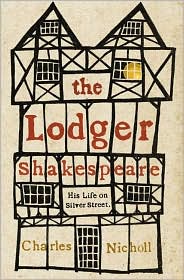
Book Review: The Lodger Shakespeare

The Lodger Shakespeare: His Life on Silver Street
Charles Nicholl
Viking Penguin, New York (2008 -- American edition)

I doff my proverbial cap to any scholar who has to rely upon pre-19th Century English records as his primary sources. The vagaries in spelling alone twist your eyeballs inside-out (not to mention the inconsistent data and the tendency of fires to destroy everything every few years). And, if that scholar happens also to be writing in a biographical way of William Shakespeare, he has my respect two-fold. Infuriating Will lurks in the shadows of history, confounding those who would extract him from his enigmatic repose. So, many books about the Bard that tend toward the biographical, rather than literary, are long on speculation and extrapolation, short on facts and corroboration.

But, that does not mean they cannot be a lot of fun.

Charles Nicholl certainly has a lot of fun, it seems, coaxing out a vivid and entertaining tale of the people and situations that surrounded Shakespeare in the two years when history can actually pinpoint his lodgings. The bare facts are as follows: In 1612, William Shakespeare gave testimony and signed a deposition at the Court of Requests in Westminster. The case was a family dispute brought by the son-in-law of Mr. Mountjoy -- a man who had let a room to Shakespeare nearly ten years before. The son-in-law, Mr. Bellot, claimed that Mountjoy had promised to pay him a dowry of £60 when he married Mountjoy's daughter in 1604. Shakespeare gave evidence that, as he was living in the Mountjoy house on Silver Street at that time (from 1603-1605), he did remember that a dowry was promised, but could not recall the sum mentioned. Then, he signed his name -- the short way: Willm Shaks -- and that was that.

But, since this is one of the rare glimpses of the man who was, inarguably, England's greatest playwright, that could not possibly be left at that. In The Lodger Shakespeare, Nicholl takes this gossamer court account and spins from it a narrative equal parts concrete and fancy. The Mountjoys, French Huguenot immigrants and tradesmen specializing in wigs and elaborate hair adornments ('tiremaking'), certainly got around, and Nicholl found traces of them all over surviving records of the era. He has also found intriguing little bits on other players in the life of the Bard, and he leaves no stone unturned in connecting the people, places and interactions of this widespread group into a web that rests lightly on the estimable shoulders of Shakespeare.

Really, I don't know how he managed to keep his wits about him while doing the research for this book. I suspect that either an abiding love of Shakespeare or massive doses of Advil got him through. 16th and 17th Century handwriting is almost indecipherable -- and this is from clerks, ministers and other learned men; you can only imagine what the script of the barely literate was like. The spelling is a thing of wild beauty and utter incomprehensibility -- they spelled words as they sounded to the speaker; and spelling varied with regional accents. The first plate in the book's illustrations is the deposition, featuring the famous signature. Charles and Hulda Wallace, who discovered these papers in 1909, must have had thrice the collective patience of Job even to have found this historical treasure. I'm sure that I would have given up looking at wretched, yellowed manuscripts and gone off to drink long before I unearthed the precious document.

So, when I think of Charles Nicholl bending his head over page after page of parish registries, ancient journals, and royal records of payment, I am grateful on two accounts. The first is that the records survive at all -- for this was a fascinating era. The second is that he did it, not I, and that he so kindly recorded his findings for me to enjoy leisurely in bed with a cup of tea. Excellent!

In The Lodger Shakespeare, Will does not dominate the action -- because we have no real insight into his extra-theatrical doings -- but he is the center. It is like a Six Degrees of William Shakespeare adventure. People march through the scenes -- the Mountjoys, the Bellots, the irritable and unstable George Wilkins, fallen women, debauched men, quacks and royalty -- and their lives only really matter now because they may just have come into contact with the Man from Avon. And yet, their lives mattered very much to them at the time. Nicholl mines their stories and rounds out their characters with an eye for the colorful supposition. Was Marie Mountjoy's dead infant son a bastard? Were Stephen and Mary Bellot ever really in love? Could Christopher Mountjoy have really despised his daughter that much? Was Sir William Devenant actually Shakespeare's illegitimate son? Was George Wilkins career with The King's Men cut short by Shakespeare? And did Dr. Forman's methods ever work for anybody?

Most of all: How did these places where Shakespeare dwelt and these people with whom he interacted affect his work? Did they inspire and amuse him? Repulse and annoy him? Did their dramas ever find their ways onto the stage at The Globe? We'll never know, of course. Nicholl knows throughout that this is a type of game that writer and reader have agreed to play. We do not know anything more about the Man or the Author Shakespeare at the end of this book. But we do know more about his surroundings and his interactions and the world in which he lived. And that is a gift and the very joy of this book.

Bill Bryson wrote in his brief, witty, and free-wheeling biography, Shakespeare: The World as Stage (HarperCollins, 2007), "It is diverting to imagine a tired and no doubt overstressed William Shakespeare trying to write Measure for Measure or Othello ( both probably written [in 1604]) in an upstairs room over a background din of family arguments" (pp 137-138). Of course, Bryson is right. It is fun to imagine all the things that Shakespeare saw and heard and what he must have thought of them -- with that unparalleled ability of his to capture the comedy and tragedy of the human condition. Nicholl has given us more than merely the Bellot-Mountjoy squabble to contemplate. He has given us a vivid snapshot of early Jacobean London, with just enough Shakespeare in it to keep you awake nights wondering just what that keen eye and ready wit made of the scenes around him. That alone makes this volume a worthy addition to the ever-growing body of work that seeks out the elusive Bard.

Tuesday, June 03, 2008

Marriage Changes Everything (Or At Least Some Things)

Jason and I have been married almost nine years. As we were both teenagers when we met, we have spent all of our adult lives as a couple. A couple of whats? Well, mostly a couple of goofballs.

After our first date (March 2. 1994), I called my father and told him that I had just been out with the man I was going to marry. It was a gutsy declaration for a 19-year-old, and my father, not unreasonably, scoffed at it. A year and a half later, I joyously became a Christian. Four years after that, Jason and I were married in a church where, to quote my dad, "they talked about Jesus, and all that."

It's been a great journey, and I know it will continue thus. A co-worker of mine once asked if I had prayed for Jason before we met. I answered that, as I was not then a Christian, praying for my future husband never entered my mind. But, God is gracious enough to give gifts that we would not think of requesting, and my husband has been one of His greatest acts of grace in my life.

But, I didn't start this post to get all mushy. I mostly wanted to establish that Jason and I have been influencing each other for about a billion and a half years (that's reckoned in Hollywood Marriage Time -- HMT) and make some observations about that sphere of influence. Ta-da!

It's kind of funny how the less-than-exceptional qualities of your spouse are the easiest to pick up. Basic Newtonian physics tells us that it is easier to bring something down a level, than it is to raise it up. For instance, I have had a very hooliganish effect on Jason's sleeping patterns. He is now just as much of a late night degenerate as I ever was -- maybe worse. I know he'd say that I have negatively affected his spending habits, too. I'd like to think that I have just helped him to embrace Matthew 6:24-27. He is now a lot more laissez-faire about money than he used to be -- although, compared to me, he is a budget hawk. (Thank God! We'd be out on the streets if I handled the finances.) In the "positives" column, he has certainly picked up something of my more relaxed nature and even-temperedness -- again, though, compared to me, he is yet a smouldering pillar of passion.

Under Jason's tutelage, I have become a bonafide baseball fan. He has yet to convince me completely about football (unless the Steelers are playing), and NASCAR is a hopeless case, because it repulses every sensibility I possess. He has entirely reversed my opinion about the necessity of household pets. I now see them more as messy inconveniences than faithful friends. My poor, old cat will not be replaced when he crosses the rainbow bridge. And I find the strange, childless Dog People of Seattle even less comprehensible than I did before. My brief, but energetic, bursts of money-managing are attributable entirely to him. Maybe one day one of them will last long enough to wipe the frown off of his face when he pays our monthly bills. And he has severed my alliance to Laura Scudder's Peanut Butter -- I am a happy Skippy girl, now.

Most edifying, though, are the ways we have grown together -- mostly in our walks of faith. My heart breaks for men and women who have to make those walks without holding the hands of their spouses. Jason was an apathetic Catholic and I pretty much a heathen when we met, but it did not take long after my conversion for Jason to start attending church with me. There was no great leap of belief for him, since he had never not believed on Jesus, but it has been a joy to see his faith strengthened and renewed as mine has blossomed and grown.

Most importantly, we have been each other's best friend since day one. We have leaned on each other, bolstered each other, comforted each other, encouraged each other, and neglected the world, rather than each other. We have had more nights filled with screams of laughter echoing at 3 AM than really is lawful in this year of Our Lord. I know that one of the ways that men and women are to become one in marriage is through children. But surely the other is in the day-to-day adventure of cohabitation. The quibbles and giggles, the compromises and acceptance, the routines and the unexpected jolts, the darkness and light, the good and bad -- it all strips away the non-essentials and makes you whole. That is, you are entirely yourself once you are half of the other person designed for you.

It's a weird, cool, scary, awesome trip.

Monday, June 02, 2008

No Gauntlet Was Thrown Down, But I Have Been Inspired!

I noticed over at Conversant Life that Carolyn Arends has been blogging quite frequently -- in fact, every day since May 28. OK, I know that's only five days, but, really, that's a lot.

So, I found out via her newsblog that she has decided to do a 30-day marathon of blogging at least one post per day. That's pretty cool -- especially considering all the other things she does.

I have been inspired by such noble inclinations. My blogging patterns have been noticably balding since the glory days of 2005. I know that, if you're reading this now, you most likely haven't been here in a long while. I haven't been here in many spans of long whiles either, nor have I been keeping up with my blog roll reading as I'd like.

So here's my goal: (insert drum roll or trumpet flourish here -- it's up to you!) In June, I will blog something here every day. Plus, I will catch up on my fellow bloggers' compositions and comment as I am led (that sounded very churchish). 'Cuz, y'know, I miss what we had going here in 2005, and I want it back, baby!

So, I already lost out on June 1; but, behold, two posts for June 2! Huzzah!

Book Review: Wrestling With Angels


Harvest House Publishers, Eugene, OR (2008)
(Formerly: Living the Questions: Making Sense of the Mess and Mystery of Life; Harvest House (2000))

As you can imagine, I read Living the Questions with great eagerness when it was released in 2000. Since the world o' blogs was either not yet invented by geniuses, or else simply not yet discovered by me (my blog history is more than fuzzy here) in that last year of the Twentieth Century,* I had no place to express my thoughts, inclinations, revelations, exuberations, meditations, and so on, other than the Staff Recommendations section at B&N.** There I recommended with all my heart -- squeezing as much onto the insufficiently sized shelf-talker (you retail folks are nodding right now) as I possibly could to cajole and command the unwitting consumer into purchasing this gem of a title. It worked pretty well. At my B&N, we sold over 100 copies of this volume from an overly talented, but under-publicized Canadian singer/songwriter, making Living the Questions a store bestseller and garnering it a place of honor on our year-end round-up table.

As much as my vanity would like to presume that it was my powerful, albeit curtailed, persuasive abilities that drew out the purchases, I cannot help but acknowledge that it was a pen other than mine that held the magic. Carolyn's book is a stand-out in every way. The writing is warm, witty and personable; the themes are big, important, engrossing; the stories are memorable, illustrative and redemptive. It is a joy.

I was reminded of that joy when I recently re-read LTQ in its new incarnation, Wrestling With Angels: Adventures in Faith and Doubt. Other than a spiffy new title and cover, as well as a characteristically Carolyn introduction, nothing seems to have changed from the original; which is good, because the original is so very good. I'm glad that no one at Harvest House was tempted to have Carolyn update it or expand it beyond the intro. If she has another book in her like this one, it deserves its own birthday party -- not a grafting onto its big sister's pages as some sort of conjoined nightmare. So, hurrah for that!

If I had been asked before I re-read this book what my favorites parts were, I would have immediately listed off the following stories: when Carolyn's dad sells his car ("The Bargain" p. 165); when Carolyn's mother fell into the fish pond ("The Fish Pond" p. 87); when Carolyn encountered the angry, swearing man at LAX with unexpected results ("The Donation" p. 183); and the heart-rending recounting of a stark and beautiful Christmas play ("Dreams of Kings and Carpenters" p. 193). And, in my most recent read-through, those chapters are still ones that make me laugh out loud, cry buckets, and ponder far into hours that I desperately need for sleep.

Yet, when I was reading WWA, I found myself wondering how I could have let such stories as "A Summer in the South" -- Carolyn's frightening, paralyzing journey of doubt and spiritual numbness -- and "The Journey Home" -- her startling, life-changing, gob-smacked by the hand of God realization that I AM is -- slip my mind? How did I mislay for so long the compartment of my brain that held "Forget-Me-Nots" -- Carolyn's heartfelt and beautiful paean of hope in the face of the travesty of Alzheimer's?*** And it's hard to imagine anyone who would not relate to the Josephian touch of "A Little Brother" -- or who would not wish to hang out with Carolyn's mother (like Larry Norman did) after reading that chapter's beautiful story of adoption (or "The Fish Pond" chapter, for that matter)?

In her new introduction, Carolyn writes of her difficulty in answering the inevitable question posed by interviewers and fans alike: "So, what's your book about?" Carolyn goes on to answer that question with her trademark humor, underscored by sincerity. She offers a few suggestions -- all of which are true, but somehow incomplete. Then she writes of the Jabbok River -- Jacob's real and her metaphorical meeting place where a fiercely tender God wrestles with believers, neither He nor they letting go, despite the breaking dawn. She writes:

Jacob has God in his arms, and God has Jacob in His. Of all the things Jacob could ask for -- strength to face his brother, healing from his pain, safety for his family -- he asks for a blessing. This is the part that makes me cry. He asks for a blessing. The love and acceptance of God, a chance to have something of His life. Jacob is willing to die for it. He's willing to live for it, too. (p. 20).

In her end analysis, her book is about wrestling with God -- about not being afraid to ask the questions that echo in eternity, answered only in a realm beyond human comprehension; about a tenacity of faith that will not let go without a blessing; about facing the fact that life is a mess and mystery, but God is beautiful and holy and draws us near to Him so that we can house His image fully.

Carolyn also writes in her introduction: I wish I could call up all the people who have read this book and ask them if they know what it's about. But I suspect that might be an unprecedented and slightly inappropriate approach. Also, I don't have most of their phone numbers. (p.12)

Well, here is one of the many reasons I find it so enchanting:

A book like Wrestling With Angels works because it is about the big stuff that gets hidden in the little stuff, and the little stuff that slowly, faithfully builds a believer. We know that life is not meant to be universally fair and fruitful and friendly and fortuitous in this fallen realm; but a life lived in the light of Christ is one that is open to the good, defiant against the evil, steeped in sweet fellowship, soaked in grace, abounding in compassion and good works, and alive with hope. But, on this side of the veil, despite our best efforts, it is also one awash in questions, mired in frustration, obscured by selfishness, choked with countless quibbles and shallow disputes among brethren that keep us from the fullness of the fellowship we desperately need. There is a black pit of aching that lives alongside the brightness of assurance. Ultimately, there is and will be reconciliation.

We can step out boldly in His name, because, though the shadows cloud our human perspective and the fog licks tauntingly at our feet, we stand on more than this faltering ground. When Carolyn shares her stories and the lessons she has extracted from them, she unerringly hits upon our common spiritual ground. We may not all be equipped by the Creator to be songwriters of exquisite caliber, or powerful and wise preachers, or valorous and intrepid African missionaries, or patient and kind teachers, or original and charming authors, but we all are gifted in some way and have a shared stake in humanity and a reason for being here. And we all have questions. And we all have doubts. And in the midst of those, we are blessed with faith. And it is quite the adventure.

*Yes, I was one of those annoying people who postponed millennial celebrations until 2001.
**Barnes & Noble
***Irony noted.

Monday, May 19, 2008

Travels with the Tiny Evangelist

We were on a glorious walk in the Mercer Slough with a homeschooling group earlier this month. It was one of the rare days this year that the Puget Sound has actually dared to dress in the garment of spring. We saw ducks galore, dragonflies, hawks, butterflies and the crown-jewel of the nature walk -- a great blue heron. And Sadie found a friend. Katie was an adorable four-year-old, game for playing and exploring, but not prone to talking too much. In other words, a perfect foil for my loquacious daughter. Her mom and I followed behind, enjoying their camaraderie and making chit-chat.

All was going well. Then, out of the blue, my daughter queried in a booming voice, "So, what's the deal? Are you people Christians, or what?"

My heart fell a few stories and lodged itself in my knees, which promptly went squishy. Not only had Sadie asked the million dollar forbidden question in the most brazen and indelicate manner possible, but that question was met by uncomfortable silence all around. Oh dear. What do I say?

Sadie, who is never easily put off, spoke up again. "We're Christians. We know that Jesus is the Lord. How about you? Do you know that Jesus is Lord?"

AAAAAARRRRGH!

I recovered my voice at last. "Sadie! That's not the right conversation to have right now. Why don't you and Katie see how far you can climb in that tree?" Luckily, the heaven-sent tree distracted Sister Sadie Semple McPherson from her revival meeting and the two girls scampered off.

Left alone with Katie's mom, I had two options: engage in a conversation about what just happened or pretend it never existed. Bold confessor of Christ that I am, I chose the latter. And I felt as wretched about that as I had felt embarrassed by Sadie's evangelism. What comes so easily -- if rather crudely -- for her is the most difficult subject in the world for me.

This was not the first time that Sadie's pointed questions and exuberant proclamations have brought the red to my cheek and the stammer to my voice. The last time she and I were in St. Louis visiting my parents, my father took us out to dinner. When Sadie and I said our quiet, unobtrusive grace over the food, it triggered a memory for my little exhorter. She looked across the table at her heathen ancestor and said, "Grandpa, why don't you and Nana believe that Jesus is the Lord -- that He died on a cross to save us from our sins?"

I wanted to crawl under the table.

My dad just laughed like the unrepentant pagan he is and said something to the effect that he was an old sinner and we should be glad that Nana (who is especially against Christianity) wasn't at dinner with us. I said, "Sadie! Don't bring up stuff like that over dinner!" Sadie piped down and ate some french fries, and the atmosphere of discomfort eventually dispelled. And yet, I felt wretched more from my own shortcomings than from Sadie's tactless inquiry.

She hears at church and at home that the most important, wonderful, joyous thing in the world is to know and love Jesus. And I believe it with all my heart. There is no greater gift than our reconciliation with the Holy King of Israel through the sacrifice of the Son's sinless blood. There is no greater hope than the hope we have in His resurrection and His promises. How strange it must seem to Sadie, then, that whenever she tries to express and share that good news, I immediately hush her up!

I fail miserably at the Great Commission every day. There are two reasons that I can think of -- and probably a few more that I don't want to admit. The first reason is that, as a former atheist (never a devout atheist, but more a resigned one), I can sort of imagine how annoying it must be to be bludgeoned with the Gospel when you're not at a place to hear it. Of course, this is where evangelistic tact comes in; planting the little seeds, adding a little fertilizer, pulling some weeds out are all steps that can be done by different believers working faithfully to bring in the Harvest -- then, when the time is right and the heart and mind are ready, it is the next worker who sees the reaping. I'm just mightily afraid that I'll be the one to add too much fertilizer. This is nonsense, of course. What an exaggerated sense of my own importance I must have to feel this way! As if the transformation of a soul could ever be sidelined by my clumsy overtures! When the Lord is working a miracle -- as the turning of any sinful heart inevitably is -- He is not about to let me mess it up. So, my first reason is obviously a paper tiger, and I need to get over myself.

The second reason may have a little more validity, but not much. Ever since I came to know the Truth, it has been such a holy, beautiful, living reality, that I have trouble talking about it. It is so real that it hurts me. Touching the perfection of the Creator does seem to cause pain in a way, doesn't it? Like when you see something in Nature that recalls the Garden, or a sweet, new baby that reminds us of the days before the Fall, or an act of human love that mirrors the Father's -- they all hurt. But it is a good pain, because it presses into our consciousness the fact that there is more in store than the ugliness, futility, and frivolity of the world -- that reconciliation has happened and its fruits are going to be even more palpable in eternity.

Since it hurts, I am afraid to talk about it -- especially to talk about it with someone who may ridicule and spurn the beauty. And yet, the very fact that it has transfigured my life so thoroughly that I cannot speak of it but tears and snot flow copiously could be the thing that makes a cynic stop and pay attention. Everyone created in His image wants to see His love working in a real way with real people; too often, all they see is a pre-packaged, nicely wrapped box of bland, happy religiosity. They really ought to come to my church -- where the "mess and mystery" is lived out daily and, if our pastor does not get choked up in the pulpit, it is a rare sermon, indeed. But, since I cannot bring everyone whom I encounter to my church, they need -- desperately -- to see it in me. Goodness, how I hate the idea of being that vulnerable! But, my Lord was vulnerable even to the point of death.

If Sadie can cultivate her enthusiasm for sharing the Gospel without learning to kowtow to the world's wisdom that makes topics like that verboten, she will be a strong witness for the Lord. After each of the two incidents I mentioned, I made an effort to instill upon Sadie a sense of propriety and timing, but she just looked at me with those big, deep eyes that seem so often to see things beyond the ken of a child of five and said, "But, Mom, people need to know that Jesus is Lord. They need to know it." And how can I argue with that? Maybe, in these late days, a few ruffled feathers, trod upon toes, and uncomfortable silences are a small price to pay for sharing with people the information that they are dying without: Jesus is Lord.

Thursday, April 17, 2008

"It Is A Monstrous Thing . . ."


Sometimes I lament that I do not have a popular blog; that is, I rarely do, except when I have something on hand about which I would love to spark a wild and free-ranging conversation. So, I'm going to go ahead and write about what I wish, and maybe someone or somefew who come along will be inspired to join in. (Somehow I have managed to include far too many "some--" words into one wee paragraph.)

I have been desperately trying to write a summer book recommendation of G.K. Chesterton's The Ball and the Cross, and I am already woefully late. I’ve missed the deadline, but never fear. Now it has turned into more of a quest to expand my understanding and appreciation of this great and puzzling novel, rather than a goal merely to get it published. I am exceedingly discomfited and ever-more mesmerized by this strange tale the more I delve into it.

This is the premise, for those who have never read the book: James Turnbull is a rationalist and atheist who runs a newspaper, properly -- yet unimaginatively -- titled, The Atheist, across the street from St. Paul's Cathedral. Here is no passive blasphemer: Mr. Turnbull is on a mission -- not from God, but against Him and all the irrationality and superstition he associates with belief in the Deity. The only trouble is, he has provoked absolutely no notice from the nominally Christian world of Edwardian London. Day after day he says "the worst thing that could be said; and it seemed accepted and ignored like the ordinary second best of the politicians."

One day, James Turnbull's world opens up; "at last a man came by who treated [his] secularist shop with a real respect and seriousness. He was a young man in grey plaid, and he smashed the window." Evan MacIan has journeyed down from the highlands of Scotland and found a world as alien to him as a distant planet. His sheltered, fervently Catholic upbringing has left him permanently out of step with the values of London, which he only realizes when he reads an article posted by Mr. Turnbull. Upon reading the assertions that the Virgin Birth is merely a Syriac expression of more ancient Mesopotamian myth, MacIan rises up with all the valor and outrage that a man of honor feels upon witnessing desecration. Once he has smashed Turnbull’s window, he challenges the editor to a duel. James Turnbull is delighted.

British law is not so well-pleased. The two are hauled before a judge who tsk-tsks MacIan’s sudden violence and fines him ten pounds. To the magistrate, this display of passion is in outrageous bad taste. Don’t you know, he chides MacIan, “the most religious people are not those who talk about it,” and certainly not those who will fight for it. Turnbull watches the proceedings and approaches MacIan after the hearing. “Well, sir,” said the editor of The Atheist, “Where is the fight to be? Name the field, sir.” And they are on.

The rest of the novel chronicles the attempts of MacIan and Turnbull to fight their duel with honor, while the entire brigade of British police and persons of various philosophical bents thwart them. The conflict in the story comes, therefore, not so much from the argument between the atheist and the Catholic, but more from a determinedly indifferent world “that has grown too cold to tolerate men who not only believe in something, but believe in it enough to fight for it,” as Sean P. Dailey wrote in the excellent introduction to the Barnes & Noble edition.

All this is a lead up to the passage that has been haunting me and that I want to open up for discussion. Early in their adventures, the runaway duelists encounter a man whom Chesterton calls “The Peacemaker.” This expansive personage tries to convince the heroes not to fight. He quotes Tolstoy: “Tolstoy has shown that violence merely breeds violence in the person towards whom it is used, whereas Love on the other hand, breeds Love. So, you see how I am placed. I am reduced to use Love in order to stop you. I am obliged to use love.” MacIan and Turnbull are not moved by this entreaty and prepare to engage. But The Peacemaker is not done. “I must and will stop this shocking crime,” he cries, crimson in the face. “It is against all modern ideas. It is against the principle of love. How do you, sir,” addressing MacIan, “who pretend to be Christian . . .”

MacIan’s interruption is the money quote:

MacIan turned upon him with a white face and bitter lip. “Sir,” he said, “talk about the principle of love as much as you like. You seem to me colder than a lump of stone; but I am willing to believe that you may at sometime have loved a cat, or a dog, or a child. When you were a baby, I suppose you loved your mother. Talk about love, then, until the world is sick of the word. But don’t you talk about Christianity. Don’t you dare say one word, white or black, about it. Christianity is, as far as you are concerned, a horrible mystery. Keep clear of it, keep silent upon it, as you would upon an abomination. It is a thing that has made men slay and torture each other; and you will never know why. It is a thing that has made men do evil that good might come; and you will never understand the evil, let alone the good. Christianity is a thing that could only make you vomit, till you are other than you are. I would not justify it to you, even if I could. Hate it, in God’s name, as Turnbull does, who is a man. It is a monstrous thing, for which men die. And if you will stand here and talk about love for another ten minutes it is very probable that you will see a man die for it.”

When I read this, my heart lunged in my chest. Chesterton pulled the shredded remains of the veil back in a different way for me. Leave it to Gilbert Keith to present a new facet of paradox in Christian faith; flinging it out with jolly little concern for this believer’s good night’s rest. Because I think, despite the general white-washing of many generations – a striving to push Christianity into a neat and tidy box of love and good deeds – every believer knows deep within that there is something horribly mysterious about the God who put on flesh to dwell with us, ultimately allowing His flesh to be pierced and His blood poured to make us holy. To have that God come so close to us that His spirit permeates our beings until we are not as we were, is as uncomfortable as it is comforting. To have our God go to such lengths for our holiness pushes upon us an obligation really to be holy. And the call to holiness is a monstrous thing, because it is uncompromising.

It seems that the big problem is defining Christian love. What does love mean, in the sense that Jesus wants us to live? Is it a cushy, feel-good triteness where nothing is demanded except tolerance and pacifism? (Another Chesterton quote comes to mind: Tolerance is the virtue of the man without convictions.) When the world complains about the Church, it complains that we do not live the kind of love that the world expects – a love that The Peacemaker espouses. When the Church complains about itself, it is often the opposite – we regret and bemoan the softness and compromise that has crept into many fellowships. I cannot help but think that holiness is the polar opposite of tolerance. But, does that make it the opposite of love? Or is tolerance the real opposite of love – e.g. a tolerance of a man’s inability to swim while watching him drown?
So, I do not know quite what to make of this passage. Does anyone else have any input?

Friday, April 11, 2008

And This Be Our Motto: "In God Is Our Trust."

I was weeping over a songbook. Shoulders shaking, tears dripping, snot flowing -- a big, indulgent cry-fest, all over a songbook. And, I still cannot decide whether the tears were more of joy or heartache; more of hope or despair. I had been reading the lyrics to patriotic songs, and I did not know whether to be more uplifted by these beautiful songs about my beloved country, or more depressed that some of these inspiring lyrics will so rarely be taught to the future generations. So, I wept.

It all started with "The Star-Spangled Banner." How many know the final verse?

Oh, thus be it ever when freemen shall stand
Between their loved homes and the war's desolation.
Blest with vict'try and peace, may the heav'n-rescued land
Praise the Pow'r that hath made and preserved us a nation.
Then conquer we must, when our cause it is just,
And this be our motto, "In God is our trust."
And the Star-Spangled Banner in triumph shall wave,
O'er the land of the free and the home of the brave.

Can you imagine the uproar if this verse were sung in public? How about at the next baseball game? No child in any public school will ever be taught this verse. Heck, I doubt that even the first verse is taught anymore.

When I was a girl, I remember some people saying that our national anthem should be replaced by "America the Beautiful," which is a song more in the vocal range of your average American singer. Of course, it never could be our national anthem nowadays, because the entire song is a prayer.

We all know the first verse:

Oh beautiful for spacious skies,
For amber waves of grain,
For purple mountain majesties
Above the fruited plain.
America, America,
God shed His grace on thee,
And crown thy good with brotherhood,
From sea to shining sea.

But, how many know verses two, three, and four?

Oh beautiful for pilgrim feet,
Whose stern impassioned stress,
A thoroughfare for freedom beat,
Across the wilderness.
America, America
God mend thine ev'ry flaw,
Confirm thy soul in self-control,
Thy liberty in law.

Oh beautiful for heroes proved
In liberating strife,
Who more than self their country loved
And mercy more than life.
America, America
May God thy gold refine,
Till all success be nobleness,
And ev'ry gain divine.

Oh beautiful for patriot dream,
That sees beyond the years,
Thine alabaster cities gleam,
Undimmed by human tears.
America, America
God shed His grace on thee,
And crown thy good with brotherhood
From sea to shining sea.

The kicker for me, though, was when I turned to "My Country 'Tis of Thee," which has always been my favorite patriotic song. This last verse reduces me to tears, even thinking about it. The songwriter, Samuel Francis Smith, having expressed the glories of this great land in three verses, turns his praise to the One from whom all these great blessings flowed:

Our fathers' God to Thee,
Author of liberty,
To Thee we sing.
Long may our land be bright
With freedom's holy light,
Protect us by Thy might,
Great God our King.

Reading these stirring words, and then reflecting on how few Americans would still proclaim these values is an exercise in conflicting emotions. I'm so proud and glad and filled with awe by what my country has been, what it was founded to be, and what it struggled -- with both ideas and blood -- to become. I am terrified by where it is going.

How much longer will our land be bright with freedom's holy light? How much longer will God sustain this rebellious nation?

Monday, January 07, 2008

"Um, Michelle Tumes . . ."

Well, 2007 would have been a worthwhile year for the concert experiences alone. I got to see Michelle Tumes in concert twice, which is remarkable, considering how little she tours. The first time was in, I think, August. She played at a church up north from here. Sadie and I did the girls' night thing, and it was a special time. Sadie, surprisingly, really likes Michelle Tumes's music -- I say surprisingly only because it is so complex, and the lyrics are a bit abstract. After that concert, while I was waiting in line to get some CDs signed, Sadie had discovered a little playmate and was busy imagining with her, so she missed meeting Michelle. When I met Ms. Tumes, I said something goofy (like I always seem to when meeting an artist I greatly admire).

"I wish my daughter would come over here to meet you," I clumsily spluttered, "You're her favorite Australian, after Dorothy the Dinosaur."

"Oh, the cartoon," Michelle laughed.

I mentioned how much I loved her music. Michelle then sprang on me this question:

"May I ask what you love about it?" She was in earnest.

"I guess," I mentally flailed about, "That it is because of the beautiful poetry of your lyrics."

"But do they really speak to you meaningfully? I don't want them to be merely pretty words."

"Oh goodness, yes! They really move me. They really mean so much to me." I was grasping at banal phrases and desperately trying to collect my thoughts enough to be coherent. I wished I'd been prepped for this examination. Mercifully, Michelle let me off the hook at this point with a sincere, "Thank you!"

I collected my daughter, and we began the drive home. I told Sadie about my conversation with Michelle and how she said that Dorothy the Dinosaur was a cartoon. That infuriated Sadie.

"Dorothy is not a cartoon! She is a real dinosaur who lives in Australia!"

I replied, "OK. You make sure to let Michelle Tumes know that next time you see her."

I did not expect that we'd be seeing her again any time soon.

Lo and behold, though, a church in Salem, OR booked Michelle Tumes for a Christmas concert on December 15. I couldn't let the chance to see one of my favorite musical artists pass by, so we packed the whole family into the CR-V and headed south.

I want to say a little here about Michelle Tumes's Christmas EP, Christmas is Here, she released last month. There are only five songs, though a full-length album is in the works for 2008. These five songs are magnificent. I have not been so gratified by Christmas music since Carolyn Arends graced the world and made the season merrier by releasing Christmas: An Irrational Season in 2004. These songs are uniformly exquisite, though I think that my favorite (were I forced to choose) would be the imaginative combination of "Ode to Joy/Angels We Have Heard on High." Though, as I type that, I'm thinking how much I also love "Christmas is Here/Carol of the Bells." And who would have thought that an Australian could have penned such a wintry homage to the northern hemisphere's Christmas traditions as "Merry Christmas"? In any event, should we judge by these temptations, the full-length album will be a treasure, indeed.

If I thought that Sadie would have forgotten the slight to Dorothy in the intervening months, I was sorely mistaken. After a glorious concert, Michelle was again out in the foyer, signing CDs and chatting with her fans. (How musical artists can do this after expending so much of themselves on stage is a measure of grace beyond my comprehension. I guess that is why so many of them, once they reach a certain level of fame, no longer make appearances before the hoi polloi.) Again, I had CDs to get signed, so I waited in line. Sadie had no playmate this time, so she waited with me. When my turn came, I thanked Michelle Tumes and asked her to sign my CDs, and Sadie saw her opportunity to school Michelle about the identity of certain dancing green dinosaurs with yellow spots.

A little pipping voice suddenly said, "Um, Michelle Tumes! Michelle Tumes!"

Michelle looked down into my daughter's stern little face. "Yes?"

"I want you to know that Dorothy the Dinosaur is not a cartoon. She is a real person, just like you!"

The hall was noisy and crowded. Michelle looked at me perplexedly. "I'm sorry, but I couldn't hear her."

I did not want to go into the whole story, partially out of respect for those waiting behind me in line, and partially not to burden Ms. Tumes, so I condensed Sadie's sentiments into, "Oh, she's just sharing how much she likes Dorothy the Dinosaur from The Wiggles."

Michelle laughed. "Oh, the cartoon!"

A strangled moan of frustration came from Sadie's throat. I bent down and whispered savagely in her ear, "Just let it go, Sadie."

Surprisingly, she did. She gave Michelle Tumes a big hug. Carolyn Arends is used to getting pounced on by Sadie (and maybe by other children of her fans), but Michelle Tumes was caught off guard. "Your daughter's very friendly," she observed bemusedly.

"Yes," I sighed in acknowledgement.

"Did you raise her to be that way? Or has she always been like that?"

"Oh, she's always been this way . . ." My voice trailed off. It's been a struggle to teach Sadie propriety and personal space issues, and I'm a little embarrassed by her easy way with strangers.

"I think it's wonderful," Michelle said.

And, maybe it is. For a fundamentally shy person like myself, it certainly is a wonder how I could have produced such an open-hearted child. But, I once heard a quote that the opposite of love is self-consciousness. So, Sadie is really living a special kind of love, because she is the least self-conscious person I know.

Anyway, the two concerts were incredibly special times. I hope that Michelle Tumes finds more and more opportunities to tour, because her music is a rare blessing. If she ever comes within a few hours of where you live, dear reader, please seek her out. You will not be disappointed. Just don't bring up Dorothy the Dinosaur. Trust me on that.

Friday, November 30, 2007

Rooting for the American Peso

I just got a new laptop computer (Sony Vaio) that runs Microsoft Vista. (I looked at Mac, but Mac is just too flipping weird.) Anyway, the features of Vista that I'm really digging most are the desktop gadgets you can put up. Currently, I have a clock (the flower clock, because it is way girly-girl), weather reports for Renton, WA, St. Louis, MO, Sioux Falls, SD, and Dublin, IRE, and the currency converter, which continually updates me on the worth of the U.S. dollar to the Canadian dollar.

I hear tell that our friends to the North have begun referring to our currency as the American peso. Oooh, that hurts! I remember back in 2002, when Jason and I went up to Victoria, BC for a weekend getaway, one U.S. dollar bought around 1.30 Canadian dollars. We lived like king and queen that weekend, ordering room service in our swanky hotel. Those days are sadly -- hopefully temporarily -- gone, as, currently, the American dollar is valued below the Canadian same.

As we are expecting some superb Canadian musical artists at our church next weekend, I am really keeping an eye on this currency converter. Two nights ago, 1 U.S. dollar bought .987 Canadian dollars. Yesterday, it was up to .998. This morning it is .999. One more thousandth, and we are at least back on par with our neighbours. Come on, dollar, you can do it! Get revalued! Up that worth! I'd like to see it back up above the Canadian dollar in time for the concert next weekend, because these particular Canadians are not at all shy about teasing us(with gentle love) as much as they can. We've already tipped a canoe up north, thus showing our American ineptitude with slender watercraft; and we were shown up as not knowing "Oh Canada!" when all the Canadians sang a lovely a cappella version of "The Star-Spangled Banner" last summer, so the last thing we need to be gibed about is our currency.

Let's all band together and root for the American peso!

***UPDATE***
As of 3:28 PM (PST), the currency converter is showing that $1 U.S. will buy you $1.001 CAN!! Whoo-hoo! Now, we just need to keep this up until after December 9 to stave off any "American peso" comments I might personally receive as part of good-natured cross-cultural ribbing from my Canadian brothers and sisters.

Monday, November 19, 2007

Too Good For The Likes of Me

Do you have any friends who are too good for you? Unfortunately, I think all my friends are. I have been dubiously blessed with the most thoughtful, inspiring, gifted, talented, delightful, and generous group of friends ever to have been assembled on this earthly plane. Oh, and they all seem to be endowed with that decorating and craft-making gene I sorely lack. And they do it all with such subtlty and quietness and finesse, that my sad attempts to return their abundance always feel so lumbering and clumsy. I feel like such a schmoo.

Take my friend, Kadie, for instance. I just finished writing a thank-you card to her for a lovely and thoughtful gift that she gave me for my birthday. Behold! This gift was exquisitely wrapped and carefully selected so as to maximize fully my pleasure in receiving it. And she wrote a card, too, that was as expressive in art as it was generous in nature.

Or, take Sabina. Here's another one who makes the very wrapping of a present into a work of artistic merit. She flipping made me a necklace for my birthday. She made me a necklace! It is gorgeous. How in the world do you equal that? How can you, if you are such a boob that even an Oriental Trading Company craft kit exasperates your meager abilities, ever hope to give something as meaningful and unique? You cannot. You simply fall back and gnash your teeth and murmur against the God who put such wonderful people in your life; and then accept it with gratitude.

Of course, nothing is coincidental. God put these lovely women into my life for many reasons, surely. But one of those must have been to hammer home into this stubborn skull of mine the meaning of grace. Now, every day, I have constant reminders about me of gifts that I do not deserve and can never hope to repay. And what greater gift do I have, ultimately, than the one given to me on the Cross by my Redeemer? Who is the original Creator of beautiful gifts I can never attempt to equal; Who gives with a heart free of "keeping score" and seeking reciprocation? And what else can I do but accept it with gratitude and tears of joy?

Thank you to my gifted and giving cadre of friends who are living, breathing examples of the grace of God in my life. You have blessed me beyond belief, and He has blessed me with belief, and my heart overflows with the wonder of it all.

Feed The Lake


Some of the most thoughtful artists and best music gathered, for your convenience, at one site on the world wide web: Feed the Lake
(Soon to include, as well, inspiring books by exceptional authors.)


Friday, November 09, 2007

Themes Revisited

So far, we have read Much Ado About Nothing, Richard III, Henry IV, Part One, Macbeth and Othello.

I was thinking just this morning -- about five minutes ago, really -- about the themes of these plays. Shakespeare had a wonderful way of revisiting themes with entirely different results.

For instance, take Much Ado and Othello. These two plays are written about trust and all of her cohorts -- vulnerability, suspicion, betrayal, redemption. Without a central theme of trust, these auxiliary themes would be meaningless. So, Shakespeare uses the theme in one play to create the lightest and most delightful of comedies (Much Ado) and then turns around and plays with the idea of trust in one of the most heartbreaking tragedies (Othello). Poor Desdemona could have used a Beatrice and Benedick pairing to come to her aid -- and, of course, the excellent sleuthing of Dogberry's men to discover the treacheries of Iago.

And then, as I've written of and posted before, Richard III and Macbeth were both portraits of ambition run amok -- the results of which in Richard were quite funny, while in Macbeth were absolutely horrifying. Richard's demons were all in his head, but they were a cheerfully depraved lot. Macbeth's demons were quite material -- whether witch or wife -- and their destructive force was most complete for they ravaged the man that was.

Now, Henry IV, Part I is in and of itself a thorough examination of the theme of honor. In the characters of Hotspur and Falstaff, Shakespeare has painted two opposite views of the importance and glory of honor. Prince Hal stands on the cusp of responsible adulthood and looks at the two -- his father's former favorite, the valiant, serious, and hot-tempered Hotspur and the jolly, drunken, thieving, but oh-so fun Falstaff. In the climactic battle scene, Hal wins his father's approval at last by coming to fight and then saving the King's life, and, eventually, he also kills the rebellious Hotspur; but has choice between honor and roguery really been made? For, when Falstaff counterfeits death to escape completing a duel and then later claims that he was the one to kill Hotspur, Prince Hal agrees to further his deception and falls back in with his disreputable buddy.

Ambition, honor, trust . . . I look forward to seeing what other themes Shakespeare will address as I finish the plays required for this class and continue to read the rest of his work on my own.

Thursday, November 01, 2007

Up to My Armpits in the Bard

I've been taking an on-line Shakespeare class, and the pace is extremely fast. We read a play a week, and write a paper bi-weekly (i.e., one half of the class writes on one play one week, the other half on the next play the next week). So far, we have read Much Ado About Nothing, Richard III, Henry IV, Part One, and Macbeth. Every one, with the exception of the Scottish play, has been an absolute pleasure, and I think my favorite to date is Richard III. I found it unremittingly hilarious.

Of course, since I am nothing if not obsessive when on the trail of a new, enriching study, I have been steeping myself in other Bard-ish delights when not reading his plays. I have read Bill Bryson's excellent and compact contribution to the Eminent Lives Series by Atlas Books, Shakespeare: The World as Stage. First of all, Mr. Bryson is a writer in whose work I almost always delight. Should you wish to treat yourself at some time and haven't yet done this, I want to encourage you to read any or all of A Walk in the Woods, In a Sunburned Country, or The Mother Tongue. Then, proceed on to his other books, and stop when you've enjoyed them all. But, do try to spread them out -- my father OD'd a year or two ago, and now he is uninterested in reading Bryson's Shakespeare bio. That is a shame, because it captures so succinctly the mystery and magic of the Man from Stratford (and, no, Bryson does not buy into any of the anti-Stratfordian garbage -- his final chapter of this book is dedicated to putting those loonies (one of whom was named "Looney") in their proper place: the fringes). Bill Bryson was a good fit for writing this biography, because his authorial voice is just about perfect: humorous, inquisitive, reflective, and not at all worshipful, mystical or academic. What a readable book! If you are interested in getting an overview of Shakespeare that you can read in about a day, you will, almost without one doubt, value this book.

Another Shakespeare book that I've just started and that promises to be a great ride is Becoming Shakespeare by Jack Lynch. This is a story of his afterlife -- that is, it tells the fascinating tale of how (from the introduction) "Shakespeare, the provincial playwright and theatre manager [turned into] Shakespeare, the universal bard at the heart of English culture." I'll be burning the itty-bitty booklight to finish this one.

A Shakespeare book that I picked up at the same time as the two previously mentioned but will return to B&N as soon as I can is Filthy Shakespeare by Pauline Kiernan. I had purchased it without looking it over thoroughly because a) rarely have I found a book with no redeeming qualities, b) I like a bawdy romp through Elizabethan and Jacobean sensibilities and protocols as much as the next girl, and c) how bad could it be? Well, it's pretty bad. Jason laughed at my disappointment and said, "What in the world did you expect from a book called Filthy Shakespeare?" A fair question, and the answer, I guess, is that I was expecting something more, well, subtle and witty and British than what simply reads as crude and artless attempt to shock. Ms. Kiernan is a Shakespeare scholar, and I certainly am not, but I just wasn't buying every sexual pun she cited. She couldn't convince me that other interchanges in the plays were quite so graphic as she claimed. Wm. Shakespeare was certainly sly and multi-layered, and not above heating things up on stage with naughty bits for the delight and appeasement of the groundlings, but, it's hard to imagine that he could have gotten anywhere with the plots had he spent so much time churning out the sex jokes. So, back to B&N it goes -- the first time in my life I have ever returned a book because I did not like it.

I'm off to read Othello!

I Respectfully Submit

Words mean things. Using language correctly is important, because how you use (or abuse) words can make or break your credibility in an argument. When lives are at stake, the cost of misuse is devastating.

I can only hope that Rep. Chris Smith's (R-NJ) words, delivered October 31, at a House Foreign Affairs Committee meeting, were transcribed incorrectly by the NRLC. He is too eloquent and valiant a persuader for the cause of human life to be saddled with this linguistic aberration:

I respectfully submit that the term "unsafe abortion" is the ultimate oxymoron.
All induced abortion, whether legal or illegal, is unsafe for the baby. It is also unsafe for the mother, who is at risk not only of physical injury, but also of long-term psychological damage including severe depression.


I think he must have said, "The term 'safe abortion' is the ultimate oxymoron." "Unsafe abortion" is a good example of redundancy or reiteration, but it is certainly not an oxymoron (unless you're one of the WeĂŻrd Sisters of NARAL).

Wednesday, October 31, 2007

Quote Archive

I'm going to use this post as a place to store for posterity all of my "Quote of the Weeks." Look for it later under "Musings from the Vault" on the sidebar. It will be updated weekly with every new quote. Thanks for stopping by!

March 14, 2005:
You can argue with your Maker, but you know that you just can't win - alrightokuhuhamen.
You can argue with your Maker, or know the joy of saying "yes" to Him - alrightokuhuhamen.
--Rich Mullins, "alrightokuhuhamen" from the album Songs.

March 21, 2005:
There are 10,000 books in my library, and it will keep growing until I die. This has exasperated my daughters, amused my friends, and baffled my accountant. If I had not picked up this habit in the library long ago, I would have more money in the bank today; I would not be richer.
--Pete Hamill, "D'Artagnan on Ninth Street: A Brooklyn Boy at the Library"

March 28, 2005:
Being gloomy is easier than being cheerful. Anybody can say "I've got cancer" and get a rise out of a crowd. But how many of us can do five minutes of good stand-up comedy?
And worrying is less work than doing something to fix the worry. This is especially true if we're careful to pick the biggest possible problems to worry about. Everybody wants to save the earth; nobody wants to help Mom do the dishes.
--P.J. O'Rourke, "Fashionable Worries" from All the Trouble in the World

April 4, 2005:
In the beginning the word was with God; all explanations, physical and moral, rested on the divine. And now for storytellers, even though those patterns of explanation are strictly human, the word has not lost a superhuman power to connect young and old, writer and reader; to connect us with each other and with the causes and consequences of what we do.
--Jill Patton Walsh

April 11, 2005:
If you love the language, the greatest thing you can do to ensure its survival is not to complain about bad usage but to pass your enthusiasm to a child. Find a child and read to him often the things you admire, not being afraid to read the classics.
--Robert Macneil, Wordstruck: A Memoir

April 18, 2005:

God has given to men all that is necessary for them to accomplish their destinies. He has provided a social form as well as a human form. And these social organs of humans are so constituted that they will develop themselves harmoniously in the clean air of liberty. Away, then, with the quacks and organizers! Away with their rings, chains, hooks and pincers! Away with their artificial systems! Away with the whims of governmental administrators, their socialized projects, their centralization, their tariffs, their government schools, their state religions, their free credit, their bank monopolies, their regulations, their restrictions, their equalization by taxation, and their pious moralizations!
And, now that the legislators and do-gooders have so futilely inflicted so many systems upon society, may they finally end where they should have begun: May they reject all systems, and try liberty; for liberty is an acknowledgment of faith in God and His works.
--Frederic Bastiat, the thrilling denouement of The Law

April 25, 2005:
People travel to wonder at the height of mountains, at the huge waves of the sea, at the long course of rivers, at the vast compass of the ocean, at the circular motion of the stars; and, yet, they pass by themselves without wondering.
--St. Augustine

May 2, 2005:
A tax-supported, compulsory educational system is the complete model of the totalitarian state...The most vindictive resentment may be expected from the pedagogic profession for any suggestion that they should be dislodged from their dictatorial position; it will be expressed mainly in epithets, such as "reactionary," at the mildest. Nevertheless, the question to put to any teacher moved to such indignation is: Do you think nobody would willingly entrust his children to you to pay you for teaching them? Why do you have to extort your fees and collect your pupils by compulsion?
--The Inimitable Isabel Paterson, "Our Japanized Educational System" from The God of the Machine (1943)

May 9, 2005:
Christianity has not been tried and found wanting; it has been found difficult and not tried.
--G.K. Chesterton, as quoted in When Bad Christians Happen to Good People by Dave Burchett
(I have also seen this quoted thus: The Christian ideal has not been tried and found wanting. It has been found difficult and left untried.)

May 16, 2005:

I believe in Christianity as I believe that the sun has risen: not only because I see it, but because by it I see everything else.
--C.S. Lewis, as quoted on Rebecca's blog, doxology.

May 23, 2005:
A sign above the main exit door of Hope Lutheran Church in Sioux Falls, SD:
You are entering the mission field. Go in peace. Serve the Lord.
To which I add: Amen.

May 30, 2005:
We are His daughters and sons. We are the colorful ones. We are the kids of the King. Rejoice in everything!
--Keith and Melody Green, "Stained Glass"

June 6, 2005:
"Miss Bingley," said [Darcy], "has given me credit for more than can be. The wisest and best of men, nay, the wisest and best of their actions, may be rendered ridiculous by a person whose first object in life is a joke."
"Certainly," replied Elizabeth --"there are such people, but I hope I am not one of them. I hope I never ridicule what is wise and good. Follies and nonsense, whims and inconsistencies do divert me, I own, and I laugh at them whenever I can."
--From Jane Austen's Pride and Prejudice, Volume I, Chapter XI

June 13, 2005:

The greatest gift a man can give his children is to love (and honor and respect and marry*) their mother.
--Anonymous (*words in parentheses my [Justine's] enhancement, because looooooving the person with whom you create a new life just ain't enough!)

June 20, 2005:
Keely Smith (singing): "Never treats me sweet and gentle the way that he should - I've got it bad and that ain't good . . ."
Louis Prima (cutting in): "I've got it good and that ain't bad!"
--From the recording of "I Got It Bad (And That Ain't Good)" (Ellington/Webster) on the new CD Live from Las Vegas: Louis Prima and Keely Smith

June 27, 2005:

A lot of American principle is contained in the two words: "Just don't." Much of the rest is encompassed by the suggestion of minding one's own business. The whole is summed up in the word "liberty."
--Isabel Paterson

July 4, 2005:

Away on vacation - the I.M.P. quote from above is excellent enough to suffice for two weeks, especially in the week that Americans celebrate our nation's birthday.

July 11, 2005:

I will be as harsh as truth and as uncompromising as justice. On this subject, I do not wish to think, or speak, or write with moderation. No! No! Tell a man whose house is on fire to give a moderate alarm; tell him to moderately rescue his wife from the hands of the ravisher; tell the mother to gradually extricate her babe from the fire into which it has fallen--but urge me not to use moderation in a cause like the present. I am in earnest--I will not equivocate--I will not excuse--I will not retreat a single inch--AND I WILL BE HEARD.
--William Lloyd Garrison, from the editorial of the inaugural issue of the abolitionist newspaper, The Liberator, published January 1, 1831. A wonderful rallying cry that applies today to the pro-life movement. May we be as stalwart in proclaiming the truth about abortion.

July 18, 2005:

Society in every state is a blessing, but government, even in its best state, is a necessary evil; in its worst state, an intolerable one.
--Thomas Paine, 1776

July 25, 2005:
We are battered and torn from the day we are born, in a world that has blinded and bound us.
Is it any surprise we don't open our eyes to the truth that's disguised all around us?
Like the secrets we keep, and don't know we're keeping, from before there was time, before there were lies.
Can we find You again, this far from the garden? Do we dare even try?
Do we dare pay attention - dare even mention - the mystery we find ourselves caught in?
And do we dare to remember all that we have forgotten?
--Carolyn Arends, "Do We Dare," Feel Free (1997)

August 1, 2005:
Democrats are . . . the party that says government can make you richer, smarter, taller and get the chickweed out of your lawn. Republicans are the party that says government doesn't work, and then they get elected and prove it.
--P.J. O'Rourke, from Parliament of Whores (1991)

August 8, 2005 - September 6, 2005:
Dead computer. No new quotes.

September 7, 2005:
She's my wife, so she stays home and takes care of me. Maybe that's the way you tell the ladies from the broads in this town.
--Humphrey Bogart of wife Lauren Bacall

September 13, 2005:

There's enough good in the worst of us and enough bad in the best of us, that it never behooves any of us to talk about the rest of us.
--Mary Chapman, mother of singer/songwriter Gary Chapman

October 3, 2005:

Right now it is a terrible thing to be a rugged individualist; but we don't know what else to be except a feeble nonentity.
--Isabel Paterson

October 11, 2005:

God does not have grandchildren.
--Gloria Grant

October 18, 2005:
Going to church doesn't make you a Christian any more than going to McDonald's makes you a hamburger.
--Keith Green

November 2, 2005:
Man hurts man -- time and time and time again. And we drown in the wake of our power -- Somebody tell me: Why?
--Amy Grant, from the song "Lead Me On"

November 10, 2005:

[The Politician] has developed a sixth sense
About living at the public's expense,
Because in private competition
He would encounter malnutrition.
. . .
Some politicians are Republican, some are Democratic,
And their feud is dramatic,
But except for the name
They are identically the same.
--Ogden Nash, the greatest poet of the 20th Century, from "The Politician"

November 18, 2005:
Chris: You know, there's a word for people who think that everyone is conspiring against them.
C.W.: I know: perceptive.
--From the movie, The Curse of the Jade Scorpion

December 1, 2005:

Do not be afraid! I bring you good news of great joy. It is for all the people. Today, in the Town of David a Savior has been born to you. He is Christ the Lord.
--Luke 2:10-11

December 30, 2005:
This will be my resolution: Every day is New Year's Day!
This could start a revolution: Every day is --
One more chance to start all over.
One more chance to change and grow, oh!
One more chance to grab a hold of grace and never let it go.
--Carolyn Arends, "New Year's Day" from the album Feel Free (1997)

January 6, 2006:
Some people seem to think that the answer to all of life's imperfections is to create a government agency to correct them. If that is your approach, then go straight to totalitarianism. Do not pass "Go." Do not collect $200.
--Thomas Sowell

January 20, 2006:

I tremble for my country when I reflect that God is just; that His justice cannot sleep forever.
--Thomas Jefferson

January 31, 2006:

The world is sleeping in the dark that the church just can't fight, 'cause it's asleep in the light. How can you be so dead when you've been so well fed? Jesus rose from the grave -- and you? You can't even get out of bed!
--Keith Green

February 20, 2006:

God is in control. We believe that His children will not be forsaken.
God is in control. We will choose to remember and never be shaken.
There is no power above or beside Him we know -- oh, God is in control.
--Twila Paris, "God is in Control"

March 6, 2006:
Judge not the Lord by feeble sense,
But trust Him for His grace;
Behind a frowning providence,
He hides a smiling face.
--William Cowper

March 16, 2006:
Almost all intellectuals profess to love humanity and to be working for its improvement and happiness. But it is the idea of humanity they love, rather than the actual individuals who compose it. They love humanity in general rather than men and women in particular. Loving humanity as an idea, they can then produce solutions as ideas. Therein lies the danger, for when people conflict with the solution as idea, they are first ignored or dismissed as unrepresentative; and then, when they continue to obstruct the idea, they are treated with growing hostility and categorized as enemies of humanity in general.
--Paul Johnson, "The Heartless Lovers of Humanity" (1989)

March 30, 2006:
Jesus is the God whom we can approach without pride and before whom we can humble ourselves without despair.
--Blaise Pascal

April 16, 2006:
Fundamentals of Christian tolerance and fellowship: In essentials, Unity. In non-essentials, Liberty. In all things, Charity.
--Anonymous, as quoted by Pastor Kevin Day, Calvary Chapel South

April 28, 2006:
All I ever have to be is what You've made me. Any more or less would be a step out of Your plan. As You daily recreate me help me always keep in mind: that I only have to do what I can find. And all I have to be -- all I ever have to be -- is what You've made me.
--Gary Chapman, "All I Have to Be"

May 15, 2006:
There's nothing so rude as a gift you don't use or a life that you choose not to live. 'Cause you're blessed to bless and the best of possessions is having something to give.
--Carolyn Arends, "Something to Give," from Pollyanna's Attic, 2006

June 12, 2006:

Be Like the BirdBe like the bird who,
Resting in his flight
On a twig too slight,
Feels it bend beneath him
Yet sings,
Knowing he has wings.
--Victor Hugo

June 29, 2006:
Picture to yourself, O fair young reader, a worldly, selfish, graceless, thankless, religionless old woman, writhing in pain and fear, and without her wig. Picture her to yourself, and ere you be old, learn to love and pray.
--William Makepeace Thackeray, Vanity Fair, "Miss Crawley at Home"

July 17, 2006:
The only people I truly envy are those who can play a musical instrument and those who can eat anything they want without gaining weight.
--Thomas Sowell

August 3, 2006:
You need to learn humility so that you can be awesome like me.
--My Humble Husband, Jason

September 5, 2006:
You can tell how good a kid's summer has been by counting up all their bruises and scrapes and cuts at the end of it.
--Mark Arends

September 15, 2006:
[I]n the long run the aggregate of decisions of individual businessmen, exercising individual judgment in a free economy, even if often mistaken, is less likely to do harm than the centralized decisions of a government; and certainly the harm is likely to be counteracted faster.
--John Cowperthwaite, British colonial officer, former governor of Hong Kong

October 12, 2006:
The therapeutic ethos of recent years has encouraged each of us to get every thought off our chest, lest we suffer from the ordeal of civility.
--Wall Street Journal Editorial, "Survivor Strategy," September 1, 2006

November 1, 2006:
[A]sk yourself whether you think God ought to have been content with the cruelty of cruel ages because they excelled in courgage or chastity. . . . From considering how the cruelty of our ancestors looks to us, you may get an inkling of how our softness, worldliness, and timidity would have looked to them, and hence how both must look to God.
--C.S. Lewis, from The Problem of Pain
December 27, 2006:
Joy, which was the small publicity of the pagan, is the gigantic secret of the Christian.
--G.K. Chesterton, from Orthodoxy

January 8, 2007:
From "A Brief for the Defense"If we deny our happiness, resist our satisfaction,we lessen the importance of their deprivation.We must risk delight. We can do without pleasure,but not delight. Not enjoyment. We must havethe stubbornness to accept our gladness in the ruthlessfurnace of this world. To make injustice the onlymeasure of our attention is to praise the Devil.
--Jack Gilbert, The New Yorker, November 15, 2004

February 12, 2007:
"Taking joy in life is a woman's best cosmetic."
--Rosalind Russell

March 30, 2007:"We are to regard existence as a raid or great adventure; it is to be judged, therefore, not by what calamities it encounters, but by what flag it follows and what high town it assaults. The most dangerous thing in the world is to be alive; one is always in danger of one's life. But anyone who shrinks from that is a traitor to the great scheme and experiment of being."
--G.K. Chesterton

June 4, 2007:"Make no little plans; they have no magic to stir men's blood and probably themselves will not be realized."
--Daniel H. Burnham, Chief Architect of the World's Columbian Exposition of 1893

August 2007:"All the world is my Jordan, someday I'm gonna cross. Ain't nobody gonna look and say my soul is lost. So I'll do my best; try to tell all the rest. And when the lion roars I'm gonna hide behind the cross. 'Cause it's the peace that passes all understanding in a world crazed with fear. They say that I am much too demanding to want a better place than here. "
--Jennifer Knapp, "Visions," from Kansas (1997)
November 19, 2007:"No matter if you're young or old, no matter if your story's told or if nobody knows your name, to Him it's all the same. He sold Himself to buy your life, and He wants to make it right. He sold Himself to buy your life, and He wants to make it right."
--"Say Once More," by Brian Carr and Gwen Moore, from Amy Grant's Never Alone (1980)
"Give thanks to the LORD; for He is good; His love endures forever."
--1 Chronicles 16:34


January 1, 2008:"For to us Trinitarians (if I may say it with reverence) -- to us God Himself is a society. It is indeed a fathomless mystery of theology . . . Suffice it to say here that this triple enigma is as comforting as wine and as open as an English fireside; that this thing that bewilders the intellect utterly quiets the heart. But out of the desert, from the dry places and the dreadful suns, come the cruel children of the lonely God; the real Unitarians who with scimitar in hand have laid waste the world. For it is not well for God to be alone."
--G.K. Chesterton, Orthodoxy, "The Romance of Orthodoxy"

March 27, 2008:"There are more things in heaven and earth, Horatio/Than are dreamt of in your philosophy."
--Hamlet, Act I, Scene 5

May 19, 2008:"Let mercy lead; let love be the strength in your legs. And in every footprint that you leave there'll be a drop of grace. If we can reach beyond the wisdom of this age into the foolishness of God, that foolishness will save those who believe. Although their foolish hearts may break they will find peace. And I'll meet you in that place where mercy leads."
--Rich Mullins and Beaker, "Let Mercy Lead," Brother's Keeper (1995)
June 5, 2008:"You are not long for this world; So do not long for this world. Have a good look around, Take joy where it's found, But you are not long for this world."
--Chris Jonat (The Clumsy Lovers), "Not Long for This World," Smart Kid (2005)
September 16, 2008:"Of a sane man there is only one safe definition. He is the man who can have tragedy in his heart and comedy in his head."
--G.K. Chesterton, "The Travelers in State," Tremendous Trifles
December 12, 2008:"If the shepherds were not wrong/If there was an angel song/If God planned this all along/Then everything changes at Christmas.
'Cause if that was the Savior's birth/That means God thought we were worth/Whatever it took to bring love down to earth/And everything changes at Christmas."
--Carolyn Arends, "Everything Changes at Christmas"

February 15, 2009:There are some refusals which, though they may be done what is called conscientiously, yet carry so much of their whole horror in the very act of them, that a man must in doing them not only harden but slightly corrupt his heart. One of them was the refusal of milk to young mothers when their husbands were in the field against us. Another is the refusal of fairy tales to children.
--G.K. Chesterton, Tremendous Trifles, "The Dragon's Grandmother"

January 2010:If . . . you are ever tempted to think that we modern Western Europeans cannot really be so very bad because we are, comparatively speaking, humane--if, in other words, you think God might be content with us on that ground--ask yourself whether you think God ought to have been content with the cruelty of past ages because they excelled in courage or chastity. You will see at once that this is an impossibility. From considering how the cruelty of our ancestors looks to us, you may get some inkling of how our softness, worldliness, and timidity would have looked to them, and hence how both must look to God.
--C.S. Lewis, The Problem of Pain, Chapter 4, "Human Wickedness"

April 2010:
She was not in the least afraid of loneliness, because she was not afraid of devils.  I think they were afraid of her.
--G.K. Chesterton, The Ball and the Cross, Chapter XI, "A Scandal in the Village"