They are dusty and musty, brittle and yellowed, distinctive in the way that old books printed in the old way are, each one a work of art and a testament to the never-ending record of human experience. They are Isabel Paterson's novels, first editions all, books printed in years ranging from 1916 to 1934. When I picked up the first one that I got from the Inter-Library Loan system and turned the delicate pages to the first chapter, I cried. And though I wish, in my heart of hearts, that these books were currently in circulation and available in editions that can be used and loved in my usual manner of perusal, I would not exchange my having had this opportunity to read the first editions, with all the care and circumspection that accompanies these fragile volumes, for anything. Just holding a book that the authoress herself might have looked upon is a treat both rare and breath-taking. It is humbling to be a belated part of this wonderful writer's reading audience.
Isabel Paterson seems to have had an inherent ability to understand the broad spectrum of humanity and find redeeming or sympathetic traits in characters who commit reprehensible acts. She paints in shades of gray, while still acknowleding the black and whites of moral absolutes. In her books, you will not find portraits of pure evil (a la Ellsworth Toohey), just portraits of the evil that comes from stupidity or imperception or lust for power. Usually, when evil comes, it comes from an institution and the representatives thereof and is against individuals. The protagonists in the novels that I have finished so far, would be fine if it weren't for the forces of society bearing down upon them. Isabel Paterson believed in the beauty and simplicity of being left alone.
For lovers of liberty, the spectrum of beloved fiction usually runs the short gamut from three Ayn Rand novels to a select group of sci-fi writers, with a smattering of children's literature and Rose Wilder Lane novels thrown in for good measure. If you're not fond of robots, outer-space, and hypothetical futuristic worlds and you've outgrown Ayn, you spend your fictional reading time searching for glimmers and smidgeons of libertarianism in the writings of others, usually only finding disappointment. If, however, you are fortunate enough to utilize your library's inter-library loan system, you will find a rich and fulfilling world in Isabel Paterson's novels. They are not overtly political or philosophical, and that is part of the reason that they are such great reads.
In The Magpie's Nest, which was the first of her novels that I read, the conflicts are internal - within the heroine, Hope. There are no villains, merely frustrations and fools that stand between the young woman becoming and the woman to be. Originally, I had a difficult time liking Hope, but as she grew up, she grew on me. It is a tribute to Paterson's skill that she could make a character change and develop in a way that is consistent with the character's age. This is a novel of youthful optimism with a few awkward plot devices, but, overall, it held my attention from start to finish.
The next novel I read is tied for my favorite with The Golden Vanity. The Fourth Queen is a rollicking and exciting historical romance, set in Elizabethan England. It starts with a sea-battle that is so enthralling you can practically taste the salt-water and blood mingling in a hearty stew of human desperation and valor as you read. The protagonists, Jack and Kate, are so likable and fresh; I fell in love with them in an instant. As the figure of absolute authority, Queen Elizabeth could have been made an easy target for villainy, but Paterson paints her with a sympathetic brush. I could not put this book down - loved it!!
The Road of the Gods is a very unusual historical romance, as its setting is neither courtly nor mannerly nor picturesque. It is set in the woods of ancient Germany, right before the Roman conquest of Europe. The pagan tribes with their customs and rites are given the barest background for the modern reader, as Paterson was less concerned with teaching about a culture lost in the mists of antiquity than in portraying the always relevant struggle of individuals to shape their destiny within the confines of society. This book was also fascinating, though the lovers were considerably less sympathetic than those in The Fourth Queen.
The Golden Vanity is a great novel. It is a time capsule, written to span a ten-year period - from five years before the stock market crash of 1929 to about five years into the Great Depression. What is so remarkable about this novel is that it was written contemporarily to the time it covers, yet the authoress has her eyes wide open. Perspective like this can usually only come some years removed from the time in which the events took place, but Isabel Paterson's keen intelligence and sound rationality bring a certain degree of completeness and remove to this look at "current events." The Golden Vanity is the intertwined stories of four women -three cousins, one dowager - who all live in New York City in the 1920's and 1930's. They are all very different in their personalities and approaches to the business of living, making a living and finding happiness. The theme of the novel seems to be the absence of men. Where did the men go? The two men we learn the most of are so very weak - one is a glib but unstable playwright, the kind of man you would invite to every cocktail party but never trust with your heart - one is an affable, gullible heir who squanders his affections on an undeserving woman and his money on undeserving causes. One peripheral man is the strong, silent type - excellent in matters of business, but unable to connect meaningfully with the woman he desires. Another peripheral man is strong and bold and action-oriented, and he is a gangster. I got the impression, while reading this novel, that the authoress was a woman who was disappointed by men - that she stood ready and willing to admire, revere, honor the glories of masculinity, but that in her time, in that era, they had disappeared; and women had to be ready to pick up the pieces and carry on, whether they wanted to or not. That is probably the reason why, in her historical novels, she could create men of strength and valor that she simply found unbelievable as characters in her modern works.
I started reading The Singing Season, which was the first one written in her trilogy of historical romances, but the ILL books were due back before I could complete it (no renewals on ILLs - what's with that?). It was promising to be a wonderful read as well, so I am now gnashing my teeth and plotting to get a copy back from the library. I also had to return The Shadow Riders and Never Ask the End before I could read them. Now I've learned my lesson to request ILL books just one at a time.
One of the things that really struck me in her novels was the way she portrayed children. Isabel Paterson was one of nine children, and, while she never had children of her own, her friends said that she had a soft spot for children; that soft spot really comes through in her stories. Children play a part in all her stories, and they are never shown to be nuisances or burdens. Usually the children are very sweet and sympathetic, and they are often used as a way to illustrate the more gentle side of a character. This is very welcome to me, as I love children so much, and I am always troubled by the way in which they are absent or devalued in libertarian circles or novels. Isabel Paterson "saw in a child what she looked for, 'a pure intellectual being,' occupied in almost Wordsworthian fashion in the 'contemplation' of the universe." (The Woman and the Dynamo, 350) Plus, it is a little refreshing to see characters actually getting pregnant after having sex - the only character to whom this happens in an Ayn Rand novel that I can think of is Marisha from We the Living...and she has an abortion. Wait! Gaea and Prometheus are pregnant at the end of Anthem, but, I believe, that is the only Randian baby in over 2,300 pages of fiction.
Well, I'm looking forward to getting my hands on those missed novels again. It is nice to read some good fiction that is optimistic and exciting and not at all brow-beating. I've always liked a good story, and Isabel Paterson certainly knew how to tell one. I hope these come back into print someday...I wonder, who owns the rights to the manuscripts? That will be something to find out. I think that Isabel Paterson, Part 4 will be coming soon.
Peace to all!
"He felt that he was in possession of some impossible good news, which made every other thing a triviality, but an adorable triviality." -- G.K. Chesterton, The Man Who Was Thursday, Chapter XV
Thursday, May 26, 2005
Friday, May 13, 2005
A Serpent in the Garden, But No Innocence Lost
Sadie and I were outside in our backyard, and I was pulling some really big weeds, when I saw a olive and yellow striped tail wiggling away into the overgrowth. A garter snake! Sadie and I watched with interest and excitement as Nature brought a live show to our home. Sadie made certain to share her Wiggles/Crocodile Hunter-gained wisdom about snakes: You can look, but you'd better not touch!
After the snake got tired of entertaining us with his tongue-flicking ways, he slithered off into a gap in the stone wall that serves as a patio border. How cool! We also saw a beautiful ladybug outside, the reddest one I've ever seen. Being outside with kids is an experience steeped in wonder. I thank God for these magic times.
Thursday, May 12, 2005
Semantic Antics: A Rant
The best part of Liberty magazine is the "Word Watch" column by Stephen D. Cox (faithful blog readers will immediately recognize this name as the author of the wonderful Isabel Paterson biography, The Woman and the Dynamo, but, never fear, this isn't an IMP post). In his column, Dr. Cox explores all of the vagaries of expression that have infiltrated this complex and dynamic English language. He's a complete semantics curmudgeon, with an uncanny ability to finger exactly all of the absurdities of linguistic contortion that assault our unsuspecting sensibilities daily in this media-saturated age. Needless to say, I love it all, even when his j'accuse pointer is fixed upon one of my own pet devices. It never hurts, when you strive for excellence and clarity in the use of language, whether on paper or in speaking, to have a nagging voice out there reminding you constantly that words do indeed mean things.
In this spirit, I would like to offer up some of my least-favorite phrases that have been done to death and yet still retain the ability not to mean anything at all in concrete reality. Here's some of what I hate and why:
1) "Bush's tax cuts only helped his rich friends." Hmmm...Bush's tax cuts helped and continue to help our family amazingly, but the last time we tried to get into a White House function, we were turned away at the door. My life as one of Bush's rich friends has certainly not resulted in boosting my social life one bit. Maybe the people who think that several hundreds of dollars in federal income tax savings doesn't represent a real difference in someone's life are too rich to know better; but, if so, why aren't they among Bush's rich friends?
2) "Abortion is about 'reproductive rights.'" Abortion has nothing to do with reproduction. Once you are pregnant, you have already done your part in reproducing. Now, all the reproduction that is going on is being done by your little baby, as he grows and grows. Abortion is about killing that little baby. The only ones whose "reproductive rights" can be violated after conception are the babies.
3) "Abortion just terminates a pregnancy." I hate this euphemism. Abortion kills a baby, and then the pregnancy is terminated. The pregnancy is supposed to terminate naturally at 9-10 months, with the baby putting an end to it by demanding to come out. Childbirth terminates pregnancy, abortion exterminates children. I like this quote I read in Pro-Life Answers to Pro-Choice Arguments from the Feminists for Life Debate Handbook: "Prolifers don't object to terminating pregnancies. Pregnancies are only supposed to last a short while. We favor terminating them at around nine months. The objection is to killing children." (70)
4) "Product of conception." Another disgusting pro-abortion euphemism to cloud the issue and shield the fragile consciences of aborting women. "Oh, dearie, it's not a baby...it's just a product of conception, a clump of cells." A product of human conception is a baby human. So, we are all "products of conception." You and I just happen to be big products of conception, well along our developmental paths, and able to run away from someone coming after us to rip off our limbs or inject us with saline. Those poor, murdered unborn babies weren't able to do that, but I bet they would have if they could have.
5) "A Woman's Sacred Right to Choose." No one ever finishes that statement, which would then be, "A woman's sacred right to choose to murder her baby." That's what we're talking about. Not choosing a dress or a husband or even to smoke pot - all of which are, I believe, legitimate choices that women make concerning their lives or their bodies. We're talking about a "choice" to kill another separate human being who is as innocent as innocent can be. I don't think there is anything "sacred" about that; in fact, it is utterly reprehensible.
6) "No-Fault Divorce." There is always fault in divorce. It may be heavily on one side or the other, or it might be pretty evenly divided between husband and wife, but there is always fault. Using terms like "no-fault" is destructive to marriage as an institution, because it implies that the union formed in this unique contract is rather casual and temporal. This bond that was pledged to last for all earthly time has disintegrated, but, hey, it's nobody's fault - these things just happen. Marriage is not something that "just happens" and neither is divorce. We need to start pointing fingers in divorce again.
7) "Irreconcilable Differences." The only difference that should have been irreconcilable was God's holiness to our sin. Jesus took care of that by His sacrifce. Now, there are no differences that are irreconcilable, especially for those of us who live under His grace. This is a euphemism to shield people's feelings and reputations. The father was a serial adulterer, but don't tell the kids or the rest of the family, it's just an "irreconcilable difference" from the way the mother sees the marital commitment. The mother is an alcoholic whom the father finds passed out drunk on the couch at the end of every day, but that is just an "irreconcilable difference." Start holding people responsible for their actions.
8) "Reality TV." There is nothing real about "reality TV." More and more, the situations on these shows seem contrived, and there are not even skilled writers on staff to cover up the implausibilities with well-written dialogue. Case in point, the season finale of "The Amazing Race 7." Don't get me wrong, I was rooting for Uchena and Joyce to win - they were by far the most likeable racers - but I am not so naive to believe that that airplane in Puerto Rico turned back to the gate without a little prodding from Phil and the good folks at CBS. Having one team way ahead would not have been "good television." Call it "unscripted TV" and be done with it!
So, there you have it - a few terms and phrases that bug the heck out of me. Feel free to add your own contributions to this irksome list in the "Comments" section, as the spirit moves you.
Peace to all,
Justine
In this spirit, I would like to offer up some of my least-favorite phrases that have been done to death and yet still retain the ability not to mean anything at all in concrete reality. Here's some of what I hate and why:
1) "Bush's tax cuts only helped his rich friends." Hmmm...Bush's tax cuts helped and continue to help our family amazingly, but the last time we tried to get into a White House function, we were turned away at the door. My life as one of Bush's rich friends has certainly not resulted in boosting my social life one bit. Maybe the people who think that several hundreds of dollars in federal income tax savings doesn't represent a real difference in someone's life are too rich to know better; but, if so, why aren't they among Bush's rich friends?
2) "Abortion is about 'reproductive rights.'" Abortion has nothing to do with reproduction. Once you are pregnant, you have already done your part in reproducing. Now, all the reproduction that is going on is being done by your little baby, as he grows and grows. Abortion is about killing that little baby. The only ones whose "reproductive rights" can be violated after conception are the babies.
3) "Abortion just terminates a pregnancy." I hate this euphemism. Abortion kills a baby, and then the pregnancy is terminated. The pregnancy is supposed to terminate naturally at 9-10 months, with the baby putting an end to it by demanding to come out. Childbirth terminates pregnancy, abortion exterminates children. I like this quote I read in Pro-Life Answers to Pro-Choice Arguments from the Feminists for Life Debate Handbook: "Prolifers don't object to terminating pregnancies. Pregnancies are only supposed to last a short while. We favor terminating them at around nine months. The objection is to killing children." (70)
4) "Product of conception." Another disgusting pro-abortion euphemism to cloud the issue and shield the fragile consciences of aborting women. "Oh, dearie, it's not a baby...it's just a product of conception, a clump of cells." A product of human conception is a baby human. So, we are all "products of conception." You and I just happen to be big products of conception, well along our developmental paths, and able to run away from someone coming after us to rip off our limbs or inject us with saline. Those poor, murdered unborn babies weren't able to do that, but I bet they would have if they could have.
5) "A Woman's Sacred Right to Choose." No one ever finishes that statement, which would then be, "A woman's sacred right to choose to murder her baby." That's what we're talking about. Not choosing a dress or a husband or even to smoke pot - all of which are, I believe, legitimate choices that women make concerning their lives or their bodies. We're talking about a "choice" to kill another separate human being who is as innocent as innocent can be. I don't think there is anything "sacred" about that; in fact, it is utterly reprehensible.
6) "No-Fault Divorce." There is always fault in divorce. It may be heavily on one side or the other, or it might be pretty evenly divided between husband and wife, but there is always fault. Using terms like "no-fault" is destructive to marriage as an institution, because it implies that the union formed in this unique contract is rather casual and temporal. This bond that was pledged to last for all earthly time has disintegrated, but, hey, it's nobody's fault - these things just happen. Marriage is not something that "just happens" and neither is divorce. We need to start pointing fingers in divorce again.
7) "Irreconcilable Differences." The only difference that should have been irreconcilable was God's holiness to our sin. Jesus took care of that by His sacrifce. Now, there are no differences that are irreconcilable, especially for those of us who live under His grace. This is a euphemism to shield people's feelings and reputations. The father was a serial adulterer, but don't tell the kids or the rest of the family, it's just an "irreconcilable difference" from the way the mother sees the marital commitment. The mother is an alcoholic whom the father finds passed out drunk on the couch at the end of every day, but that is just an "irreconcilable difference." Start holding people responsible for their actions.
8) "Reality TV." There is nothing real about "reality TV." More and more, the situations on these shows seem contrived, and there are not even skilled writers on staff to cover up the implausibilities with well-written dialogue. Case in point, the season finale of "The Amazing Race 7." Don't get me wrong, I was rooting for Uchena and Joyce to win - they were by far the most likeable racers - but I am not so naive to believe that that airplane in Puerto Rico turned back to the gate without a little prodding from Phil and the good folks at CBS. Having one team way ahead would not have been "good television." Call it "unscripted TV" and be done with it!
So, there you have it - a few terms and phrases that bug the heck out of me. Feel free to add your own contributions to this irksome list in the "Comments" section, as the spirit moves you.
Peace to all,
Justine
Wednesday, May 11, 2005
It's My Blog and I'll Brag if I Want To...Sadie Pics
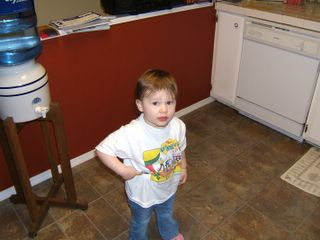
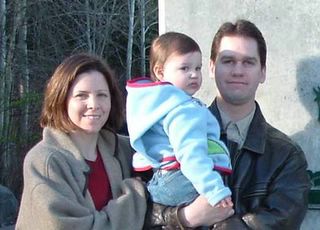
Jason just got a new digital camera (bringing us out of the 1 Mega Pixel Dark Ages of our old Olympus). It's a Sony Cyber-Shot DSC-W5 with a whopping 5.1 mega pixels, and he got the 1 GB memory stick to boot! So, you can expect that, with this newfound ability to record every action of our two-year-old's life with heretofore unknown clarity and quantity, Sadie pics will accost my dear blog readers with much greater frequency. I can't help it - I'm a mom and she is just so darn cute! To see any picture at 320 pixels, just click on it. Enjoy!


Key: Reading from left to right/top to bottom
1. Aaaaw yeeaaah...loving the juicebox.
2. I gotta deal with you two? I gotta knock heads with the cat?
3. Cooookie Muuuunch
4. Dad, just stop it!
5. Okay, here's a smile!
6. I love my Chrissy dog.
7. I'm eating here, crazy cameraman!
8. Hands on my hips, what is this here? This is my waist-bender, my mummer dear.
9. Smiling again for Dad.
10. I'm just da cutest little person ever!


Key: Reading from left to right/top to bottom
1. Aaaaw yeeaaah...loving the juicebox.
2. I gotta deal with you two? I gotta knock heads with the cat?
3. Cooookie Muuuunch
4. Dad, just stop it!
5. Okay, here's a smile!
6. I love my Chrissy dog.
7. I'm eating here, crazy cameraman!
8. Hands on my hips, what is this here? This is my waist-bender, my mummer dear.
9. Smiling again for Dad.
10. I'm just da cutest little person ever!
Sadie's Hair Odyssey or The Kindest Cut of All
Sunday, May 08, 2005
Mother's Day
When I was a child, observing duly the Hallmark favorites of Mother's Day and Father's Day, I remember often wondering aloud when it would be "Kid's Day." I mostly wanted a day wherein I would be brought breakfast in bed (a weakness for this rarely allowed luxury leads me still to order room service in hotels as often as Jason lets me get away with it). My parents would then laugh and tell me that,"Every day is 'Kid's Day'."
So, now it is my third Mother's Day as a mom, and Jason wanted to know what I would like to do to celebrate. I thought for a second and said, "You know, I don't want to do anything special, because, for me, every day is 'Mother's Day'." Jason made a face and said, "Come on..." Truly, though, I revel so much every day in the blessing of being a stay-at-home mama to my sweet Sadie and the wife of such a wonderful man. I don't ever feel like I need a special day to be honored - to me the honor is that God has given me these opportunities to share with Him a bit of the building of eternity. I just want to honor God on this day (and my mother-in-law and stepmom too, of course). There's a good reason why Mother's Day is on a Sunday - to help to remind us all whence the privilege of motherhood came.
Every day is Mother's Day. Every day, I get to wake up and go see my daughter who never fails to greet me with a big smile and a big hug. Every day, I get to watch her grow, to hear all of the amazing things that come out of her mouth from her vast imagination, to stroke her soft, downy head and kiss her smooth, round cheeks. Every day, I get to take my shoes off and dance with Sadie in the kitchen and chase her around the house and tickle her tiny toes. Every day, my husband comes home to me after working hard and says that he appreciates me - he appreciates me. With joy like this permeating every facet of my day-to-day existence, what need have I for some separate acknowledgment? That is the reason Jason and I have never celebrated Valentine's Day either - it's about living every day with love, respect, celebration, honor, and gratitude.
This is my seventh Mother's Day without my mom, and I do miss her so. I wish she could see Sadie and be the grandma that I know she would have been. I'm sure that I would have marveled at the softness and gentleness that she would have brought to the role, but which she always seemed so good at hiding when it came to being my "Mom." I bet that we would have grown closer in this wife-and-motherhood stage of my life, and I am so glad to have the hope that we will indeed meet again - and everything will at last be free and easy between us. Happy Mother's Day to you, Mom.
A public proclamation of "Happy Mother's Day" to the two moms now in my life - my wonderful mother-in-law, Sheri, and my stepmom of about eighteen years, Nancy. I love you! Thank you for being wonderful mom figures in my life.
So, now it is my third Mother's Day as a mom, and Jason wanted to know what I would like to do to celebrate. I thought for a second and said, "You know, I don't want to do anything special, because, for me, every day is 'Mother's Day'." Jason made a face and said, "Come on..." Truly, though, I revel so much every day in the blessing of being a stay-at-home mama to my sweet Sadie and the wife of such a wonderful man. I don't ever feel like I need a special day to be honored - to me the honor is that God has given me these opportunities to share with Him a bit of the building of eternity. I just want to honor God on this day (and my mother-in-law and stepmom too, of course). There's a good reason why Mother's Day is on a Sunday - to help to remind us all whence the privilege of motherhood came.
Every day is Mother's Day. Every day, I get to wake up and go see my daughter who never fails to greet me with a big smile and a big hug. Every day, I get to watch her grow, to hear all of the amazing things that come out of her mouth from her vast imagination, to stroke her soft, downy head and kiss her smooth, round cheeks. Every day, I get to take my shoes off and dance with Sadie in the kitchen and chase her around the house and tickle her tiny toes. Every day, my husband comes home to me after working hard and says that he appreciates me - he appreciates me. With joy like this permeating every facet of my day-to-day existence, what need have I for some separate acknowledgment? That is the reason Jason and I have never celebrated Valentine's Day either - it's about living every day with love, respect, celebration, honor, and gratitude.
This is my seventh Mother's Day without my mom, and I do miss her so. I wish she could see Sadie and be the grandma that I know she would have been. I'm sure that I would have marveled at the softness and gentleness that she would have brought to the role, but which she always seemed so good at hiding when it came to being my "Mom." I bet that we would have grown closer in this wife-and-motherhood stage of my life, and I am so glad to have the hope that we will indeed meet again - and everything will at last be free and easy between us. Happy Mother's Day to you, Mom.
A public proclamation of "Happy Mother's Day" to the two moms now in my life - my wonderful mother-in-law, Sheri, and my stepmom of about eighteen years, Nancy. I love you! Thank you for being wonderful mom figures in my life.
Tuesday, May 03, 2005
Playing Catch-Up
Wow! I think that's the longest I've gone between blog postings since starting this baby back in January. I haven't had as much time to write as I'd like, because I've been spending so much time reading Isabel Paterson novels. They are all out of print, so I have to get them from the library, and the King County Library System doesn't own any of them, so I've had to get them from the Inter-Library Loan program. I requested about seven novels at once and they all came in in a timely manner (whoda thunk that a gov'ment operation could be so efficient?), and you can only check them out for three weeks (normally KCLS checks out for four weeks), and they are non-renewable. So you can see why I've been kept so busy.
But, I put this counter do-hickey on my blog late last week, and, earlier on Tuesday, the counter read at nineteen hits. Then, later in the evening, the counter read thirty-two hits. I don't think that I sneaked onto my blog thirteen times within a few hours, nor can I imagine that Jason and my dad combined could have added so much to the counter, so maybe I've had some visitors - which is a very exciting possibility! Another possibility, of course, is that Bravenet has programmed their counters to up a few numbers to aid the self-esteem of insecure, low-traffic bloggers. If the former is the case, which I certainly hope is true, then I thought I'd better put a little update on this site, so as not to discourage frequent visitors.
I'm in the middle of my fourth Isabel Paterson novel, The Golden Vanity. Her biographer, Stephen D. Cox, avers that this is the best of her novels. It is quite good, but I've enjoyed everything I've read of hers so far. I especially enjoyed the two I read of her historical fiction trilogy, The Fourth Queen and The Road of the Gods. Her breadth of historical knowledge and her ability to make bygone times and the characters therein so fresh and revelant is simply astonishing. The third in the trilogy, The Singing Season (which I believe was actually the first book in the series written, but the one that it took KCLS the longest to retrieve), is awaiting my perusal, and I can hardly wait. But, The Golden Vanity is due first, so I'll be lost in a world quite a bit more modern (1920s and 1930s America), but still removed from my own experience by years and sensibilities for a while yet.
Thomas Jefferson once wrote: I cannot live without books. I could not agree more. At least, I wouldn't want to live without books. I am so grateful that Sadie loves books as much as I. I am looking so forward to sharing my favorites with her, and having her share her new discoveries with me. I'll have to try to collect these out-of-print Paterson novels over the years, because I'm bursting to talk them over with someone, and probably no one alive today has read them all, other than Dr. Cox (and I cannot keep bugging that poor man - no matter how much I'd like to!). I'm thinking that they'll be a great homeschooling unit for when Sadie is about twelve or thirteen. Whoo-hoo!
Peace to all!
But, I put this counter do-hickey on my blog late last week, and, earlier on Tuesday, the counter read at nineteen hits. Then, later in the evening, the counter read thirty-two hits. I don't think that I sneaked onto my blog thirteen times within a few hours, nor can I imagine that Jason and my dad combined could have added so much to the counter, so maybe I've had some visitors - which is a very exciting possibility! Another possibility, of course, is that Bravenet has programmed their counters to up a few numbers to aid the self-esteem of insecure, low-traffic bloggers. If the former is the case, which I certainly hope is true, then I thought I'd better put a little update on this site, so as not to discourage frequent visitors.
I'm in the middle of my fourth Isabel Paterson novel, The Golden Vanity. Her biographer, Stephen D. Cox, avers that this is the best of her novels. It is quite good, but I've enjoyed everything I've read of hers so far. I especially enjoyed the two I read of her historical fiction trilogy, The Fourth Queen and The Road of the Gods. Her breadth of historical knowledge and her ability to make bygone times and the characters therein so fresh and revelant is simply astonishing. The third in the trilogy, The Singing Season (which I believe was actually the first book in the series written, but the one that it took KCLS the longest to retrieve), is awaiting my perusal, and I can hardly wait. But, The Golden Vanity is due first, so I'll be lost in a world quite a bit more modern (1920s and 1930s America), but still removed from my own experience by years and sensibilities for a while yet.
Thomas Jefferson once wrote: I cannot live without books. I could not agree more. At least, I wouldn't want to live without books. I am so grateful that Sadie loves books as much as I. I am looking so forward to sharing my favorites with her, and having her share her new discoveries with me. I'll have to try to collect these out-of-print Paterson novels over the years, because I'm bursting to talk them over with someone, and probably no one alive today has read them all, other than Dr. Cox (and I cannot keep bugging that poor man - no matter how much I'd like to!). I'm thinking that they'll be a great homeschooling unit for when Sadie is about twelve or thirteen. Whoo-hoo!
Peace to all!
Monday, April 11, 2005
Isabel Paterson, Part 2: The Highest Form of Intelligence
Well, I've finished my second read-through of Stephen Cox's biography of Isabel Paterson. I have a tendency to re-read stories (whether fictional or not) that leave me unsatisfied in some way, despite the quality of the writing. I think I'm looking for satisfaction with every subsequent reading. Of course, since words on paper do not magically change when books are shut, I am always left again unsatisfied. Nobody could have written a more beautiful, enchanting telling of Isabel Paterson's life than The Woman and the Dynamo, but you are left with the impression that even the author himself was unsatisfied at the conclusion of this biography.
Isabel Paterson, graced by God with natural genius, humor, flair and originality, died and remains in such obscurity that the conscientious reader cannot help but gnash her teeth at the whole of mankind that rejects to this day the very prophets God sends to enlighten us. I think somehow in this second reading I was hoping to find the ending changed to something like this:
And then the entire world sat up and listened to what Isabel Paterson had been saying all along, everyone stopped poking their noses into everyone else's business, the governments stopped interfering in the energy circuit of the free exchange of ideas and goods and instead started protecting life, liberty and property, and that is why the world is a place of peace and fulfillment for all individuals today. The End.
And then I would look up from the book and miraculously see a country that is not at war, not trillions in debt, not aborting babies, not throwing away billions into government schools, and is basically minding its own business with the rest of the world following our lead, as it tends to do. Peace and prosperity would be the norm, Isabel Paterson would be on Mount Rushmore, and I could go about my life without worrying so much about the fate of my beloved country.
Though, believe me, there is a lot to be comforted by in the reading of this extraordinary life. The very fact that she was able to find a voice in the Twentieth Century and express that voice to the world in a regular column of a mainstream publication (not to mention in many novels and her great work, The God of the Machine) is simply amazing when you consider that that was the century that brought us Wilson and WWI, Lenin, Stalin and the whole blight of Communism, FDR and the New Deal, Hitler, Mussolini and WWII, and colorless, wishy-washy, gutless, spineless collectivism in just about every other arena of life, in America and abroad. The most surprising thing about Pat is not that she became somewhat bitter toward the end, but that she found the courage and conviction even to begin the fight for individual liberty and the morality of capitalism.
So, let me sit with a cup of tea - Pat's preferred tonic of imbibition - and try to express my love for my dear Isabel.
Well, as I wrote before, Isabel Paterson was funny. Very funny. So funny, that reading excerpts from her column will lead the reader through reactions ranging from the quiet titter to the boisterous guffaw. The amazing part of this is that she wrote a timely column, filled with persons and literary works from a bygone era. That her humor could be so relevant to the modern reader is a mark of her particular skill, and that these bits of humor were framed so well as to make them relevant is a tribute to the skill of her biographer. Sometimes, Dr. Cox lets these aphorisms stand alone:
The main object of a university press seems to be to publish books which one wouldn't be found dead reading. (66)
Psychology is a science which tells you what psychologists are like. (66)
Nothing that well-meaning people might do would surprise us. (68)
People mostly do as they like, and that would be fine if they'd let other people do the same. (68)
Sometimes he gives contextual information to pack a greater punch:
Unmerited fame was easily punished. Hearing that the work of a popular sociologist had been translated into German, she asked, "Why wouldn't it be a popular move to translate it into English?" (69)
After watching Bruce Barton's life of Christ, The Man Nobody Knows, linger for months on the bestsellers list, she greeted the appearance of his next effort, The Book Nobody Knows, with a brief gloss: "Meaning the Bible, which Mr. Barton has just discovered." (69-70)
She was perhaps the only person in the Western world who was immune to Churchill's "Blood, Sweat, and Tears" speech. She noted that he had borrowed the salient idea from Garibaldi, and besides, "All heads of states are considered great writers while they are in office. It goes with the job. And we mean it goes with the job." (70)
He notes that she wrote amidst the peerage of such luminous literary wits as Mencken, Parker, Fitzgerald and Lardner, in fact stating that "wit and humor were the soundest currency of the age...and Paterson had no difficulty exploiting her own sense of humor." The fact that she was not afraid to express this humor in the "vulgar tongue of this country," that she was at home in America's newly rooted sense of itself as a separate entity from European culture, that she helped to distinguish our distinctly colloquial and casual version of the English language, that she was enchanted by this vernacular's "elusive note of poetry," made her a powerful voice in both literary and political commentary. Reading excerpts from her column in The Herald Tribune calls to mind some of Ring Lardner's ability to capture "American" as a language.
"Wit and humor," she said, "are the highest forms of intelligence." One would tend to agree, especially if that one has ever tried to "write funny" or do five minutes of good stand-up comedy. One should then reflect on the fact that so little of what so-called intellectual lights write or say is funny in the least. A lightness in self-expression will draw readers back continually in a way that no pedantic pondering ever will. Ever wonder why so many of "Oprah's Book Club" authors have no success with their successive literary offerrings? Oprah's recommendation is enough to coax a purchase from the legions who hail her as Messiah, but, once having read and become fully in-touch with the artistic proclivities of the Great OW, these readers will not seek out further works by these authors...because most of them are sooooooo depressing and annoying and boring. Oy!
So, Isabel was very funny.
I have recently been checking out her novels from the library, and I am pleased to report that her style with fiction is also very accessible. The two I have so far read I will share about in Part 3 (you knew it was coming, didn't you?). Until then, have fun reading The God of the Machine (which I know you have, because you purchased it at my bidding two weeks ago from www.lfb.com). I'll be back with more Isabel-adoration soon.
Peace to all!
Isabel Paterson, graced by God with natural genius, humor, flair and originality, died and remains in such obscurity that the conscientious reader cannot help but gnash her teeth at the whole of mankind that rejects to this day the very prophets God sends to enlighten us. I think somehow in this second reading I was hoping to find the ending changed to something like this:
And then the entire world sat up and listened to what Isabel Paterson had been saying all along, everyone stopped poking their noses into everyone else's business, the governments stopped interfering in the energy circuit of the free exchange of ideas and goods and instead started protecting life, liberty and property, and that is why the world is a place of peace and fulfillment for all individuals today. The End.
And then I would look up from the book and miraculously see a country that is not at war, not trillions in debt, not aborting babies, not throwing away billions into government schools, and is basically minding its own business with the rest of the world following our lead, as it tends to do. Peace and prosperity would be the norm, Isabel Paterson would be on Mount Rushmore, and I could go about my life without worrying so much about the fate of my beloved country.
Though, believe me, there is a lot to be comforted by in the reading of this extraordinary life. The very fact that she was able to find a voice in the Twentieth Century and express that voice to the world in a regular column of a mainstream publication (not to mention in many novels and her great work, The God of the Machine) is simply amazing when you consider that that was the century that brought us Wilson and WWI, Lenin, Stalin and the whole blight of Communism, FDR and the New Deal, Hitler, Mussolini and WWII, and colorless, wishy-washy, gutless, spineless collectivism in just about every other arena of life, in America and abroad. The most surprising thing about Pat is not that she became somewhat bitter toward the end, but that she found the courage and conviction even to begin the fight for individual liberty and the morality of capitalism.
So, let me sit with a cup of tea - Pat's preferred tonic of imbibition - and try to express my love for my dear Isabel.
Well, as I wrote before, Isabel Paterson was funny. Very funny. So funny, that reading excerpts from her column will lead the reader through reactions ranging from the quiet titter to the boisterous guffaw. The amazing part of this is that she wrote a timely column, filled with persons and literary works from a bygone era. That her humor could be so relevant to the modern reader is a mark of her particular skill, and that these bits of humor were framed so well as to make them relevant is a tribute to the skill of her biographer. Sometimes, Dr. Cox lets these aphorisms stand alone:
The main object of a university press seems to be to publish books which one wouldn't be found dead reading. (66)
Psychology is a science which tells you what psychologists are like. (66)
Nothing that well-meaning people might do would surprise us. (68)
People mostly do as they like, and that would be fine if they'd let other people do the same. (68)
Sometimes he gives contextual information to pack a greater punch:
Unmerited fame was easily punished. Hearing that the work of a popular sociologist had been translated into German, she asked, "Why wouldn't it be a popular move to translate it into English?" (69)
After watching Bruce Barton's life of Christ, The Man Nobody Knows, linger for months on the bestsellers list, she greeted the appearance of his next effort, The Book Nobody Knows, with a brief gloss: "Meaning the Bible, which Mr. Barton has just discovered." (69-70)
She was perhaps the only person in the Western world who was immune to Churchill's "Blood, Sweat, and Tears" speech. She noted that he had borrowed the salient idea from Garibaldi, and besides, "All heads of states are considered great writers while they are in office. It goes with the job. And we mean it goes with the job." (70)
He notes that she wrote amidst the peerage of such luminous literary wits as Mencken, Parker, Fitzgerald and Lardner, in fact stating that "wit and humor were the soundest currency of the age...and Paterson had no difficulty exploiting her own sense of humor." The fact that she was not afraid to express this humor in the "vulgar tongue of this country," that she was at home in America's newly rooted sense of itself as a separate entity from European culture, that she helped to distinguish our distinctly colloquial and casual version of the English language, that she was enchanted by this vernacular's "elusive note of poetry," made her a powerful voice in both literary and political commentary. Reading excerpts from her column in The Herald Tribune calls to mind some of Ring Lardner's ability to capture "American" as a language.
"Wit and humor," she said, "are the highest forms of intelligence." One would tend to agree, especially if that one has ever tried to "write funny" or do five minutes of good stand-up comedy. One should then reflect on the fact that so little of what so-called intellectual lights write or say is funny in the least. A lightness in self-expression will draw readers back continually in a way that no pedantic pondering ever will. Ever wonder why so many of "Oprah's Book Club" authors have no success with their successive literary offerrings? Oprah's recommendation is enough to coax a purchase from the legions who hail her as Messiah, but, once having read and become fully in-touch with the artistic proclivities of the Great OW, these readers will not seek out further works by these authors...because most of them are sooooooo depressing and annoying and boring. Oy!
So, Isabel was very funny.
I have recently been checking out her novels from the library, and I am pleased to report that her style with fiction is also very accessible. The two I have so far read I will share about in Part 3 (you knew it was coming, didn't you?). Until then, have fun reading The God of the Machine (which I know you have, because you purchased it at my bidding two weeks ago from www.lfb.com). I'll be back with more Isabel-adoration soon.
Peace to all!
Tuesday, April 05, 2005
Isabel Paterson, Part 1:The Fountainhead's Fountainhead
Has there ever been any mortal more cool than Isabel Paterson?
No, there hasn't.
I am nearing the end of my second reading of Stephen Cox's sublime biography of Ms. Paterson, The Woman and the Dynamo: Isabel Paterson and the Idea of America. It is interesting that Ms. Paterson had a brief, presumably inconsequential, marriage early in her life, because her marriage of consequence turns out to be the perfect match of biographer to biographee. I cannot imagine a more harmonious pairing of sympathetic natures than that of Dr. Cox's with Ms. Paterson's. The offspring of this union is a highly readable, inexhaustively entertaining tribute to the almost-forgotten importance of one of the best minds of the twentieth century.
Oh - how Isabel winced at the application of the phrase "Best Minds" which so permeated the meddlers' and do-gooders' vocabularies before, during, and after the disasterous FDR administrations. Apologies to Pat (her preferred nickname), but I must bestow the title upon her, despite her misgivings. Her mind was an American original (though she was born in and bred mostly in Canada), and it worked with both a precision and abstraction that can leave her reader dazzled by its brilliance and giddied by its implications and possibilities. She so totally rocks!
And she was funny! Dr. Cox makes full use of all her witty aphorisms that brought delight to her readers and consternation to the objects of said observations. His own sly observations throughout the book also contribute to a light-heartedness too rarely found in non-fiction. While he approaches his subject with a seriousness and thoughtfulness worthy of such a giant, he also frames his story of her life and work with humor and good fun. A delightful instance of this that comes to mind is in Chapter 3, "The Unsheltered Life." Dr. Cox quotes from a letter that Isabel wrote later in her life of her "bachelor girl" days in Calgary as a young, unmarried career woman. He frames what she wrote as such: "She 'was thought rather fast' for bucking the fashion by wearing low shoes - 'anything different was fast!' She was free and she enjoyed her freedom, however mindless the freedom might seem."(26) In the next paragraph, Dr. Cox writes of Isabel's lifelong friendship with Grace Luckhart, whom she met at this time: "Around Grace and Isabel clustered a group of friends whose faint impressions linger in correspondence: nice young working women who rented a room in someone's house or shared a cottage with someone; and nice young men, ditto. Undoubtedly, they all enjoyed the feeling that they were very fast."(27) His phrasing is so wonderfully placed - neither crowding or brow-beating Isabel's original statement by coming too close, nor leaving the reader confused by being too obtuse - just a perfect little summation that evokes so easily the innocence and gaiety of a lost time. I can't help but think that Isabel would have chuckled to read it.
My dad (who, being the man of impeccable taste that he is, also loves this biography) wondered aloud in a recent conversation what drew Dr. Cox to exploring and revealing this undeservedly obscure heroine of liberty. I do not know for certain what sparked his curiosity, but I would bet that it had something to do with Ayn Rand. Anyone who has read Rand, her fiction and her non-fiction, and has found a lot to value in her ideas, has probably also read some of the biographical works written about her, in particular Barbara Branden's The Passion of Ayn Rand. And in this and other chronicles, you will come across the figure of Isabel Paterson. Ayn Rand was, for lack of a more Randian term, quite the acolyte of Isabel's in the 1940's. Contemporary observers recall her sitting "at the feet" of Isabel, soaking up everything she could from Pat's vast intellectual storehouse of history, politics, philosophy, etc. Pat had what Mr. Darcy in Pride and Prejudice called, "something more substantial [than the commonly accepted accomplishments suitable for young ladies]...the improvement of her mind by extensive reading." Apparently, Ayn was not much of a reader herself, so the impact of Paterson's influence on Rand's contextual understanding of these subjects should not be underestimated.
So, I imagine that Stephen Cox (who is an admirer of Ayn's and a scholar of her work - he writes for The Journal of Ayn Rand Studies), was intrigued enough by this glimpse into Ayn's background to want to investigate further this person so influential in her life. What a thrill it must have been for him to discover - or, rather, uncover - what one reviewer of his biography called "the lost goddess of libertarianism!" After reading about Pat, I have come to the conclusion that Ayn Rand may be the gold flake floating down the river and into the pan of the miner downstream, but Pat is the vein of gold-ore that lies under the stones and earth. It takes a bit more digging to get to Pat, but the riches reaped far outweigh the cost. She is marvelous - the acuity of her thinking has not been dulled by years of neglect - and she is more relevant than ever. In fact, I would say that she is more relevant than the perennial Ayn, because she had a greater, broader understanding of human nature and a greater generosity of spirit toward the human condition.
Okay, it's going to take a lot more writing than I have time for right now to pay proper homage to this amazing lady and exceptional biography, so I'll entitle this "Part 1" and come back later to write "Part 2" and beyond. If you have never read The God of the Machine, and you care deeply about individual liberty, go right now to Laissez-Faire Books and buy it and read it and make it a part of you! Do it! Then, go to same and buy The Woman and the Dynamo. Two books you'll never regret. And that's my public service announcement for the day.
Peace to all, and more Isabel-adulation to come!
No, there hasn't.
I am nearing the end of my second reading of Stephen Cox's sublime biography of Ms. Paterson, The Woman and the Dynamo: Isabel Paterson and the Idea of America. It is interesting that Ms. Paterson had a brief, presumably inconsequential, marriage early in her life, because her marriage of consequence turns out to be the perfect match of biographer to biographee. I cannot imagine a more harmonious pairing of sympathetic natures than that of Dr. Cox's with Ms. Paterson's. The offspring of this union is a highly readable, inexhaustively entertaining tribute to the almost-forgotten importance of one of the best minds of the twentieth century.
Oh - how Isabel winced at the application of the phrase "Best Minds" which so permeated the meddlers' and do-gooders' vocabularies before, during, and after the disasterous FDR administrations. Apologies to Pat (her preferred nickname), but I must bestow the title upon her, despite her misgivings. Her mind was an American original (though she was born in and bred mostly in Canada), and it worked with both a precision and abstraction that can leave her reader dazzled by its brilliance and giddied by its implications and possibilities. She so totally rocks!
And she was funny! Dr. Cox makes full use of all her witty aphorisms that brought delight to her readers and consternation to the objects of said observations. His own sly observations throughout the book also contribute to a light-heartedness too rarely found in non-fiction. While he approaches his subject with a seriousness and thoughtfulness worthy of such a giant, he also frames his story of her life and work with humor and good fun. A delightful instance of this that comes to mind is in Chapter 3, "The Unsheltered Life." Dr. Cox quotes from a letter that Isabel wrote later in her life of her "bachelor girl" days in Calgary as a young, unmarried career woman. He frames what she wrote as such: "She 'was thought rather fast' for bucking the fashion by wearing low shoes - 'anything different was fast!' She was free and she enjoyed her freedom, however mindless the freedom might seem."(26) In the next paragraph, Dr. Cox writes of Isabel's lifelong friendship with Grace Luckhart, whom she met at this time: "Around Grace and Isabel clustered a group of friends whose faint impressions linger in correspondence: nice young working women who rented a room in someone's house or shared a cottage with someone; and nice young men, ditto. Undoubtedly, they all enjoyed the feeling that they were very fast."(27) His phrasing is so wonderfully placed - neither crowding or brow-beating Isabel's original statement by coming too close, nor leaving the reader confused by being too obtuse - just a perfect little summation that evokes so easily the innocence and gaiety of a lost time. I can't help but think that Isabel would have chuckled to read it.
My dad (who, being the man of impeccable taste that he is, also loves this biography) wondered aloud in a recent conversation what drew Dr. Cox to exploring and revealing this undeservedly obscure heroine of liberty. I do not know for certain what sparked his curiosity, but I would bet that it had something to do with Ayn Rand. Anyone who has read Rand, her fiction and her non-fiction, and has found a lot to value in her ideas, has probably also read some of the biographical works written about her, in particular Barbara Branden's The Passion of Ayn Rand. And in this and other chronicles, you will come across the figure of Isabel Paterson. Ayn Rand was, for lack of a more Randian term, quite the acolyte of Isabel's in the 1940's. Contemporary observers recall her sitting "at the feet" of Isabel, soaking up everything she could from Pat's vast intellectual storehouse of history, politics, philosophy, etc. Pat had what Mr. Darcy in Pride and Prejudice called, "something more substantial [than the commonly accepted accomplishments suitable for young ladies]...the improvement of her mind by extensive reading." Apparently, Ayn was not much of a reader herself, so the impact of Paterson's influence on Rand's contextual understanding of these subjects should not be underestimated.
So, I imagine that Stephen Cox (who is an admirer of Ayn's and a scholar of her work - he writes for The Journal of Ayn Rand Studies), was intrigued enough by this glimpse into Ayn's background to want to investigate further this person so influential in her life. What a thrill it must have been for him to discover - or, rather, uncover - what one reviewer of his biography called "the lost goddess of libertarianism!" After reading about Pat, I have come to the conclusion that Ayn Rand may be the gold flake floating down the river and into the pan of the miner downstream, but Pat is the vein of gold-ore that lies under the stones and earth. It takes a bit more digging to get to Pat, but the riches reaped far outweigh the cost. She is marvelous - the acuity of her thinking has not been dulled by years of neglect - and she is more relevant than ever. In fact, I would say that she is more relevant than the perennial Ayn, because she had a greater, broader understanding of human nature and a greater generosity of spirit toward the human condition.
Okay, it's going to take a lot more writing than I have time for right now to pay proper homage to this amazing lady and exceptional biography, so I'll entitle this "Part 1" and come back later to write "Part 2" and beyond. If you have never read The God of the Machine, and you care deeply about individual liberty, go right now to Laissez-Faire Books and buy it and read it and make it a part of you! Do it! Then, go to same and buy The Woman and the Dynamo. Two books you'll never regret. And that's my public service announcement for the day.
Peace to all, and more Isabel-adulation to come!
Friday, April 01, 2005
Would Terri Have Wanted to Break Her Parents' Hearts?
In planning our eventual move back to South Dakota, Jason has been faced with the reality, reinforced with rib-poking sauciness and endless teasing by me, that in Sioux Falls he will be under quiet, unspoken, consistent, unrelenting pressure to join the Shriners. His father is a Shriner, his grandfather is a Shriner, and who knows how far back the fez-wearing, tiny-car-driving tradition goes? Jason probably does, but I've never asked him, so I can't record that fact. In any event, Jason (who is emphatically not a joiner) will have to decide whether to stand his ground or give in to the Shrine-ness of his ancestors. I mentioned this little item of Jason's consternation to my father (I mention just about everything to my father - he's that kind of dad), and my father said, "Well, of course he'll join to make his old man happy."
I replied, "Oh, I don't think so. He's not merely apathetic, he's antipathetic to the whole idea."
My dad then thoughtfully answered, "Oh...so he's not to that point yet. Maybe someday he'll see it as a relatively small way to please his father." And he left it at that.
And so, of course, like so many things my dad says in passing, his words continue to resonate, bringing deeper understanding and further dimension to other issues in my life and thoughts.
Like so much of the nation, I was transfixed by the sad situation of Terri Schindler Schiavo in Florida. Unlike so many pro-lifers, I do not get all bent out of shape by right-to-die cases. I know that I wouldn't want to be kept alive artificially on a respirator or some similar device, and I think it's a sin to hold on to earthly life so stubbornly when God is calling you home. That said, I was on the Schindlers' side in this controversy.
First of all, Terri was not terminally ill. She was a severely brain-damaged woman who was kept alive via a liquid diet transmitted through a feeding tube. She was able to swallow her saliva, and, with aggressive therapy, I have learned of no reason to believe that she could not have learned how to eat again, if only through a bottle. Even if she could not have learned this, I don't see how starving a woman who was otherwise healthy is ever an act of mercy. She wasn't even in a hospital. She probably could have been cared for quite well in the Schindlers' home with the aid of a part-time nurse. She was like a big, newborn infant who was probably not ever going to progress beyond that stage, but is that any reason to kill her?
Second of all, I can not, nor will I ever be able to, understand why Michael Schiavo did not just walk away. Many folks say this was because he was deeply committed to fulfilling his wife's deeply held desire to die. I hardly think that an off-hand comment while watching a television show is a "deeply held desire." Who hasn't shuddered at a story like this one and remarked, "I wouldn't want to live that way"? I make off-hand comments all the time - God forbid I be held accountable for them when my life is at stake. I think that Michael Schiavo sincerely wanted to help his wife in the beginning of her incapacitation, but I think that after five years or so, he looked at the next forty or fifty years of this unfulfilling existence stretching before him, and it scared him to the core. How terrible it must be to be barely over thirty and seeing a marital future that holds so little? I think of Mr. Rochester in Jane Eyre, fighting off the attack of his mad wife and turning with anger toward the men who have come to accuse him, "This is my wife. Such is the sole conjugal embrace I am ever to know -- such are the endearments which are to solace my leisure hours... Off with you now! I must shut up my prize." Poor Terri - she was not to blame for Michael's feelings of desperation, but it's also not hard to see how he might have felt trapped.
In this way, spouses think differently from parents. With your spouse, love them though you may, forsaking all others as you have promised, there needs to be a common bond that unites you - I doubt that Michael would have exterminated Terri if they had had children together. A spouse is a partner you need for mutual emotional fulfillment and a physical legacy. If the Schiavos had been married for thirty or forty years before Terri's brain damage occurred, I would bet that the bond would have been much more difficult for him to sever. Add to this the fact that Michael did move on to a certain extent - becoming involved extramaritally with a sympathetic woman (who obviously did not possess the qualms that little Jane Eyre did when confronted with a similar option) with whom he produced two children.
Parents do not "move on." They cannot. That's your kid there, nothing will change that fact. Now that I'm a parent, I know that I would never be able to stand by meekly and watch my child die, especially a slow, unnatural death from dehydration and starvation. God forbid that I ever have to. I cannot in the least blame Terri's parents for their decade-long battle to save their daughter's life. No parent worth their salt could do otherwise.
Third of all, the brain is the most mysterious element of the human body. I seriously doubt that we've even scratched the surface of understanding this marvelous organ. Many physicians said that Terri was in a persistent vegetative state - that she was completely unaware of her surroundings and any supposed reaction to stimuli was a mere coincidence. A few physicians said that she was in a minimally conscious state - a hazy, slight awareness of her surroundings with minimal reaction to stimuli. I say that we cannot know what she was able to perceive or the internal workings of her poor, damaged brain. We cannot know if she was able to feel her lips cracking and her eyeballs drying or the sharp pains of her dehydrated organs contracting. We'll never know until Judgment Day, when all the secrets of our inner hearts and the stories of our inner lives are revealed. Would you want to answer for this travesty on that day?
I like what I read on one message board. A woman stated that in terms of technology and medical advancement, the next ten years could have been like ten light years for Terri. You cannot tell from such a distance what breakthrough discoveries will lead to regenerating brain cells or reversing the damage. Why not err on the side of life? We'll never know what treatments might work on patients like Terri if we keep killing them off.
Probably the lamest thing that I heard from the "Kill Terri" side of the debate was from a caller to the Michael Medved radio show. This caller said that, as a Christian, he did not believe that it was right to keep Terri alive because she was in some kind of "limbo state" (not his words, but my own phraseology) in relation to God. He said that since she could not use her mind or willpower to initiate interaction with the Almighty, she was essentially being kept from Him, and it was better to let her die (read: kill her deliberately) than keep her from God. Huh? What Bible has this guy read? Michael Medved then asked him the appropriate follow-up question, which was, "Should we then just kill off every incapacitated child and adult because they lack the ability to initiate this kind of relationship? Where do you stop in determining who is able to interact with God?" I do not remember the caller's reply, but it couldn't have been anything excusable or enlightening, because his premise was so flawed. Our entire relationship with the Creator of the heavens and the earth is based upon His initiation, not ours - His saving grace, not our ability to tell Him what we need - and our proclamations of faith are merely outward evidence of His grace, not vice versa. This guy probably would have looked at my mother, lying in a near-coma, cancer eating through her body, and thought that she had no ability to interact with God. I know for a fact that he would have been incorrect. If you think that Terri was not held continually in Jesus's arms everyday, especially while she lay withering and starving, then you have put God into a box that does His greatness - His absolute inability to be defined and constrained - no justice and will not do you any good at all. God communicates with His children in an entirely different way than humans communicate with each other (maybe this guy gets telephone calls and e-mails from Jesus, but I doubt it). To try to evaluate someone's relationship with Him based upon a person's medical condition is just as futile as trying to read a locked diary. Don't assume there's not good stuff in there, just because you can't see it and no one is telling you anything about it. I bet this "Christian" fellow also thinks that ripping little babies from their pre-born homes is no big deal, because, hey, it's not like they were in any state to initiate a communication with God. What a sad sack!
Anyway, it was such a heart-wrenching case - another example of our nation's entrenchment in the "culture of death." I know Terri's at peace, and I hope her parents will find peace soon. I hope Michael is able to find forgiveness from God for not doing the right thing and walking away and letting Terri's parents have their daughter back. I think that it probably just became a control issue for him. He became so desperate to get out of his marriage to Terri that he grasped onto this (presumably) off-handed comment she once made (which I have little doubt that she did make), found a despicable attorney who latched onto this as a "right-to-die" case to promote his own little warped view of "quality of life," and then he couldn't let it go. How many times have I personally seen people hanging on to bad arguments and ideas after they've been thoroughly shown valueless or even reprehensible, just because letting go means the other side wins? It's a fatal flaw of human nature that we hate to back down from a side we've taken, even when we're wrong, wrong, wrong. This kind of stiff-neckedness can ruin marriages, friendships, international relations, and, as we've seen, lives.
So, here's my final view on this matter, and it's one I haven't really seen addressed anywhere else. It goes back to my initial little story about Jason and the Shriners. Jason is twenty-seven. He's a young guy with young parents, and he's busy with his own life and pursuits. Right now, he has no interest in doing things for his folks for the sole reason that it'd maybe tickle them pink if he did. That doesn't mean he does not love his parents - I know he loves them greatly. He's just not at that stage yet, as my dad said. Who knows? In a few more years, as his dad gets older and frailer and Jason realizes that he will not be around indefinitely, he may reconsider his stance and join up just to give his dad the warm-fuzzy (warm-fezzy?) of having his son continue the tradition. Having lost my own mother at a relatively young age, I've come to that point earlier than most kids. There's nothing I wouldn't do to give my dad a little bit of pleasure - even if it went against my own nature and desires. You do these things because you are so grateful to your parents - for what they've given you in terms of their own sacrifices and love.
So, say Terri at the age of twenty-six really did look into what her future as an invalid might be - dependent on a feeding tube, needing "diaper" changes, unable to read or watch movies or walk or speak - and she did shudder with revulsion and believe in her heart that she would "never want to live like that." Say that everything Michael Schiavo said about his wife was true. Say that by "artificial means" she really did mean nutrition and hydration and not merely the respirator that most of us think of. I can believe that.
But all of the above does not mean that, at the age of forty-one, Terri would have wanted to break her parents' hearts by ending her life. Terri Schiavo, not in pain, perhaps knowing, seeing, feeling more than anyone suspects, would have been so touched by her parents' vigilance - their unceasing devotion to her - their commitment to loving her for the rest of their lives in a way that her husband could not have been reasonably expected to. Could not the twenty-six-year-old have grown to be a woman who wanted to honor her parents by giving them the last thing she could - her life? Would she not have looked into their grief-stricken, desperate eyes, clinging as they did to any avenue of hope for her custody, and said, "Okay, Mom and Dad, I'm yours"? My best guess is, yes.
Peace to the Schindlers. Peace to the Schiavos. Peace to all, and may God forgive our often misguided country.
I replied, "Oh, I don't think so. He's not merely apathetic, he's antipathetic to the whole idea."
My dad then thoughtfully answered, "Oh...so he's not to that point yet. Maybe someday he'll see it as a relatively small way to please his father." And he left it at that.
And so, of course, like so many things my dad says in passing, his words continue to resonate, bringing deeper understanding and further dimension to other issues in my life and thoughts.
Like so much of the nation, I was transfixed by the sad situation of Terri Schindler Schiavo in Florida. Unlike so many pro-lifers, I do not get all bent out of shape by right-to-die cases. I know that I wouldn't want to be kept alive artificially on a respirator or some similar device, and I think it's a sin to hold on to earthly life so stubbornly when God is calling you home. That said, I was on the Schindlers' side in this controversy.
First of all, Terri was not terminally ill. She was a severely brain-damaged woman who was kept alive via a liquid diet transmitted through a feeding tube. She was able to swallow her saliva, and, with aggressive therapy, I have learned of no reason to believe that she could not have learned how to eat again, if only through a bottle. Even if she could not have learned this, I don't see how starving a woman who was otherwise healthy is ever an act of mercy. She wasn't even in a hospital. She probably could have been cared for quite well in the Schindlers' home with the aid of a part-time nurse. She was like a big, newborn infant who was probably not ever going to progress beyond that stage, but is that any reason to kill her?
Second of all, I can not, nor will I ever be able to, understand why Michael Schiavo did not just walk away. Many folks say this was because he was deeply committed to fulfilling his wife's deeply held desire to die. I hardly think that an off-hand comment while watching a television show is a "deeply held desire." Who hasn't shuddered at a story like this one and remarked, "I wouldn't want to live that way"? I make off-hand comments all the time - God forbid I be held accountable for them when my life is at stake. I think that Michael Schiavo sincerely wanted to help his wife in the beginning of her incapacitation, but I think that after five years or so, he looked at the next forty or fifty years of this unfulfilling existence stretching before him, and it scared him to the core. How terrible it must be to be barely over thirty and seeing a marital future that holds so little? I think of Mr. Rochester in Jane Eyre, fighting off the attack of his mad wife and turning with anger toward the men who have come to accuse him, "This is my wife. Such is the sole conjugal embrace I am ever to know -- such are the endearments which are to solace my leisure hours... Off with you now! I must shut up my prize." Poor Terri - she was not to blame for Michael's feelings of desperation, but it's also not hard to see how he might have felt trapped.
In this way, spouses think differently from parents. With your spouse, love them though you may, forsaking all others as you have promised, there needs to be a common bond that unites you - I doubt that Michael would have exterminated Terri if they had had children together. A spouse is a partner you need for mutual emotional fulfillment and a physical legacy. If the Schiavos had been married for thirty or forty years before Terri's brain damage occurred, I would bet that the bond would have been much more difficult for him to sever. Add to this the fact that Michael did move on to a certain extent - becoming involved extramaritally with a sympathetic woman (who obviously did not possess the qualms that little Jane Eyre did when confronted with a similar option) with whom he produced two children.
Parents do not "move on." They cannot. That's your kid there, nothing will change that fact. Now that I'm a parent, I know that I would never be able to stand by meekly and watch my child die, especially a slow, unnatural death from dehydration and starvation. God forbid that I ever have to. I cannot in the least blame Terri's parents for their decade-long battle to save their daughter's life. No parent worth their salt could do otherwise.
Third of all, the brain is the most mysterious element of the human body. I seriously doubt that we've even scratched the surface of understanding this marvelous organ. Many physicians said that Terri was in a persistent vegetative state - that she was completely unaware of her surroundings and any supposed reaction to stimuli was a mere coincidence. A few physicians said that she was in a minimally conscious state - a hazy, slight awareness of her surroundings with minimal reaction to stimuli. I say that we cannot know what she was able to perceive or the internal workings of her poor, damaged brain. We cannot know if she was able to feel her lips cracking and her eyeballs drying or the sharp pains of her dehydrated organs contracting. We'll never know until Judgment Day, when all the secrets of our inner hearts and the stories of our inner lives are revealed. Would you want to answer for this travesty on that day?
I like what I read on one message board. A woman stated that in terms of technology and medical advancement, the next ten years could have been like ten light years for Terri. You cannot tell from such a distance what breakthrough discoveries will lead to regenerating brain cells or reversing the damage. Why not err on the side of life? We'll never know what treatments might work on patients like Terri if we keep killing them off.
Probably the lamest thing that I heard from the "Kill Terri" side of the debate was from a caller to the Michael Medved radio show. This caller said that, as a Christian, he did not believe that it was right to keep Terri alive because she was in some kind of "limbo state" (not his words, but my own phraseology) in relation to God. He said that since she could not use her mind or willpower to initiate interaction with the Almighty, she was essentially being kept from Him, and it was better to let her die (read: kill her deliberately) than keep her from God. Huh? What Bible has this guy read? Michael Medved then asked him the appropriate follow-up question, which was, "Should we then just kill off every incapacitated child and adult because they lack the ability to initiate this kind of relationship? Where do you stop in determining who is able to interact with God?" I do not remember the caller's reply, but it couldn't have been anything excusable or enlightening, because his premise was so flawed. Our entire relationship with the Creator of the heavens and the earth is based upon His initiation, not ours - His saving grace, not our ability to tell Him what we need - and our proclamations of faith are merely outward evidence of His grace, not vice versa. This guy probably would have looked at my mother, lying in a near-coma, cancer eating through her body, and thought that she had no ability to interact with God. I know for a fact that he would have been incorrect. If you think that Terri was not held continually in Jesus's arms everyday, especially while she lay withering and starving, then you have put God into a box that does His greatness - His absolute inability to be defined and constrained - no justice and will not do you any good at all. God communicates with His children in an entirely different way than humans communicate with each other (maybe this guy gets telephone calls and e-mails from Jesus, but I doubt it). To try to evaluate someone's relationship with Him based upon a person's medical condition is just as futile as trying to read a locked diary. Don't assume there's not good stuff in there, just because you can't see it and no one is telling you anything about it. I bet this "Christian" fellow also thinks that ripping little babies from their pre-born homes is no big deal, because, hey, it's not like they were in any state to initiate a communication with God. What a sad sack!
Anyway, it was such a heart-wrenching case - another example of our nation's entrenchment in the "culture of death." I know Terri's at peace, and I hope her parents will find peace soon. I hope Michael is able to find forgiveness from God for not doing the right thing and walking away and letting Terri's parents have their daughter back. I think that it probably just became a control issue for him. He became so desperate to get out of his marriage to Terri that he grasped onto this (presumably) off-handed comment she once made (which I have little doubt that she did make), found a despicable attorney who latched onto this as a "right-to-die" case to promote his own little warped view of "quality of life," and then he couldn't let it go. How many times have I personally seen people hanging on to bad arguments and ideas after they've been thoroughly shown valueless or even reprehensible, just because letting go means the other side wins? It's a fatal flaw of human nature that we hate to back down from a side we've taken, even when we're wrong, wrong, wrong. This kind of stiff-neckedness can ruin marriages, friendships, international relations, and, as we've seen, lives.
So, here's my final view on this matter, and it's one I haven't really seen addressed anywhere else. It goes back to my initial little story about Jason and the Shriners. Jason is twenty-seven. He's a young guy with young parents, and he's busy with his own life and pursuits. Right now, he has no interest in doing things for his folks for the sole reason that it'd maybe tickle them pink if he did. That doesn't mean he does not love his parents - I know he loves them greatly. He's just not at that stage yet, as my dad said. Who knows? In a few more years, as his dad gets older and frailer and Jason realizes that he will not be around indefinitely, he may reconsider his stance and join up just to give his dad the warm-fuzzy (warm-fezzy?) of having his son continue the tradition. Having lost my own mother at a relatively young age, I've come to that point earlier than most kids. There's nothing I wouldn't do to give my dad a little bit of pleasure - even if it went against my own nature and desires. You do these things because you are so grateful to your parents - for what they've given you in terms of their own sacrifices and love.
So, say Terri at the age of twenty-six really did look into what her future as an invalid might be - dependent on a feeding tube, needing "diaper" changes, unable to read or watch movies or walk or speak - and she did shudder with revulsion and believe in her heart that she would "never want to live like that." Say that everything Michael Schiavo said about his wife was true. Say that by "artificial means" she really did mean nutrition and hydration and not merely the respirator that most of us think of. I can believe that.
But all of the above does not mean that, at the age of forty-one, Terri would have wanted to break her parents' hearts by ending her life. Terri Schiavo, not in pain, perhaps knowing, seeing, feeling more than anyone suspects, would have been so touched by her parents' vigilance - their unceasing devotion to her - their commitment to loving her for the rest of their lives in a way that her husband could not have been reasonably expected to. Could not the twenty-six-year-old have grown to be a woman who wanted to honor her parents by giving them the last thing she could - her life? Would she not have looked into their grief-stricken, desperate eyes, clinging as they did to any avenue of hope for her custody, and said, "Okay, Mom and Dad, I'm yours"? My best guess is, yes.
Peace to the Schindlers. Peace to the Schiavos. Peace to all, and may God forgive our often misguided country.
Monday, March 28, 2005
The Unexpected Poetry of Prose
Anyone who knows me knows I'm not much for poetry. My favorite "poet" is Ogden Nash ("Doggerel!" my father exclaimed jocularly when I confessed this fact), and recently, when I forced myself to read Tennyson's "Enoch Arden," I was nearly lulled into comatosity. I sometimes think that people only write poetry when they lack the musical ability to write songs or the structural discipline to write short stories or novels or essays. Yes, some poets work within other genres, but please note that those poets are usually best known for their accomplishments in those other (more enjoyable) genres (e.g. Shakespeare, Jane Austen, L.M. Montgomery). There are some poems that have stirred my soul (I'm not a complete philistine, you know), but, in general, my assessment of poetry is, "Those who can, write. Those who cannot, compose poetry."
Sometimes, though, I run across something in the prosy line that just reads to me like what poetry should be - beautiful ebb and flow of words with solid, rock-hard sense running underneath like a current - ideas presented so uniquely and mellifluously that the form they take transcends the subject and becomes art. This is the poetry to which I am drawn - poetry of meaningful communication and not just a bunch of flowery claptrap. One such piece is an open letter I found on the website of Libertarians for Life (www.l4l.org). It is not surprising to find that these words were penned by a musician, since they are alive with music. I am posting them here (with all due credit to the source) for your reading pleasure.
Respectfully,
Sometimes, though, I run across something in the prosy line that just reads to me like what poetry should be - beautiful ebb and flow of words with solid, rock-hard sense running underneath like a current - ideas presented so uniquely and mellifluously that the form they take transcends the subject and becomes art. This is the poetry to which I am drawn - poetry of meaningful communication and not just a bunch of flowery claptrap. One such piece is an open letter I found on the website of Libertarians for Life (www.l4l.org). It is not surprising to find that these words were penned by a musician, since they are alive with music. I am posting them here (with all due credit to the source) for your reading pleasure.
When is a woman not a woman?
Therein lies the only clear refutation of a woman’s rights.
A woman’s rights —
seems a mere tautology, a redundant catch phrase.
Are not rights self evident?
Intrinsic assumptions of the inalienable?
So, when is a woman not a woman,
a right not a right?
When she doesn’t exist.
When does a woman become a woman?
Is it when her first ballot has been cast?
Or when she graduates from her class?
Is it when she makes a wish on her sweet sixteenth?
Would I be amiss if it were her first kiss?
Is it when she’s diagnosed by the boy next door?
Or as ambiguous as the cutting of the cord?
Is it the time it takes to travel the distance through the canal?
Or when she’s kicking and becomes viable?
Is it when her sex is discovered by a sonogram?
Or after eight weeks when the changes in her body will be mainly in dimension?
Is it when her brain waves are detected after 40 days?
Or is it around three weeks when her primitive heart beats?
Can there be only one true line of demarcation?
One finite measurable point in time that differentiates
life from non-life?
Womanhood from non-womanhood?
Rights from no right?
Is it the moment of conception —
that point when all of the above is set in motion?
That precise moment when
"a separate human individual, with her own genetic code,
needing only food, water, and oxygen, comes into existence"?
Indeed,
It is at that point,
"like the infant, the child, the adolescent,
that the conceptus is a being who is becoming,
not a becoming striving toward being.
She is not a potential life,
she is a life with great potential".
She is not the mother,
she is an other —
a somebody other than the mother.
A woman,
however beautiful, however complex when fully grown,
begins life as a single cell, a zygote —
that stage in human development through which we all pass.
She fulfills "the four criteria necessary to all life —
metabolism, growth, reaction to stimuli, and reproduction.
Her genetic makeup is established at conception,
determining to a great extent
her own individual, physical characteristics":
her eyes, her hair, her skin color, bone structure, her gender.
So let us not be confused,
"she did not come from a zygote — she once was a zygote.
She did not come from an embryo, she once was an embryo.
She did not come from a fetus, she once was a fetus".
She did not come from a little girl — she once was a little girl.
When is a woman not a woman?
The answer is absolute, non-negotiable.
To argue against would be to ignore the innate,
the fact of the matter.
The answer can never be a matter of opinion or choice.
This is not a metaphysical contention.
This is biology 101.
The answer is scientifically self-evident —
as inherent as the inalienable.
Therefore,
the ability to pursue happiness
is contingent upon liberty —
her liberty,
and her freedom is solely dependent upon
the mother of all human rights...
the right of life.
Respectfully,
Gary Cherone
(June 1999)
[Quotations by Francis J. Beckwith]
Copyright ©1999, Gary Cherone
Credit for source must be given to Rock for Life.
Friday, March 25, 2005
The Angriest Pro-Lifer - An Appreciation of Jill Stanek
A little while ago, shortly after writing my post Choose? Life, I e-mailed it to Dave Andrusko of NRLC, a man I respect so heartily for his commitment everyday to shining the light of truth on the darkness of abortion (and other disregardings of the sanctity of life). He was kind enough to e-mail me back that he appreciated my thoughtfulness on the issue of the phrase "choose life," but that the goal was to be gently non-judgmental when confronting prospective aborting women. And that is all well and good, and I can understand his point of view and the way that the NRLC attempts to walk the fine line between effective communication of the horror of abortion and not offending the very people they most want to reach. The NRLC is a wonderful tool for pro-lifers who need resources to fight the genteel fight in the nicest possible way - you catch more flies with honey than vinegar, bless those who curse you, love your enemies, etc.
BUT, sometimes I just get so angry! So very angry with those who willfully destroy life at its most vulnerable stages. I don't want to play Ms. Nice Person; I want to take the gloves off and call those child murderers what they are. I get tired of having endless sympathy for women who abort. I get tired of the new pro-life trend of seeing them as victims as much as the children they hired hit men to kill. I get tired of pro-lifers letting the other side dictate the terms from which any discussion originates. I get so angry I shake. Sometimes, while just sitting there, minding my own business, it hits me that in America today, women are allowed to kill at will their children, and that fact never ceases to stun me, to knock the very breath out of me. It is so opposite of everything that this country was founded upon, and yet it is treated with such a sense of blase. So, when a mood like this overwhelms me, and I simply cannot bear it any longer, I take pleasure in the writings of Jill Stanek - the angriest pro-lifer of all.
Ms. Stanek is wonderful. Her writings are sharp, prickly, full of the moral indignation with which I so fully empathize. She is merciless when it comes to exposing the real bankruptcy of the pro-abortion death-mongers. She pulls no pinpricks, let alone punches. Every aspect of what the reality of legal, on-demand abortion has been in our deluded country is ruthlessly (and often quite wittily - as humorously as possible when the topic is infanticide) examined, and every shadow of our national abortion shame has a flood-light shone upon it. She writes movingly, heart-wrenchingly, concisely, convincingly, and with such refreshing anger and candor. I admire her so greatly. Her writings are such an outlet for my turbulent emotions - she gives a voice to my heart's cries of anguish.
Visit her site and read her columns at www.jillstanek.net.
I do not think that anger in this instance is misplaced. Jesus Himself had appropriate anger - He was angered by all affronts to His Father and religious hypocrisy, and I'll bet He's very much angered by all the people out there playing God today by deciding that they are the ultimate arbiters of life. Of course, Jesus will offer grace and forgiveness to abortionists and women who have had abortions, just as He offers grace and forgiveness to all truly repentant sinners. I do think that God wants us to experience our anger and then make steps toward resolving it, though. Be angry and do not sin: do no let the sun go down on your wrath, nor give place to the devil (Eph. 4:26-27). So, it is right for me to feel this anger, to let it strengthen my resolve to do all I can to end this atrocity, then to let it go. Ms. Stanek's writings are just such the catalyst I need to vent my darker frustrations, and the NRLC is just the support frame I need to re-arm positively for the battle ahead. God is so gracious to give me and other pro-lifers these tools.
Please, Lord Jesus, forgive our country.
BUT, sometimes I just get so angry! So very angry with those who willfully destroy life at its most vulnerable stages. I don't want to play Ms. Nice Person; I want to take the gloves off and call those child murderers what they are. I get tired of having endless sympathy for women who abort. I get tired of the new pro-life trend of seeing them as victims as much as the children they hired hit men to kill. I get tired of pro-lifers letting the other side dictate the terms from which any discussion originates. I get so angry I shake. Sometimes, while just sitting there, minding my own business, it hits me that in America today, women are allowed to kill at will their children, and that fact never ceases to stun me, to knock the very breath out of me. It is so opposite of everything that this country was founded upon, and yet it is treated with such a sense of blase. So, when a mood like this overwhelms me, and I simply cannot bear it any longer, I take pleasure in the writings of Jill Stanek - the angriest pro-lifer of all.
Ms. Stanek is wonderful. Her writings are sharp, prickly, full of the moral indignation with which I so fully empathize. She is merciless when it comes to exposing the real bankruptcy of the pro-abortion death-mongers. She pulls no pinpricks, let alone punches. Every aspect of what the reality of legal, on-demand abortion has been in our deluded country is ruthlessly (and often quite wittily - as humorously as possible when the topic is infanticide) examined, and every shadow of our national abortion shame has a flood-light shone upon it. She writes movingly, heart-wrenchingly, concisely, convincingly, and with such refreshing anger and candor. I admire her so greatly. Her writings are such an outlet for my turbulent emotions - she gives a voice to my heart's cries of anguish.
Visit her site and read her columns at www.jillstanek.net.
I do not think that anger in this instance is misplaced. Jesus Himself had appropriate anger - He was angered by all affronts to His Father and religious hypocrisy, and I'll bet He's very much angered by all the people out there playing God today by deciding that they are the ultimate arbiters of life. Of course, Jesus will offer grace and forgiveness to abortionists and women who have had abortions, just as He offers grace and forgiveness to all truly repentant sinners. I do think that God wants us to experience our anger and then make steps toward resolving it, though. Be angry and do not sin: do no let the sun go down on your wrath, nor give place to the devil (Eph. 4:26-27). So, it is right for me to feel this anger, to let it strengthen my resolve to do all I can to end this atrocity, then to let it go. Ms. Stanek's writings are just such the catalyst I need to vent my darker frustrations, and the NRLC is just the support frame I need to re-arm positively for the battle ahead. God is so gracious to give me and other pro-lifers these tools.
Please, Lord Jesus, forgive our country.
Plus Ca Change, Plus Ce La Meme Chose...
The following column, written by George Will, appeared April 2, 1982. Read it and, alas, weep.
***********************
The Killing Will Not Stop
The baby was born in Bloomington, Ind., the sort of academic community where medical facilities are more apt to be excellent than moral judgments are. Like one of every 700 or so babies, this one had Down's syndrome, a genetic defect involving varying degrees of retardation and, sometimes, serious physical defects.
The baby needed serious but feasible surgery to enable food to reach its stomach. The parents refused the surgery, and presumably refused to yield custody to any of the couples eager to become the baby's guardians. The parents chose to starve their baby to death. Their lawyer concocted an Orwellian euphemism for this refusal of potentially life-saving treatment—"Treatment to do nothing." It is an old story: language must be mutilated when a perfumed rationalization of an act is incompatible with a straightforward description of the act.
Indiana courts, accommodating the law to the Zeitgeist, refused to order surgery, and thus sanctioned the homicide. Common sense and common usage require use of the word "homicide." The law usually encompasses homicides by negligence. The Indiana killing was worse. It was the result of premeditated, aggressive, tenacious action, in the hospital and in courts.
Such homicides can no longer be considered aberrations, or culturally incongruous. They are part of a social program to serve the convenience of adults by authorizing adults to destroy inconvenient young life. The parents' legal arguments, conducted in private, reportedly emphasized— what else?—"freedom of choice." The freedom to choose to kill inconvenient life is being extended, precisely as predicted, beyond fetal life to categories of inconvenient infants, such as Down's syndrome babies.
There is no reason—none—to doubt that if the baby had not had Down's syndrome the operation would have been ordered without hesitation, almost certainly, by the parents or, if not by them, by the courts. Therefore the baby was killed because it was retarded. I defy the parents and their medical and legal accomplices to explain why, by the principles affirmed in this case, parents do not have a right to kill by calculated neglect any Down's syndrome child—regardless of any medical need—or any other baby that parents decide would be inconvenient.
Indeed, the parents' lawyer implied as much when, justifying the starvation, he emphasized that even if successful the surgery would not have corrected the retardation. That is, the Down's syndrome was sufficient reason for starving the baby. But the broader message of this case is that being an unwanted baby is a capital offense.
In 1973 the Supreme Court created a virtually unrestrictable right to kill fetuses. Critics of the ruling were alarmed because the court failed to dispatch the burden of saying why the fetus, which unquestionably is alive, is not protectable life. Critics were alarmed also because the court, having incoherently emphasized "viability," offered no intelligible, let alone serious, reason why birth should be the point at which discretionary killing stops. Critics feared what the Indiana homicide demonstrates: the killing will not stop.
The values and passions, as well as the logic of some portions of the "abortion rights" movement, have always pointed beyond abortion, toward something like the Indiana outcome, which affirms a broader right to kill. Some people have used the silly argument that it is impossible to know when life begins. (The serious argument is about when a "person" protectable by law should be said to exist.) So what could be done about the awkward fact that a newborn, even a retarded newborn, is so incontestably alive?
The trick is to argue that the lives of certain kinds of newborns, like the lives of fetuses, are not sufficiently "meaningful"—a word that figured in the 1973 ruling—to merit any protection that inconveniences an adult's freedom of choice.
The Indiana parents consulted with doctors about the "treatment" they chose. But this was not at any point, in any sense, a medical decision. Such homicides in hospitals are common and will become more so now that a state's courts have given them an imprimatur. There should be interesting litigation now that Indiana courts—whether they understand this or not—are going to decide which categories of newborns (besides Down's syndrome children) can be killed by mandatory neglect.
Hours after the baby died, the parents' lawyer was on the "CBS Morning News" praising his clients' "courage." He said, "The easiest thing would have been to defer, let somebody else make that decision."
Oh? Someone had to deliberate about whether or not to starve the baby? When did it become natural, even necessary, in Indiana for parents to sit around debating whether to love or starve their newborns? The lawyer said it was a "no-win situation" because "there would have been horrific trauma— trauma to the child who would never have enjoyed a —a quality of life of—of any sort, trauma to the family, trauma to society." In this "no-win" situation, the parents won: the county was prevented from ordering surgery; prospective adopters were frustrated; the baby is dead. Furthermore, how is society traumatized whenever a Down's syndrome baby is not killed? It was, I believe, George Orwell who warned that insincerity is the enemy of sensible language.
Someone should counsel the counselor to stop babbling about Down's syndrome children not having "any sort" of quality of life. The task of convincing communities to provide services and human sympathy for the retarded is difficult enough without incoherent lawyers laying down the law about whose life does and whose does not have "meaning."
The Washington Post headlined its report: "The Demise of 'Infant Doe'" (the name used in court). "Demise," indeed. That suggests an event unplanned, even perhaps unexplained. ("The Demise of Abraham Lincoln"?) The Post's story began: "An Indiana couple, backed by the state's highest court and the family doctor, allowed their severely retarded newborn baby to die last Thursday night. . . ." But "severely retarded" is a misjudgment (also appearing in The New York Times) that is both a cause and an effect of cases like the one in Indiana. There is no way of knowing, and no reason to believe, that the baby would have been "severely retarded." A small fraction of Down's syndrome children are severely retarded. The degree of retardation cannot be known at birth. Furthermore, such children are dramatically responsive to infant stimulation and other early interventions. But, like other children, they need to eat.
When a commentator has a direct personal interest in an issue, it behooves him to say so. Some of my best friends are Down's syndrome citizens. (Citizens is what Down's syndrome children are if they avoid being homicide victims in hospitals.) Jonathan Will, 10, fourth-grader and Orioles fan (and the best Wiffle-ball hitter in southern Maryland), has Down's syndrome. He does not "suffer from" (as newspapers are wont to say) Down's syndrome. He suffers from nothing, except anxiety about the Orioles' lousy start.
He is doing nicely, thank you. But he is bound to have quite enough problems dealing with society—receiving rights, let alone empathy. He can do without people like Infant Doe's parents, and courts like Indiana's asserting by their actions the principle that people like him are less than fully human. On the evidence, Down's syndrome citizens have little to learn about being human from the people responsible for the death of Infant Doe.
***********************************
Please pray for Terri and her family.
The above was copied from "Today's News & Views" which is the excellent daily e-mail update I receive from Dave Andrusko of the National Right to Life Committee. To its ending, I would add please pray for our misguided country, that we would be delivered from this culture of death that has encompassed our formerly noble nation. In a lot of ways, it all started with Roe vs. Wade in 1973...Roe has to go!
***********************
The Killing Will Not Stop
The baby was born in Bloomington, Ind., the sort of academic community where medical facilities are more apt to be excellent than moral judgments are. Like one of every 700 or so babies, this one had Down's syndrome, a genetic defect involving varying degrees of retardation and, sometimes, serious physical defects.
The baby needed serious but feasible surgery to enable food to reach its stomach. The parents refused the surgery, and presumably refused to yield custody to any of the couples eager to become the baby's guardians. The parents chose to starve their baby to death. Their lawyer concocted an Orwellian euphemism for this refusal of potentially life-saving treatment—"Treatment to do nothing." It is an old story: language must be mutilated when a perfumed rationalization of an act is incompatible with a straightforward description of the act.
Indiana courts, accommodating the law to the Zeitgeist, refused to order surgery, and thus sanctioned the homicide. Common sense and common usage require use of the word "homicide." The law usually encompasses homicides by negligence. The Indiana killing was worse. It was the result of premeditated, aggressive, tenacious action, in the hospital and in courts.
Such homicides can no longer be considered aberrations, or culturally incongruous. They are part of a social program to serve the convenience of adults by authorizing adults to destroy inconvenient young life. The parents' legal arguments, conducted in private, reportedly emphasized— what else?—"freedom of choice." The freedom to choose to kill inconvenient life is being extended, precisely as predicted, beyond fetal life to categories of inconvenient infants, such as Down's syndrome babies.
There is no reason—none—to doubt that if the baby had not had Down's syndrome the operation would have been ordered without hesitation, almost certainly, by the parents or, if not by them, by the courts. Therefore the baby was killed because it was retarded. I defy the parents and their medical and legal accomplices to explain why, by the principles affirmed in this case, parents do not have a right to kill by calculated neglect any Down's syndrome child—regardless of any medical need—or any other baby that parents decide would be inconvenient.
Indeed, the parents' lawyer implied as much when, justifying the starvation, he emphasized that even if successful the surgery would not have corrected the retardation. That is, the Down's syndrome was sufficient reason for starving the baby. But the broader message of this case is that being an unwanted baby is a capital offense.
In 1973 the Supreme Court created a virtually unrestrictable right to kill fetuses. Critics of the ruling were alarmed because the court failed to dispatch the burden of saying why the fetus, which unquestionably is alive, is not protectable life. Critics were alarmed also because the court, having incoherently emphasized "viability," offered no intelligible, let alone serious, reason why birth should be the point at which discretionary killing stops. Critics feared what the Indiana homicide demonstrates: the killing will not stop.
The values and passions, as well as the logic of some portions of the "abortion rights" movement, have always pointed beyond abortion, toward something like the Indiana outcome, which affirms a broader right to kill. Some people have used the silly argument that it is impossible to know when life begins. (The serious argument is about when a "person" protectable by law should be said to exist.) So what could be done about the awkward fact that a newborn, even a retarded newborn, is so incontestably alive?
The trick is to argue that the lives of certain kinds of newborns, like the lives of fetuses, are not sufficiently "meaningful"—a word that figured in the 1973 ruling—to merit any protection that inconveniences an adult's freedom of choice.
The Indiana parents consulted with doctors about the "treatment" they chose. But this was not at any point, in any sense, a medical decision. Such homicides in hospitals are common and will become more so now that a state's courts have given them an imprimatur. There should be interesting litigation now that Indiana courts—whether they understand this or not—are going to decide which categories of newborns (besides Down's syndrome children) can be killed by mandatory neglect.
Hours after the baby died, the parents' lawyer was on the "CBS Morning News" praising his clients' "courage." He said, "The easiest thing would have been to defer, let somebody else make that decision."
Oh? Someone had to deliberate about whether or not to starve the baby? When did it become natural, even necessary, in Indiana for parents to sit around debating whether to love or starve their newborns? The lawyer said it was a "no-win situation" because "there would have been horrific trauma— trauma to the child who would never have enjoyed a —a quality of life of—of any sort, trauma to the family, trauma to society." In this "no-win" situation, the parents won: the county was prevented from ordering surgery; prospective adopters were frustrated; the baby is dead. Furthermore, how is society traumatized whenever a Down's syndrome baby is not killed? It was, I believe, George Orwell who warned that insincerity is the enemy of sensible language.
Someone should counsel the counselor to stop babbling about Down's syndrome children not having "any sort" of quality of life. The task of convincing communities to provide services and human sympathy for the retarded is difficult enough without incoherent lawyers laying down the law about whose life does and whose does not have "meaning."
The Washington Post headlined its report: "The Demise of 'Infant Doe'" (the name used in court). "Demise," indeed. That suggests an event unplanned, even perhaps unexplained. ("The Demise of Abraham Lincoln"?) The Post's story began: "An Indiana couple, backed by the state's highest court and the family doctor, allowed their severely retarded newborn baby to die last Thursday night. . . ." But "severely retarded" is a misjudgment (also appearing in The New York Times) that is both a cause and an effect of cases like the one in Indiana. There is no way of knowing, and no reason to believe, that the baby would have been "severely retarded." A small fraction of Down's syndrome children are severely retarded. The degree of retardation cannot be known at birth. Furthermore, such children are dramatically responsive to infant stimulation and other early interventions. But, like other children, they need to eat.
When a commentator has a direct personal interest in an issue, it behooves him to say so. Some of my best friends are Down's syndrome citizens. (Citizens is what Down's syndrome children are if they avoid being homicide victims in hospitals.) Jonathan Will, 10, fourth-grader and Orioles fan (and the best Wiffle-ball hitter in southern Maryland), has Down's syndrome. He does not "suffer from" (as newspapers are wont to say) Down's syndrome. He suffers from nothing, except anxiety about the Orioles' lousy start.
He is doing nicely, thank you. But he is bound to have quite enough problems dealing with society—receiving rights, let alone empathy. He can do without people like Infant Doe's parents, and courts like Indiana's asserting by their actions the principle that people like him are less than fully human. On the evidence, Down's syndrome citizens have little to learn about being human from the people responsible for the death of Infant Doe.
***********************************
Please pray for Terri and her family.
The above was copied from "Today's News & Views" which is the excellent daily e-mail update I receive from Dave Andrusko of the National Right to Life Committee. To its ending, I would add please pray for our misguided country, that we would be delivered from this culture of death that has encompassed our formerly noble nation. In a lot of ways, it all started with Roe vs. Wade in 1973...Roe has to go!
Tuesday, March 15, 2005
Sadie and Jesus
"There's a world of wonders waiting in store just outside our door, but the greatest thing that we ever will do is kneel by your bedside and introduce you to the One Who first thought of the wonder of you, your Father in Heaven." --Carolyn Arends, "Your Father in Heaven" from the album We've Been Waiting For You: The Parenthood Project
This past Sunday, Sadie, who now goes to "big girl" Sunday school instead of the church nursery, had a poopy-butt when we retrieved her at the end of service. While I was changing her in the bathroom, I asked her conversationally what she had learned that day. She told me that she colored a picture of Jesus. Then she clasped her hands in front of her and told me that she had been taught how to pray to Jesus. That's just one of those moments you live for as a parent. I got all choked up, right in the middle of a diaper change in the church bathroom. She's learning how to pray to Jesus. Wow.
Last night, we had our first "official" goodnight prayers session together after her two bedtime stories and drink of water. I've been waiting since before I was even pregnant to share this moment with her. We knelt together and clasped our hands before us. I told her that I would start, and she could add whatever she wanted to say at the end. So I started by thanking Jesus for His gift of salvation, for another day of watching Sadie grow, for my marriage to Jason, for our respective families, for our house, our sustenance, our church, our community, our troops, our country, and so on. Then I asked Sadie if she would like to add anything else for which she was thankful. She added that she was thankful for the park and dogs. Then I asked for God's protection over our family's health and safety, and for Him to watch especially over the vulnerable children of the world, born and unborn. We said, "Amen!" and she crawled into bed for her lullabies. Another milestone reached. I am so grateful.
Then, just this morning, I was singing a song about Jesus, and Sadie suddenly said, "I love Jesus..." and, as I started to beam with motherly pride and gratitude, she made my jaw drop by adding, "...because Jesus is a bad-ass." Oh dear. Well, He is. But, I think we'll have to work this kink out before next Sunday...
This past Sunday, Sadie, who now goes to "big girl" Sunday school instead of the church nursery, had a poopy-butt when we retrieved her at the end of service. While I was changing her in the bathroom, I asked her conversationally what she had learned that day. She told me that she colored a picture of Jesus. Then she clasped her hands in front of her and told me that she had been taught how to pray to Jesus. That's just one of those moments you live for as a parent. I got all choked up, right in the middle of a diaper change in the church bathroom. She's learning how to pray to Jesus. Wow.
Last night, we had our first "official" goodnight prayers session together after her two bedtime stories and drink of water. I've been waiting since before I was even pregnant to share this moment with her. We knelt together and clasped our hands before us. I told her that I would start, and she could add whatever she wanted to say at the end. So I started by thanking Jesus for His gift of salvation, for another day of watching Sadie grow, for my marriage to Jason, for our respective families, for our house, our sustenance, our church, our community, our troops, our country, and so on. Then I asked Sadie if she would like to add anything else for which she was thankful. She added that she was thankful for the park and dogs. Then I asked for God's protection over our family's health and safety, and for Him to watch especially over the vulnerable children of the world, born and unborn. We said, "Amen!" and she crawled into bed for her lullabies. Another milestone reached. I am so grateful.
Then, just this morning, I was singing a song about Jesus, and Sadie suddenly said, "I love Jesus..." and, as I started to beam with motherly pride and gratitude, she made my jaw drop by adding, "...because Jesus is a bad-ass." Oh dear. Well, He is. But, I think we'll have to work this kink out before next Sunday...
On the Verge of a Miracle...
"The realisation that one is to be hanged in the morning concentrates the mind wonderfully. "
--Samuel Johnson
Isn't it amazing how, when people are faced with their own mortality, the chains that bind them to this world creak and crack and fall away and they are freed? Thank you so much for that post about Ray Charles - I don't read that magazine (Rolling Stone), nor do I listen to his music, but his words were very powerful and moved me incredibly (See: "Ray Charles on Praise" at Carolyn Arends's blog: www.carolynarends.com/cgi-bin/cablog/blogger.cgi).
I had a similar experience with my mother on the day before she died. She had always said that when she died, she would have no regrets. She was not the sort of person who admitted to any kind of weakness easily. She had divorced two husbands and was on the verge of divorcing her third when she found out that her previously-in-remission breast cancer had spread to her liver, and she had about six months to live (in actuality, it was only three months). She did not have contact with two of her three brothers. She and I had recently ended a year of "not talking" and were trying to heal our often turbulent relationship. Even after the diagnosis, she was still her stubborn, hard-as-nails self, making me promise that I would not let either of her two estranged brothers into any memorial service we might plan. She had her death as well organized as her life. Not a thing happened that she hadn't carefully planned for. Every emotion that she had seemed to be well-ordered and accounted for. I felt somewhat foolish every time I broke into tears while talking to her. She seemed to approach death with the same detached impassivity that had left me so cold over the years. I had been a Christian for almost three years when this occured, and I had stumblingly tried to discuss my faith with my mother a few times, but had never felt that we were at the same dinner party, let alone having the same dish. I prayed and prayed for her peace and for God's grace to fall upon her. She never discussed anything with me, other than the practical "stuff of earth."
The night before she died was Thanksgiving. After a bleak and solemn meal with my to-be-husband and aunt and uncle (the one brother she talked to), I crept into my mother's bedroom, just to be still and close to her. The Hospice nurses had told us that she was practically in a coma, that the cancer had spread to her brain, and that she wouldn't be alive much longer. I just wanted to be alone with her, in the dark as we must have spent many an hour when I was a nursing baby or a toddler awakened by a bad dream or a sick child, to try to ponder the mystery that she had always been to me, and to be near her in love as she prepared to leave this world. I lay on the bed next to her, listening to her breathing, occasionally touching her in wonder that this vital woman, who had been to me almost like a force of nature, was now a shrunken shell.
Sometimes, God lets us be witnesses to miracles. He does it every time we bring a new, tiny, yelling baby into this world, and He did it that night for me and my mom. In the stillness, my mother, whom I had been told that I would never hear speak again, starting to call out. Her voice was rough and hoarse (I'm sure she hadn't much saliva available to speak well), but its cry was unmistakable. She was crying over and over, full of raw emotion, "Jesus, forgive me. Please forgive me, Jesus. Jesus...Jesus, forgive me. Jesus...Jesus...Please forgive me..." Over and over the words tumbled out of her, like the floodgates of life pouring out, and I felt His presence there as I never had before, even upon my own conversion. I trembled with awe (and finally understood the real meaning behind this phrase), and the atmosphere in the room suddenly grew lighter and easier somehow, as if the burdens my mother carried and the burden I had carried from years of a really rotten relationship with her were simply lifted. His yoke is easy, His burden is light. And I knew that my mother was closer to experiencing the full reality of life at that hour so close to her death than she had ever been in her busy and immaculately-planned existence.
Aside from the privilege of being mom to Sadie, this night six years ago stands out as the greatest blessing (among countless blessings) that I have ever been given. When my mother took her last earthly breath the following afternoon, I was able to be filled with hope in the midst of my grief. What a gift, not only for my mother to receive the Living Water of the Lord, but for Him to allow me to witness this intimate moment between Him and His child! He knew that I needed this as much as she, and He does not give us stones in lieu of bread. My mom...such a cool, self-sufficient, indomitable presence she had seemed to me her entire life. In the end, in her desperate crying out, when all her defenses were stripped bare, when all the barriers she had built up in this world had crumbled to dust, she found a God Who is so very good - His grace is, well, amazing - His mercy is boundless.
I'm glad that Ray Charles had a little more time than my mother to live with the eternal in sight. I hope that he was able to fall upon the grace of Jesus with a whole heart, knowing that forgiveness is always available. Who knows? Maybe we'll see him in concert soon (I'd like to see Keith Green and Ray Charles jamming on pianos with Rich Mullins on the hammered dulcimer, Carolyn Arends on guitar - and sax too! it is heaven after all - Spencer Capier on violin, with a whole angel choir singing backup - aren't you going to love concerts in His kingdom?). Jesus told us He was coming back quickly (God's version of "quickly" seems a little long, but this clay won't question the Potter), and I want to chime in with John, "Amen. Even so, come, Lord Jesus!" But He really does come so quickly, even in this late age, when you call His name ("When Your love comes down, You take my soul by storm - You take my soul by storm." --Carolyn Arends). I am so grateful that He still stands ready to open eyes and soften hearts.
Rich Mullins wrote such a great song that sums up so beautifully that moment before you know the Lord. I wasn't thinking of this song on the night my mother cried out - I was too deep in grief and regrets to think of anything other than the moment at hand - but I have never listened to this song since without remembering that night. I would like to copy the lyrics out, so you'll see what I mean:
"Verge of a Miracle"
Words and music by Rich Mullins
Copyrighted 1986 by BMG Songs, Inc. (ASCAP)
Clung to a ball that was hung in the sky
Hurled into orbit - there you are
Whether you fall down or whether you fly
Seems you can never get too far
Someone's waiting to put wings
Upon your flightless heart
Chorus:
You're on the verge of a miracle
Standing there - oh -
You're on the verge of a miracle
Just waiting to be believed in
Open your eyes and see
You're on the verge of a miracle
Here in your room where nobody can see
Voices are loud but seldom clear
But beneath the confusion that's running so deep
There is a promise you must hear
The love that seems so far away
Is standing very near
Repeat Chorus
When you've played out your last chance
And your directions have all been lost
When the roads that you look down are all dead ends
Look up - you could see if you just look up
What an incredible talent God housed in that clay vessel, Rich Mullins! The generosity of God is such that He shared him with us for as long as He did.
Peace to all...
--Samuel Johnson
Isn't it amazing how, when people are faced with their own mortality, the chains that bind them to this world creak and crack and fall away and they are freed? Thank you so much for that post about Ray Charles - I don't read that magazine (Rolling Stone), nor do I listen to his music, but his words were very powerful and moved me incredibly (See: "Ray Charles on Praise" at Carolyn Arends's blog: www.carolynarends.com/cgi-bin/cablog/blogger.cgi).
I had a similar experience with my mother on the day before she died. She had always said that when she died, she would have no regrets. She was not the sort of person who admitted to any kind of weakness easily. She had divorced two husbands and was on the verge of divorcing her third when she found out that her previously-in-remission breast cancer had spread to her liver, and she had about six months to live (in actuality, it was only three months). She did not have contact with two of her three brothers. She and I had recently ended a year of "not talking" and were trying to heal our often turbulent relationship. Even after the diagnosis, she was still her stubborn, hard-as-nails self, making me promise that I would not let either of her two estranged brothers into any memorial service we might plan. She had her death as well organized as her life. Not a thing happened that she hadn't carefully planned for. Every emotion that she had seemed to be well-ordered and accounted for. I felt somewhat foolish every time I broke into tears while talking to her. She seemed to approach death with the same detached impassivity that had left me so cold over the years. I had been a Christian for almost three years when this occured, and I had stumblingly tried to discuss my faith with my mother a few times, but had never felt that we were at the same dinner party, let alone having the same dish. I prayed and prayed for her peace and for God's grace to fall upon her. She never discussed anything with me, other than the practical "stuff of earth."
The night before she died was Thanksgiving. After a bleak and solemn meal with my to-be-husband and aunt and uncle (the one brother she talked to), I crept into my mother's bedroom, just to be still and close to her. The Hospice nurses had told us that she was practically in a coma, that the cancer had spread to her brain, and that she wouldn't be alive much longer. I just wanted to be alone with her, in the dark as we must have spent many an hour when I was a nursing baby or a toddler awakened by a bad dream or a sick child, to try to ponder the mystery that she had always been to me, and to be near her in love as she prepared to leave this world. I lay on the bed next to her, listening to her breathing, occasionally touching her in wonder that this vital woman, who had been to me almost like a force of nature, was now a shrunken shell.
Sometimes, God lets us be witnesses to miracles. He does it every time we bring a new, tiny, yelling baby into this world, and He did it that night for me and my mom. In the stillness, my mother, whom I had been told that I would never hear speak again, starting to call out. Her voice was rough and hoarse (I'm sure she hadn't much saliva available to speak well), but its cry was unmistakable. She was crying over and over, full of raw emotion, "Jesus, forgive me. Please forgive me, Jesus. Jesus...Jesus, forgive me. Jesus...Jesus...Please forgive me..." Over and over the words tumbled out of her, like the floodgates of life pouring out, and I felt His presence there as I never had before, even upon my own conversion. I trembled with awe (and finally understood the real meaning behind this phrase), and the atmosphere in the room suddenly grew lighter and easier somehow, as if the burdens my mother carried and the burden I had carried from years of a really rotten relationship with her were simply lifted. His yoke is easy, His burden is light. And I knew that my mother was closer to experiencing the full reality of life at that hour so close to her death than she had ever been in her busy and immaculately-planned existence.
Aside from the privilege of being mom to Sadie, this night six years ago stands out as the greatest blessing (among countless blessings) that I have ever been given. When my mother took her last earthly breath the following afternoon, I was able to be filled with hope in the midst of my grief. What a gift, not only for my mother to receive the Living Water of the Lord, but for Him to allow me to witness this intimate moment between Him and His child! He knew that I needed this as much as she, and He does not give us stones in lieu of bread. My mom...such a cool, self-sufficient, indomitable presence she had seemed to me her entire life. In the end, in her desperate crying out, when all her defenses were stripped bare, when all the barriers she had built up in this world had crumbled to dust, she found a God Who is so very good - His grace is, well, amazing - His mercy is boundless.
I'm glad that Ray Charles had a little more time than my mother to live with the eternal in sight. I hope that he was able to fall upon the grace of Jesus with a whole heart, knowing that forgiveness is always available. Who knows? Maybe we'll see him in concert soon (I'd like to see Keith Green and Ray Charles jamming on pianos with Rich Mullins on the hammered dulcimer, Carolyn Arends on guitar - and sax too! it is heaven after all - Spencer Capier on violin, with a whole angel choir singing backup - aren't you going to love concerts in His kingdom?). Jesus told us He was coming back quickly (God's version of "quickly" seems a little long, but this clay won't question the Potter), and I want to chime in with John, "Amen. Even so, come, Lord Jesus!" But He really does come so quickly, even in this late age, when you call His name ("When Your love comes down, You take my soul by storm - You take my soul by storm." --Carolyn Arends). I am so grateful that He still stands ready to open eyes and soften hearts.
Rich Mullins wrote such a great song that sums up so beautifully that moment before you know the Lord. I wasn't thinking of this song on the night my mother cried out - I was too deep in grief and regrets to think of anything other than the moment at hand - but I have never listened to this song since without remembering that night. I would like to copy the lyrics out, so you'll see what I mean:
"Verge of a Miracle"
Words and music by Rich Mullins
Copyrighted 1986 by BMG Songs, Inc. (ASCAP)
Clung to a ball that was hung in the sky
Hurled into orbit - there you are
Whether you fall down or whether you fly
Seems you can never get too far
Someone's waiting to put wings
Upon your flightless heart
Chorus:
You're on the verge of a miracle
Standing there - oh -
You're on the verge of a miracle
Just waiting to be believed in
Open your eyes and see
You're on the verge of a miracle
Here in your room where nobody can see
Voices are loud but seldom clear
But beneath the confusion that's running so deep
There is a promise you must hear
The love that seems so far away
Is standing very near
Repeat Chorus
When you've played out your last chance
And your directions have all been lost
When the roads that you look down are all dead ends
Look up - you could see if you just look up
What an incredible talent God housed in that clay vessel, Rich Mullins! The generosity of God is such that He shared him with us for as long as He did.
Peace to all...
Monday, March 14, 2005
Living the Simple Life with Gratitude, Not Guilt
I recently checked a book out of the library entitled, Living Simply with Children: A Voluntary Simplicity Guide for Moms, Dads and Kids Who Want to Reclaim the Bliss of Children and the Joy of Parenting by Marie Sherlock. This sounded like my kind of book. My goal for Sadie (and our future children, D.V.) has always been to offer her a complete, old-fashioned kind of childhood - safe, secure, loving, carefree, wholesome, preserving her innocence, etc. I have long thought that the best way to do this is to live simply - taking joys and sorrows as they come - not complicating her young life with too many flashy toys or overwhelming situations - providing a haven against commercialization and materialism - instilling to the best of my abilities a sense of gratitude based upon strong faith. So far, this lifestyle has been easy to provide, but I know it will get more and more difficult as she gets older and more independent. So, I'm always on the lookout for tips from other parents for achieving this goal, which is why I picked up this book with more than a little interest.
Unfortunately, I was only able to get through the first three chapters before I had to give up in disgust. The lady who wrote this book seemed to have a chip on her shoulder that was a cinder block. Within the first three chapters that I read, she mentioned the current Bush administration three times, never flatteringly. Now, I can understand not liking the Bush administration, but what in the world does that have to do with raising children simply? I mean, I don't like some of the things that have been a part of this President's policies, but in some ways the administration has enhanced my ability to live a simple life. For instance, the tax cuts he advocated have been a real help to our family - any extra money we have to use in our single-income household or give to a charity of our choice is a welcome blessing and takes us closer to the kind of lives we want to live.
Another thing that really bothered me was the attitude throughout the three chapters that seemed to say that we should live simply because most of the rest of the world is in poverty and it's (somehow) all our fault as Americans. Many of the parents whom she quoted in the book were raising their children with this guilt-based philosophy, which I hardly think is a simple way to raise children. What is simple about weighing down a childhood with a sense of guilt everyday? That seems like a way to burden children that is unconscionable. How can children grow up with a sense of optimism and joy under such a dark cloud?
How much better would it be to raise children with gratitude instead of guilt? How much better to instill the virtues of earthly stewardship upon their hearts than the fear of ecological devastation? How much better to teach children to give much because they have been given much by God than to see third-world poverty as somehow their fault? How much better to choose walking and bicycle riding for transportation because of health and family-togetherness than to view automobiles as gas-guzzling destroyers? How much better to introduce them to living with and among animals and let their natural love for God's creation shine through than to somehow say that humans and animals are at odds, with humans always in the wrong?
To me, living simply is about making choices that will enhance your child's innate sense of wonder and joy at the world around them. I think that humans are naturally rather simple - God certainly made us naked and in a garden; what's more simple than that? I think that sin is what leads us to complicate our lives - that desire to over-think and over-do and over-use - to always be looking past what He gives to more, more, more ("I'd rather fight You for something I don't really want, than take what You give that I need." --Rich Mullins, "Hold Me, Jesus"). Also, the sin of wanting to be in control over everything, including other people, to "play God" in other words, is what leads to things like poverty, genocide, mass-disease, etc. If people everywhere were free, if they had economic liberty and political liberty and religious liberty, you would not see such widespread inequality among the nations.
I'll never forget the horrible problem of the starving Ethiopians in the 1980s. For a while, you couldn't turn around without seeing a tragic portrait of a starving child with a bloated belly besieged by flies and filth staring piteously out at you from a magazine cover. Developed nations everywhere, and the United States in particular (as always), sprung into immediate action - poured out their hearts and emptied their wallets at the plight of these innocents. My school had a fund-raiser to send money to a group who would send food to these poor souls. With great zeal, I eagerly followed the news stories of the relief efforts. I was horrified that children should die for lack of food and clean water. Food and supplies were sent in crate after crate after crate - and what happened? If I remember correctly, most of it sat, rotting on the Ethiopian tarmac, unable to reach the needy because a corrupt government was blocking distribution; the rest, I believe went directly to that corrupt government's storehouses and coffers. That taught me a fundamental lesson I shall never forget. I learned that there is not poverty in the world because Americans (read: Christians - those are the only Americans that the gloom-and-doomers like to blame for our manifold "evils") do not fulfill their call to action on behalf of the poor - there is poverty because most of the poor live under such wretched oppression - unable to receive that which Americans (Christians) so freely wish to give.
I do not feel guilty at all for the blessings I enjoy daily, but I am humbled by them and grateful for them. I think that if I were to feel guilty for these gifts, it would be an affront to the Giver. Living life well with a full and giving heart is the greatest proof of His grace. Because my heart is so filled with gratitude, its desire is to serve Jesus as He wills. This is the only way I've found that leads to joy and fulfillment, and it is because the Way found me that I can truly say that I have all that I need in this life. And what is more simple than that?
Unfortunately, I was only able to get through the first three chapters before I had to give up in disgust. The lady who wrote this book seemed to have a chip on her shoulder that was a cinder block. Within the first three chapters that I read, she mentioned the current Bush administration three times, never flatteringly. Now, I can understand not liking the Bush administration, but what in the world does that have to do with raising children simply? I mean, I don't like some of the things that have been a part of this President's policies, but in some ways the administration has enhanced my ability to live a simple life. For instance, the tax cuts he advocated have been a real help to our family - any extra money we have to use in our single-income household or give to a charity of our choice is a welcome blessing and takes us closer to the kind of lives we want to live.
Another thing that really bothered me was the attitude throughout the three chapters that seemed to say that we should live simply because most of the rest of the world is in poverty and it's (somehow) all our fault as Americans. Many of the parents whom she quoted in the book were raising their children with this guilt-based philosophy, which I hardly think is a simple way to raise children. What is simple about weighing down a childhood with a sense of guilt everyday? That seems like a way to burden children that is unconscionable. How can children grow up with a sense of optimism and joy under such a dark cloud?
How much better would it be to raise children with gratitude instead of guilt? How much better to instill the virtues of earthly stewardship upon their hearts than the fear of ecological devastation? How much better to teach children to give much because they have been given much by God than to see third-world poverty as somehow their fault? How much better to choose walking and bicycle riding for transportation because of health and family-togetherness than to view automobiles as gas-guzzling destroyers? How much better to introduce them to living with and among animals and let their natural love for God's creation shine through than to somehow say that humans and animals are at odds, with humans always in the wrong?
To me, living simply is about making choices that will enhance your child's innate sense of wonder and joy at the world around them. I think that humans are naturally rather simple - God certainly made us naked and in a garden; what's more simple than that? I think that sin is what leads us to complicate our lives - that desire to over-think and over-do and over-use - to always be looking past what He gives to more, more, more ("I'd rather fight You for something I don't really want, than take what You give that I need." --Rich Mullins, "Hold Me, Jesus"). Also, the sin of wanting to be in control over everything, including other people, to "play God" in other words, is what leads to things like poverty, genocide, mass-disease, etc. If people everywhere were free, if they had economic liberty and political liberty and religious liberty, you would not see such widespread inequality among the nations.
I'll never forget the horrible problem of the starving Ethiopians in the 1980s. For a while, you couldn't turn around without seeing a tragic portrait of a starving child with a bloated belly besieged by flies and filth staring piteously out at you from a magazine cover. Developed nations everywhere, and the United States in particular (as always), sprung into immediate action - poured out their hearts and emptied their wallets at the plight of these innocents. My school had a fund-raiser to send money to a group who would send food to these poor souls. With great zeal, I eagerly followed the news stories of the relief efforts. I was horrified that children should die for lack of food and clean water. Food and supplies were sent in crate after crate after crate - and what happened? If I remember correctly, most of it sat, rotting on the Ethiopian tarmac, unable to reach the needy because a corrupt government was blocking distribution; the rest, I believe went directly to that corrupt government's storehouses and coffers. That taught me a fundamental lesson I shall never forget. I learned that there is not poverty in the world because Americans (read: Christians - those are the only Americans that the gloom-and-doomers like to blame for our manifold "evils") do not fulfill their call to action on behalf of the poor - there is poverty because most of the poor live under such wretched oppression - unable to receive that which Americans (Christians) so freely wish to give.
I do not feel guilty at all for the blessings I enjoy daily, but I am humbled by them and grateful for them. I think that if I were to feel guilty for these gifts, it would be an affront to the Giver. Living life well with a full and giving heart is the greatest proof of His grace. Because my heart is so filled with gratitude, its desire is to serve Jesus as He wills. This is the only way I've found that leads to joy and fulfillment, and it is because the Way found me that I can truly say that I have all that I need in this life. And what is more simple than that?
Tuesday, March 08, 2005
Subscribe to:
Posts (Atom)


.