I'm trying to find a news link to this story, since all I've been able to find is a video link, but the story made me smile, so I want to share. I will add a link when I can find one.
In Virginia, a Ruby Tuesday's waitress was left a life-changing tip. The patron had a bill for $26. He or she left $1000 on the table (in $100 bills) and left a note at the top of the check to "Keep the change." and "Have a great day!" Have a great day, indeed. The 19-year-old waitress is pregnant, and you should have seen her face when she said that she could "really use" the money right now.
Sometimes people in this world just do amazingly beautiful things. I know from experience how hard waitressing can be, and it was just written all over this girl's stunned and grateful expression how much she appreciated this generosity and compassion.
Whoever you are out there, anonymous restaurant patron, you are a blessing and an inspiration. Thank you for making it so that there are stories like this to share.
Thursday, March 09, 2006


Sins of Omission: My Abortion Guilt
When you consider that abortion has been unregulated in America for over thirty-three years now, and that approximately 4,000 babies are robbed of their lives every day, it is probable that most everyone between the ages of, say, sixteen and sixty has an abortion story. When I think of the impact of rampant abortion on society, an image from the movie The Ten Commandments comes to mind. Remember the final curse that the Lord placed on Egypt when Pharaoh's heart was hardened toward the Israelites? It was the taking of the lives of the firstborn in all the land, but the Passover covering protected the children of Israel from the wrath of the Lord. Anyway, Cecile B. DeMille chose to portray the fulfillment of this plague in a particularly striking way. The fingers of a putrid green mist spread out into the households of Egypt that are not marked by the blood of the lamb, seeping in through cracks and under doorways, unstoppable, ubiquitous, deadly. The Bible does not shy away from detailing the devastating consequences of this tenth and final plague: And it came to pass at midnight that the Lord struck all the firstborn in the land of Egypt, from the firstborn of Pharaoh who sat on his throne to the firstborn of the captive who was in the dungeon, and all the firstborn of livestock. So Pharaoh rose in the night, he, all his servants, and all the Egyptians; and there was a great cry in Egypt, for there was not a house where there was not one dead. (Exodus 12:29-30)
A big crisis for the pro-abortion crowd is the turning of the younger generations increasingly pro-life. I think that, to a large extent, this is because there is hardly a person in post-Roe America who does not have a corner of his or her heart touched and scarred in some way by the tragedy of abortion. My only encounter with abortion has weighed more and more heavily on my heart every year. No, I have not had an abortion (by the grace of God), but I do have abortion guilt.
One of the few books that should be read by every aspiring or established creative artist regardless, I would say, even of faith is Madeleine L'Engle's Walking on Water: Reflections on Faith and Art. You will never see the act of putting words to paper, brush to canvas, lyrics to melody in the same way again. In Chapter 2, "Icons of Truth," L'Engle writes of changes that have been made to update the Book of Common Prayer. She notes that, in the new version, a confession of the sins of commission is made before the confession of the sins of omission. Psychologically, L'Engle writes, it is more appropriate to confess the "things left undone which ought to have been done" first, since, "when someone dies, those who are left are apt to cry out, 'Oh, if I had only taken her on that picnic!' or, 'If only I had gone to see him last Wednesday.' It is the things I have left undone which haunt me far more than the things which I have done" (p. 41). How true that is! For my only personal exposure to the reality of a baby who was there one day, growing, developing, living, and then the next brutally dismembered by the will of his mother has left me for years with the burden of the sin of omission. If only my eyes had not been blind and my heart had not been hard, there might just be a boy or girl of twelve years old alive today.
In 1994, I was living in South Dakota when I received a telephone call from a childhood friend in California. We were having that sort of guarded, casual conversation that you have with people who are forever tied to your youth, but whose company you now hold of little value. In the course of our chit-chat, she revealed that she was scheduled to have an abortion the following week. While I was a little startled by this intimation, I was not too surprised, since this friend had long been involved in reckless sexuality, and certainly would have been, had I had such a mental list, the top candidate among my acquaintances for "Most Likely to Get Knocked-Up." Also, knowing the level of self-absorption that this friend routinely demonstrated, I would have also, had I had such a grisly category, nominated her for "Most Likely to Have an Abortion." But, you see, I was pro-choice at this time, and so, while the news of her abortion was a little disturbing (though I knew not why it should be), I did nothing to talk to her about it, and I changed the subject as quickly as possible. We hung up, and I didn't talk with her at length for the next ten years.
In the meantime, I came to know the Lord of Life, and, though my change of heart for the unborn was not immediate upon my conversion, I grew to become stridently pro-life.
Fast forward to 2004. I decided to look up this friend and catch up with her. I think that a part of me wanted to make sure that she was okay. Through the miracle of the Internet, I was able to locate her and e-mail her. Eventually, we ended up exchanging phone numbers and having several very long conversations. At least, she spoke at length to me. True to her trademark self-involvement, I scarcely got a word in edgewise. But, I think that she needed a listening ear. And no wonder, for I have never come across a more shattered person in any of my years. Not only has she myriad physical health problems, but she is such a wreck emotionally that her inner self is more fragile than even her outer shell. She had never been the most even-keeled soul, but she seemed more broken than I remember her having been. During one of these phone calls, she mentioned in passing about meeting with her psychologist when she discovered she was pregnant at the age of twenty. She said that the psychologist seemed to dismiss the grave doubts that she was having over her scheduled abortion. My friend did not think that this therapist offered her any concrete help during that heart-wrenching time. Conviction fell on my heart with a thud, as my mind raced back to my own conversation with this friend in 1994. Could she have called me out of the blue at that time as a cry for help?
What if, instead of brushing off my discomfort with her announcement of her planned abortion, I had instead lent her a shoulder to lean on? What if I had said, "Dear friend, do not kill your child. Come, stay here with me. Get away from the man whose rejection is hurting you and the parents who think that ending this pregnancy will restore your life's promise. I have some money saved up, and I will support you. You can rest and have your baby and, if you need to, keep it or let it be adopted into a loving family. But, do not kill this tiny child. There is a better way, and I am here for you all that way."? Now, this may not have changed her mind. This may not have saved her baby. But, this would have been the kind of response that my Lord would have wanted me to give. I did not know Him at the time, or things might have been very different. Because my heart was still hardened to His call, and because my eyes were so blind to the humanity of the tiny babe, a child lost his chance to live in the most vulnerable moment of his mother's fateful decision. This is abortion guilt indeed, just as surely if I had commissioned the scalpel to rip his limbs from him and activated the vacuum to suck his broken body from the womb where he should have rested in complete safety.
So, I think about that child, probably not as often as my friend does, but as often as I think about abortion and the voids in this world where the lives should be. That is quite often indeed. I ask for God to forgive me, because I truly knew not what I omitted to do. God forgive us all.
Recently, Dave Andrusko wrote a two-part entry for "Today's News & Views," a daily e-mail newletter of the National Right to Life Committee, about Anne Lamott. What he wrote illustrates my point. Lamott recently wrote an absolutely abhorrent editorial that was published in the Los Angeles Times defending abortion. Here is a link to her essay, if you have the stomach for it. Dave Andrusko, in his gentle, thoughtful, and spiritually-strong way, looked at the views she expressed in her editorial and compared them with her history that she has written about in her book, Traveling Mercies: Some Thoughts on Faith. In the very first part of the book, "Overture: Lily Pads," Lamott writes about an abortion that she had when she was thirty years old: I did not have the money or wherewithal to have a baby. The father was someone I had just met, who was married, and no one I wanted a real life or a baby with. So Pammy one evening took me in for the abortion, and I was sadder than I had been since my father died, and when she brought me home that night, I went upstairs to my loft with a pint of Bushmills and some of the codeine a nurse had given me for pain. I drank until nearly dawn. (p. 48). The next time Lamott got pregnant outside of a marriage, a few years later, the outcome was quite different (see if you can guess the reason why): Two years later, I'm pregnant by a man I was dating, who really didn't want to be a father at the time. I was still poor, but friends and the people at my church convinced me that if I decided to have a child, we would be provided for every step of the way. Pammy really wanted a kid. She had been both trying to conceive and waiting to adopt for years. She said, "Let me put it this way, Annie. We're going to have this baby." [I]n August of 1989, my son is born. I named him Sam. (p. 52) Amazing, isn't it, how when the friend who drove her to the abortion clinic turned into the friend who gave her unconditional support, the child was allowed to live? That was the over-arching theme of the two-part TN&V that Dave Andrusko wrote about Lamott's disgusting editorial. You can read the first part here and the second part here.
Should that call ever come again from another friend (or the same friend), how different now will my reaction be! There is no emotional boundary, no protective wall that my friend will be able to erect that will keep me from scaling it. I will push through and do whatever I can to save that precious little life by offering love, support, and strength to his mother.
Lord, please keep me as much as possible from leaving undone those things which I ought to have done. And, forgive me too, for doing those things which I ought to have not done. And cover with Your mercy and grace those millions of us who today walk under the burden of abortion guilt -- show us our sin, and free us from its bondage. In the name of Your holy Son, Amen.
Tuesday, March 07, 2006
Spring Has Sprung!
Well, what do you know? I look out today, and our cherry blossom trees are in bloom. Plus, the crocuses and daffodils that line our front walk are opening their faces to the sun (and finding themselves very disappointed, I'm sure, since it is so overcast today). I've been seeing the robins back in town for a few weeks now. Spring and autumn are, in my opinion, in a perpetual coin toss for most beautiful season.
Everything is renewed again. It is difficult to be gloomy in the midst of such beauty. Who am I kidding? It's difficult for me to be gloomy anytime, but I'm annoying like that. But springtime is an extra-happy season.
I hope that, wherever you happen to be reading this post from, you are enjoying the beginning of a lovely spring!*
*Or the beginning of a lovely autumn, in the case of our neighbors in the southern hemisphere. Thanks for the reminder, Morris!
Wanting What I Can Get
"If I can't get what I want, I'll want what I can get."
L.M. Montgomery put those words into the mouth of Ilse Burnley, a woman about to marry a man who is her second choice, in the third book of the Emily trilogy, Emily's Quest. And, while this may not be a good motto in choosing your life's mate, this small phrase has stuck with me year after year, shielding me from disappointments and balancing my perspective. In fact, this idea has been a driving philosophy in my life, bringing me comfort when the inevitable setbacks or reductions of goals occur.
This does not mean that I dream small, managable dreams. No. Indeed, my fancy often roams as wild as woodland brook in springtime. I love the big dreams, immense hopes, unfathomable what-ifs that fuel my quiet hours and keep me awake and excited far into the night. After all, I believe in the grandest, most seemingly impossible hope in all the world: that I will someday see my Redeemer's face and hear His voice whisper tenderly, "Well done, my good and faithful servant." So, it is not a fear of pursuing the highest that bends me to this practical philosophy.
In a world where so much of what happens is beyond our control, in a world where "the best-laid schemes o' mice an' men gang aft agley," in a world where the ultimate good or purpose of an event is so often shrouded in a mystery beyond human understanding, I have found joy by knowing what I want and, if that fails to come about, to want what I can get. I think that, to a large extent, this idea has forged my even-temperedness and my ability to avoid getting mired in frustration. If my plans get skewed, it is easy for me to embrace a revised plan. If I fail to meet a goal, no time is lost in regrets as I redirect my energies toward a new goal that I can, with grace, achieve. Inherent in the philosophy behind this phrase is the ability to let go of the need for control. Inherent in letting go of the need for control is the peaceful repose of a contented soul.
Wanting what you can get is not really "settling." It is not in any way passive or even really resigned. Rather, it is an active exercise in faith and trust. What becomes attainable in this world is a gift, and learning to want that gift is gateway to fulfillment. What is more in tune with the Father? Setting goals, failing to attain them, then sitting in self-pity and regret, immobilized by your disappointment? Or, dreaming big, doing what you can, and then wanting whatever you are gifted with, no matter how that may deviate from your original dream? To want something is to desire it. Desiring what you can get is a blessing to the Father. It speaks to a willingness to view His provision as sufficient.
I have often not gotten what I have thought that I wanted. But, with His grace, I am learning day by day to want what I can get.
Monday, March 06, 2006
Chasing Colleen and Playing Catch-Up (Again!)
What a rotten blogger I've been! My muse, Colleen (she's a lesser muse -- what, you thought there were only nine?), had her bags packed and a ticket for the next train back to Pieria, when I caught her at the station and plied her with flowers, chocolates, promises I don't intend to keep -- the usual. She returned still a little sulky, but I think she's coming around.
In any event, for those of you who still stop by this barren corner of the blogosphere, I thought that I'd plant a seed and sprinkle some water and try to catch up my words to my life.
Well, the most exciting thing that has been happening is the solidifying of Internet buddies into real friendships. I've had the immense pleasure and honor lately to have furthered my acquaintances with Andrea and Joelle, two worthy ladies who are known already by their writings to many of you. Andrea and I had a good, long conversation on the phone a couple weeks ago, and Joelle I actually got to meet in person last week. To meet and connect and fellowship with two sisters in Christ who are well-read, thoughtful, and funny is a blessing that defies description.
We are trying like crazy to get this house in shape to put on the market. It seems like every time we turn around, something else is collapsing or bulging or leaking or stopped-up. However, what is kind of cool is that Jason has conceded to staying another year in my beloved Washington, so long as we move back into an apartment. Well, we've been looking at apartments, and it is a bit depressing to contemplate living in one again, since we are used to the style, independence and comfort of a stand-alone house. But, when I think of the freedom from worrying about rats, yard maintenance, plumbing, mold, etc., I find myself easily reconciled to a renter's life again (at least for one year!). Plus, Sadie will really like living in a place with a swimming pool, so it is sounding better and better. And, I really shouldn't be complaining at all, since no matter where we end up living, it will be in the lap of luxury compared to 95% of the rest of the world. We are really blessed -- and, though it doesn't always sound that way, we do know and appreciate that blessedness. It's not like this world is really our home, anyway. Right?
We were up in Vancouver, BC this past weekend. We were supposed to go to a performance at the Pacific Theatre called Testimony. Carolyn Arends was a featured performer in this. We ended up planning very poorly, though, and missed the show. As a consolation, we got to see downtown Vancouver at night, and it is a really lovely cityscape. We made our customary stop at Tim Horton's as soon as we crossed the border. It is the time of year when they are running the "Rrrroll Up The Rim" promotion. When you purchase a hot drink, you have a chance to win one of many fabulous prizes by rrrrolling up the rim of your cup and peeking underneath. We had a total of three hot drinks in BC, and we won nothing. It was fun playing, though. British Columbia is truly beautiful (Don't believe me? Just ask their license plates.), and I would recommend a trip across our northern border to anyone who comes as far up as Seattle.
As much as I love Washington, I cannot help but be proud of my future home state, South Dakota, when I read articles like this. Go Governor Rounds! Wouldn't you just LOVE to see those baby butchers getting jail-time for murdering those most innocent of little ones? I know I would. I wouldn't mind seeing the women seeking abortions getting some chill time in the slammer too (say nine to ten months?), but I know that that's not the official pro-life party line. So, I'll settle for the butchers.
You can blame a lot of my absence from the blogging scene on books. I've been reading some really good stuff lately. Frances Burney's Evelina was a delightful 18th Century romp through a young lady's introduction into society and all the mirth that ensued therefore. The Grizzly Maze by Nick Jans was enthralling. This is an account of Timothy Treadwell's life and, ultimately, death among Alaskan grizzly bears. You'll be more amazed that this goofball was able to go thirteen years without being mauled, rather than amazed by his being found in a grizzly's digestive tract. The best book I've read since, well, since his last book, is Stephen Cox's The New Testament and Literature: A Guide to Literary Patterns. Think that this sounds dry and scholarly and like something only an English major might enjoy? Well, you'd be wrong! Again, I am struck by God's infinite nature when I consider that the first part of this book has given me a whole new outlook on a very old Story. I will post a full-length review (and regular visitors know what that means! Ha! Ha!) when I am finished reading it through a second time.
Sadie turned three last Thursday. Thanks, Joelle, for the birthday shout out. She was born on the nine-year anniversary of my first date with Jason. That means that Jason and I have been a couple for twelve years (me do math good). On March 2, 1994, I called my dad on the telephone and exclaimed, "I just went out on a date with the guy I'm going to marry!" Since I was nineteen years old at the time (not to mention that the "guy" was not yet seventeen!), my dad can be forgiven for dismissing my proclamation as incredible. Four and a half years after that, we were married. Now, we are parents. Since I know that there are no coincindences in God's sweet providence, I like to think that the Lord was chuckling a little that night so long ago to see us falling into a love that was ordained from before time began. I married my best friend, and no one makes me laugh harder than he or makes me feel more secure and treasured. When I dared to whisper early in our relationship that my dream was to write, this wonderful man's immediate (and hyperbolic) response was, "Cool -- you're going to be a famous author!" Thank you, Jason, for your belief in me that has sustained my dreams in spite of myself. Someday, I hope to justify your steady faith.
I'm looking forward to rekindling the flame with Colleen and showing the fruits thereof in the very near future. Thank you to those who continue to stop by despite my neglect. I never meant to let it go this long, but I'm not even close to being through.
Peace to all, and happy blogging!
Wednesday, February 15, 2006
Taunting Wild Beasts
***Re. the disappearing post: I am sorry to have posted this and then hidden it again. I was confused as to which editor of Jyllands-Posten was responsible for commissioning the original cartoons that have (at least in name) incited violence throughout the Muslim world. I originally wrote about the general editor, when I needed to write about the cultural editor. I have corrected this mistake. If you would like to read Flemming Rose's excellent editorial defending his decision to run the cartoons, here is a link. It is no longer timely, really, but I'll re-post it anyway. Thanks for stopping by!***
What do Roy Horn, Timothy Treadwell, and Flemming Rose have in common? They all, despite the fact that they supposedly ought to have known better, poked and prodded the sensibilities of wild beasts.
Roy Horn, of the famous Las Vegas Mirage duo, Siegfried and Roy, was mauled on October 3, 2003 by a seven-year-old white tiger in the middle of his performance. Siegfried and Roy had been famous for working with large cats for over thirty years. Yet, to many animal behaviorists, this was a mauling that was, for the tiger, a long-overdue instinctive reaction. You cannot, the experts pointed out, ever take for granted that a wild animal, even one raised in captivity, is truly domesticated.
Timothy Treadwell has been brought back into the public's attention recently by the award-winning documentary, Grizzly Man. He first caught the media's eye in the 1990s, when his innovative immersion into the grizzly bear populations of Alaska began to have a following. Timothy Treadwell believed in his heart that his unconventional habitation with the most fearsome of bears was somehow accepted and welcomed by the creatures. He spent 13 summers in Alaska, amidst the grizzlies. On October 5, 2003, Timothy Treadwell and his companion Amie Huguenard were attacked and killed by a grizzly bear. National Forest rangers found and shot the rogue animal, and they discovered the remains of the two "bear-whisperers" in his stomach. Bear experts, biologists and zoologists who have spent their entire lives studying the nature and habits of bears, shook their heads collectively over an outcome they had foreseen. These bears are not cuddly little teddies who just need love and understanding to commune with humans, the experts emphasized. These are wild animals -- to be studied and seen as unobtrusively as possible.
Flemming Rose was the cultural editor of Jyllands-Posten, a Danish newspaper. In September 2005, he decided that his cartoonists were self-censoring themselves by not ever depicting the Islamic prophet, Mohammed, in their drawings. He asked the cartoonists to break free by drawing their interpretation of the Prophet, which Rose then published in Denmark. In January 2006, the Islamic world errupted with violent fury, that the face of their prophet and religious founder should be depicted at all, let alone the two most satirical of drawings. Leaders and commentators from all over the world decried the drawings with this most unexpected of messages: Flemming Rose should have known that any affront to Mohammed would result in this barbarous display, so he is the one responsible for all of the deaths and destruction. In other words, he needled wild beasts, and the result was the proper harvest of contention sowed.
And, what surprises me the most, is that Islamic leaders and Muslims alike let them get away with this reaction. It is amazing how many times I have heard in essence the statement: Oh, sure, the violence is regrettable, but, really, what could you expect after that level of provocation? When did it become okay to see Muslims as less than human, less than responsible for their reprehensible actions? When is an editorial decision in a non-Muslim country an absolute precursor to the mobilization of insanity within practitioners of a religion? What is remarkable, too, is that Flemming Rose gave Muslims around the world more credit for rational thought and adult behavior than their own leaders. He may have wanted to start a dialogue. What he got was a tantrum, a stampede, a frenzy.
This entire general international complacence with the rioting speaks terribly of a world-view that Muslims are somehow sub-human -- that they are beasts who must be excused from evil behavior because they are merely ruled by instinct and savagery. Why aren't people decrying these despicable actions without the addendum that they are, after all, simply the just deserts for a rash act of spiritual insensitivity? Goodness, give Muslims the respect and responsibility of being accountable to rational evaluation and reasonable response. Mob violence is a disgusting predisposition of the darker side of the human condition, but nowhere else do we see it widely excused as a foregone conclusion. As those made in the image of our Creator, all humans must be held to a standard above our baser elements.
It seems to me that, when people are secure and steadfast in their faith, they tend not to be this touchy. Idolatry is forbidden also in Christianity and Judaism, but we see cartoonists drawing their (not always considerate) depictions of our Lord every day. It never made me want to burn down an embassy to see them, though. I've actually even laughed at some cartoon depictions (the "Far Side" cartoon of God's kitchen comes to mind), because I know that my God is so much bigger than anything man does. He is Creator of the heavens and the earth -- of things seen and unseen -- and nothing will diminish Him, no matter how inane, blasphemous, or downright silly.
May the peace of the one, true God come upon the Middle East and to all of us frail and fallen humans around the world.
How Annoying
I know, I know, it's been an age since hide or hair of a new post has been seen on this blog, and I'm a stinker. But, this will just be a short item about something new that is so supremely annoying within the cult of celebrity worship: The Combined Names.
Didn't it start with Jennifer Lopez and Ben Affleck's romance when the fluff-media started calling the two "Bennifer?" Ugh.
Oh, but how clever they are! How cutesy-fartsy-barfy the whole thing is!
Now we have:
Bennifer 2 -- Ben Affleck (again) with Jennifer Garner
Brangelina -- Brad Pitt and Angelina Jolie
TomKat -- Tom Cruise and Kate Holmes
What do these couples have in common, besides their vomit-inducing nicknames? Yep, tell-tale stomach bumps on the chicks without the wedding ring. Although, I think Affleck (Worst Actor Ever) and Garner have since tied the knot (probably pretty loosely).
Most celebrities are so rich and so coddled and so adulated and so famous for so little. There is a disgusting level of celebrity worship in America today. I probably shouldn't even lend credence to it, but I just had to express my distaste.
And, yes, I do feel a little better now.
Sunday, February 05, 2006


Wednesday, January 25, 2006
I'm Leaving on a Jet Plane ...
... I'm pretty sure when I'll be back again, but, as James admonished in his epistle, I ought to say, "If the Lord wills, we shall live and return on Monday, January 30."
At last, we are leaving the giant rat and the cowardly cat to fight it out, and we are journeying to Ottawa, ON via MA, NH and VT. All this in pursuit of another Carolyn Arends/Spencer Capier concert experience. Plus, we get to meet a long time Internet friend and fellow admirer of the mighty triumvirate of female wordsmiths (that would be Carolyn Arends, Jane Austen, and L.M. Montgomery, in case you didn't know), vermonster. She is no monster, according to Carolyn herself, who, legend has it, once received from vermonster a jug of Vermont Maple Syrup so large that she is still using it on her pancakes years later. This promises to be a delightful trip.
I am very guilty of blog neglect, but I take comfort in knowing that, since most of us have many blogs we read regularly, a paucity of posts here makes little difference to anyone other than my muse (who is sitting and sulking in the corner as you read this). Here are some things I have wanted to post about at length, but haven't yet, and may never before they are pushed aside by more pressing events:
The March for Life in Olympia on January 18, 2006: Sadie and I attended sans Jason this year. The pro-life crowd was gloriously huge! This was the largest turnout I've ever seen at a March for Life, and it was most heartening to witness. As I wrote in an e-mail to Joelle, I was fully expecting that -- with Judge Alito's upcoming confirmation and the overturning of Roe vs. Wade looking more and more like a blessed future reality instead of a pipe dream -- the turnout would be smaller, with many pro-lifers lulled into cheerful complacence. Boy, was I wrong! The peaceful gathering spread out to fill the capitol steps and much of the pavement surrounding the building. It was so wonderful to see that most of the faces were under forty-years-old. Women my age and younger, who have lived our whole lives with the slaughter of innocents enshrined as a right, who have seen our generations thinned out by mass-murder called "choice," are now leading the way to end this travesty and restore liberty to this land.
My only complaint about the March this year, was that the rally was so Christo-centric. Please do not get me wrong. I think that believers' lives should always be Christo-centric. But, in a fight like this one, we do not need to alienate the Jewish believers, the Muslims, the atheists, the agnostics, the Buddhists, etc. So, on one hand, my heart swelled with joy to hear the name of the Most High proclaimed in the capital of a state where He is often ignored. On the other, I felt a twinge for the marchers who did not share our beautiful faith in Jesus. Of course, the Catholics have been the group most responsible for holding together and promoting the pro-life view throughout the dark years, so if they want to pray "Our Fathers" and "Hail Marys," it is their due for the long years of keeping the flame from burning out. I only wish that the speakers had been more varied.
The anti-lifers, pro-abortionists were there too, but they seemed even more irrelevant this year, though they were even more obscene. They haven't too much to worry about, actually. When Roe vs. Wade is overturned, Washington will still allow legal abortion -- God forgive us all. Since this state is so reactionary about this issue, it will probably have the most liberal abortion laws in the country, outside of New York and California. Maybe even less restrictive than California, come to think of it. There is a large pro-life group of Latino-Americans in California that will speak up for the littlest ones.
Gehenna by Paul Thigpen: Andrea recommended this book a few weeks ago. I got it from the library last week and read it in two days. It is a fast-paced religious thriller. Basically, the plot is an updating of Dante's Inferno, made relevant to the prevalent sins of today. The protagonist, Thomas, is an agnostic professor of theology at an Atlanta, GA seminary who, while running in fear of his life, takes a wrong turn and falls farther than he had imagined possible. After regaining consciousness in a colorless underworld, he approaches a manhole, looking for a way back. Across the manhole cover, he sees the words: ABANDON ALL HOPE, YOU WHO ENTER HERE. Soon, an old, small, serene woman appears and begins to guide him through the circles of what he comes to find is Hell.
This book is gripping and chilling. Some parts made me gasp with conviction, such as when Thomas met face-to-face with the demon judge of souls: His hooded eyes flashed and burned a hole through mine, piercing all the way through to my brain. He had me. I couldn't look away, and the guilty revelations exploded from my mouth against my will: "Fornication, gluttony, greed, rage, heresy ..." I reached the end of the list quickly, and his wire-stitched fingers latched around my throat. (p. 66) I could easily see myself in Thomas' place, a confession of my wretched sins pulled from my unwilling lips by a power beyond me. How my heart praised the blood covering of Jesus when I read those words!
Some parts made me weep with heartache, such as the author's description of the Lake of Innocents: When we reached the water's edge, I saw what the bubbles held.
Babies. Millions of unborn and newborn babies.
"This is the grisly harvest of your century, Thomas. These were murdered by their own parents, the victims of abortion, infanticide and what your people so glibly call 'fetal harvesting.' Here they rest for a season in a womb safe at last from the selfishness of the mothers who rejected them, the fathers who hired killers to take their lives."
As far as I could see to the horizon, the babies floated, wave after gentle wave of countless little bodies, perfectly formed and still.
I had to sit down.
Miss C. remained standing. "I have heard of King Herod's slaughter of the innocents. He has a place now in the flames below. But far below him, in torturous pains of conscience Herod has never even dreamed of, lie the mothers and fathers who had their babies poisoned, dismembered, sold for body parts -- for the sake of their own convenience or profit.
"Tell me, Thomas: How could you have lived in such a land, where such a crime was protected by law?" (p.59)
She might as well have said, "Tell me, Justine, how do you live in this land?" What a call to conscience never to cease to speak up and fight against this travesty of justice and liberty!
But then came the tears of joy: "You said that they rest here for a season. Do they leave, then?" ...
Her face brightened. "Yes. The messengers come for the children and take them away."
"To heaven?"
"To Him. They say the babies play around His throne."
"Why don't the children go there as soon as they die?"
"They have purposes to accomplish here first. But they are not here long. Even heaven's patience has its limits, and He is eager to hold them." (p. 60)
Wow.
The book is written with many of the questions that Thomas poses to his guide, Capopia, justifiably left unanswered. I have never read Inferno, but now I have been inspired to pursue it. My main quarrel with the book is that Hell is written in such a way that makes God seem almost petty in His punishment of sin. I think that the author tries valiantly to make the souls consigned to Hell reprehensible enough to warrant the eternal punishment they are given. It is just so hard for me to believe that the Lord of Life and Love who I know through the life, death and resurrection of Jesus Christ, the kind of God who saw me dead in my sin and restored me to Him through unmerited grace, could allow the torment of souls created in His image for an eternity. Maybe that is why Dante wrote Inferno as only one part of his trilogy, The Divine Comedy. Maybe Hell does seem petty when taken alone, and can only be understood by journeying also through Purgatory (if such a place exists) and into Paradise.
In any event, this book kept me on the edge of my seat. Absolutely enthralling! My thanks to Andrea, and a hearty recommendation. This is the sort of book that you want to discuss afterward and chew it over with others, both points of agreement and disagreement. It will never leave you.
A Prayer for Owen Meany: I awoke this morning thinking again of this wretched book. Vermonster has invited Carolyn Arends and Spencer Capier to lunch before Saturday's concert, giving some of their fans the opportunity to "treat [them] to a meal when they have kept our souls so well fed all these years with their beautiful music." I just quoted myself, which is, I've been told, geeky and narcissistic. Oh well. Anyway, this will be the first time I've seen Carolyn Arends since she recommended A Prayer for Owen Meany last summer at camp. I feel slightly queasy and nervous about this, since I detested the book so much. I suppose I could just not bring up books at all, but I do so want to let her know how much I loved The Jesus I Never Knew, and how much I appreciated her recommendation of it. But that might bring the uncomfortable follow-up inquiry: "And, did you have a chance to read Owen Meany?" Or, it might not. But, if it does, I need to be prepared to put the sentiment, "I thought that it was the most putrid heap of literary fertilizer that I'd read since Light in August," into more gentle terms.
Then, like a blessed bolt from the blue, I found this comment on my ancient Owen Meany review:
Came across your blog when I was actually searching for Eddie Askew painting retreats. Totally agree that "A Prayer for Owen Meany" was a dreadful book, I just couldn't believe in his character. It was the first book we had to read for a readers' group a few years ago. I was the only one who didn't like it, probably the only Christian in the group too...
An incomparably better book is Eddie Askew's recent autobiography, "The Edge of Daylight"
Linda, Scotland
I was beginning to feel all alone. Not only do Carolyn, Rich and Flicka like the book, I was reminded by my friend Kadie that she likes the book too. Now, I have an unexpected ally in the anti-Owen camp. I couldn't be more tickled. I had always said that Scottish people tend to be filled with common sense and excellent literary judgement. Or, at least, I'm going to start saying that.
Well, peace to all. Any prayers you could spare for a safe and non-tantrum-filled travelling experience would be mightily appreciated. Six-hour flights with toddlers, then ten-hour road-trips with same, do not the most relaxing of vacations make. At least there will be no rats. There had better not be!
Write often, write passionately, and I look forward to reading your wit, insight, passion and persuasion when, if the Lord wills it, we return.
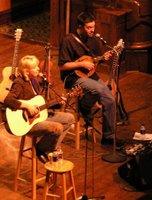
Some photos from last year's appearance at the venue to which we will soon be travelling are posted below for you poor souls who have never experienced the wonder and power of a live concert of Carolyn Arends and Spencer Capier. Please note Carolyn's rock star pants (which, I confess, are one of the main attractions of seeing a live show). Photos were stolen fair and square from DC Presentations, the hosts of Saturday night's concert:

At last, we are leaving the giant rat and the cowardly cat to fight it out, and we are journeying to Ottawa, ON via MA, NH and VT. All this in pursuit of another Carolyn Arends/Spencer Capier concert experience. Plus, we get to meet a long time Internet friend and fellow admirer of the mighty triumvirate of female wordsmiths (that would be Carolyn Arends, Jane Austen, and L.M. Montgomery, in case you didn't know), vermonster. She is no monster, according to Carolyn herself, who, legend has it, once received from vermonster a jug of Vermont Maple Syrup so large that she is still using it on her pancakes years later. This promises to be a delightful trip.
I am very guilty of blog neglect, but I take comfort in knowing that, since most of us have many blogs we read regularly, a paucity of posts here makes little difference to anyone other than my muse (who is sitting and sulking in the corner as you read this). Here are some things I have wanted to post about at length, but haven't yet, and may never before they are pushed aside by more pressing events:
The March for Life in Olympia on January 18, 2006: Sadie and I attended sans Jason this year. The pro-life crowd was gloriously huge! This was the largest turnout I've ever seen at a March for Life, and it was most heartening to witness. As I wrote in an e-mail to Joelle, I was fully expecting that -- with Judge Alito's upcoming confirmation and the overturning of Roe vs. Wade looking more and more like a blessed future reality instead of a pipe dream -- the turnout would be smaller, with many pro-lifers lulled into cheerful complacence. Boy, was I wrong! The peaceful gathering spread out to fill the capitol steps and much of the pavement surrounding the building. It was so wonderful to see that most of the faces were under forty-years-old. Women my age and younger, who have lived our whole lives with the slaughter of innocents enshrined as a right, who have seen our generations thinned out by mass-murder called "choice," are now leading the way to end this travesty and restore liberty to this land.
My only complaint about the March this year, was that the rally was so Christo-centric. Please do not get me wrong. I think that believers' lives should always be Christo-centric. But, in a fight like this one, we do not need to alienate the Jewish believers, the Muslims, the atheists, the agnostics, the Buddhists, etc. So, on one hand, my heart swelled with joy to hear the name of the Most High proclaimed in the capital of a state where He is often ignored. On the other, I felt a twinge for the marchers who did not share our beautiful faith in Jesus. Of course, the Catholics have been the group most responsible for holding together and promoting the pro-life view throughout the dark years, so if they want to pray "Our Fathers" and "Hail Marys," it is their due for the long years of keeping the flame from burning out. I only wish that the speakers had been more varied.
The anti-lifers, pro-abortionists were there too, but they seemed even more irrelevant this year, though they were even more obscene. They haven't too much to worry about, actually. When Roe vs. Wade is overturned, Washington will still allow legal abortion -- God forgive us all. Since this state is so reactionary about this issue, it will probably have the most liberal abortion laws in the country, outside of New York and California. Maybe even less restrictive than California, come to think of it. There is a large pro-life group of Latino-Americans in California that will speak up for the littlest ones.
Gehenna by Paul Thigpen: Andrea recommended this book a few weeks ago. I got it from the library last week and read it in two days. It is a fast-paced religious thriller. Basically, the plot is an updating of Dante's Inferno, made relevant to the prevalent sins of today. The protagonist, Thomas, is an agnostic professor of theology at an Atlanta, GA seminary who, while running in fear of his life, takes a wrong turn and falls farther than he had imagined possible. After regaining consciousness in a colorless underworld, he approaches a manhole, looking for a way back. Across the manhole cover, he sees the words: ABANDON ALL HOPE, YOU WHO ENTER HERE. Soon, an old, small, serene woman appears and begins to guide him through the circles of what he comes to find is Hell.
This book is gripping and chilling. Some parts made me gasp with conviction, such as when Thomas met face-to-face with the demon judge of souls: His hooded eyes flashed and burned a hole through mine, piercing all the way through to my brain. He had me. I couldn't look away, and the guilty revelations exploded from my mouth against my will: "Fornication, gluttony, greed, rage, heresy ..." I reached the end of the list quickly, and his wire-stitched fingers latched around my throat. (p. 66) I could easily see myself in Thomas' place, a confession of my wretched sins pulled from my unwilling lips by a power beyond me. How my heart praised the blood covering of Jesus when I read those words!
Some parts made me weep with heartache, such as the author's description of the Lake of Innocents: When we reached the water's edge, I saw what the bubbles held.
Babies. Millions of unborn and newborn babies.
"This is the grisly harvest of your century, Thomas. These were murdered by their own parents, the victims of abortion, infanticide and what your people so glibly call 'fetal harvesting.' Here they rest for a season in a womb safe at last from the selfishness of the mothers who rejected them, the fathers who hired killers to take their lives."
As far as I could see to the horizon, the babies floated, wave after gentle wave of countless little bodies, perfectly formed and still.
I had to sit down.
Miss C. remained standing. "I have heard of King Herod's slaughter of the innocents. He has a place now in the flames below. But far below him, in torturous pains of conscience Herod has never even dreamed of, lie the mothers and fathers who had their babies poisoned, dismembered, sold for body parts -- for the sake of their own convenience or profit.
"Tell me, Thomas: How could you have lived in such a land, where such a crime was protected by law?" (p.59)
She might as well have said, "Tell me, Justine, how do you live in this land?" What a call to conscience never to cease to speak up and fight against this travesty of justice and liberty!
But then came the tears of joy: "You said that they rest here for a season. Do they leave, then?" ...
Her face brightened. "Yes. The messengers come for the children and take them away."
"To heaven?"
"To Him. They say the babies play around His throne."
"Why don't the children go there as soon as they die?"
"They have purposes to accomplish here first. But they are not here long. Even heaven's patience has its limits, and He is eager to hold them." (p. 60)
Wow.
The book is written with many of the questions that Thomas poses to his guide, Capopia, justifiably left unanswered. I have never read Inferno, but now I have been inspired to pursue it. My main quarrel with the book is that Hell is written in such a way that makes God seem almost petty in His punishment of sin. I think that the author tries valiantly to make the souls consigned to Hell reprehensible enough to warrant the eternal punishment they are given. It is just so hard for me to believe that the Lord of Life and Love who I know through the life, death and resurrection of Jesus Christ, the kind of God who saw me dead in my sin and restored me to Him through unmerited grace, could allow the torment of souls created in His image for an eternity. Maybe that is why Dante wrote Inferno as only one part of his trilogy, The Divine Comedy. Maybe Hell does seem petty when taken alone, and can only be understood by journeying also through Purgatory (if such a place exists) and into Paradise.
In any event, this book kept me on the edge of my seat. Absolutely enthralling! My thanks to Andrea, and a hearty recommendation. This is the sort of book that you want to discuss afterward and chew it over with others, both points of agreement and disagreement. It will never leave you.
A Prayer for Owen Meany: I awoke this morning thinking again of this wretched book. Vermonster has invited Carolyn Arends and Spencer Capier to lunch before Saturday's concert, giving some of their fans the opportunity to "treat [them] to a meal when they have kept our souls so well fed all these years with their beautiful music." I just quoted myself, which is, I've been told, geeky and narcissistic. Oh well. Anyway, this will be the first time I've seen Carolyn Arends since she recommended A Prayer for Owen Meany last summer at camp. I feel slightly queasy and nervous about this, since I detested the book so much. I suppose I could just not bring up books at all, but I do so want to let her know how much I loved The Jesus I Never Knew, and how much I appreciated her recommendation of it. But that might bring the uncomfortable follow-up inquiry: "And, did you have a chance to read Owen Meany?" Or, it might not. But, if it does, I need to be prepared to put the sentiment, "I thought that it was the most putrid heap of literary fertilizer that I'd read since Light in August," into more gentle terms.
Then, like a blessed bolt from the blue, I found this comment on my ancient Owen Meany review:
Came across your blog when I was actually searching for Eddie Askew painting retreats. Totally agree that "A Prayer for Owen Meany" was a dreadful book, I just couldn't believe in his character. It was the first book we had to read for a readers' group a few years ago. I was the only one who didn't like it, probably the only Christian in the group too...
An incomparably better book is Eddie Askew's recent autobiography, "The Edge of Daylight"
Linda, Scotland
I was beginning to feel all alone. Not only do Carolyn, Rich and Flicka like the book, I was reminded by my friend Kadie that she likes the book too. Now, I have an unexpected ally in the anti-Owen camp. I couldn't be more tickled. I had always said that Scottish people tend to be filled with common sense and excellent literary judgement. Or, at least, I'm going to start saying that.
Well, peace to all. Any prayers you could spare for a safe and non-tantrum-filled travelling experience would be mightily appreciated. Six-hour flights with toddlers, then ten-hour road-trips with same, do not the most relaxing of vacations make. At least there will be no rats. There had better not be!
Write often, write passionately, and I look forward to reading your wit, insight, passion and persuasion when, if the Lord wills it, we return.
Some photos from last year's appearance at the venue to which we will soon be travelling are posted below for you poor souls who have never experienced the wonder and power of a live concert of Carolyn Arends and Spencer Capier. Please note Carolyn's rock star pants (which, I confess, are one of the main attractions of seeing a live show). Photos were stolen fair and square from DC Presentations, the hosts of Saturday night's concert:
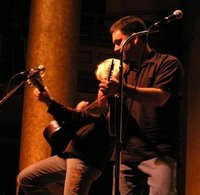
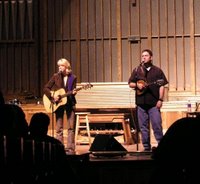
I can never get pics this good at concerts. I hate to use a flash, and my seats are usually too far away. These serve to illustrate reality much better than anything I'll ever get.
Wednesday, January 11, 2006
Post #100! And The Rain, Rain, Rain Came Down, Down, Down
100 posts in almost one year! Hozzah!
And, of course, you parents out there will recognize the title of this entry as having been taken from The Many Adventures of Winnie The Pooh:
And the rain, rain, rain came down, down, down
In rushing, rising rivlets
And the river crept out of its bed
And rushed right into Piglet's.
We are on the 24th consecutive day of rain here in the Northwet [sic]. I love it! My dad asked yesterday if I were at all depressed by it. I said, "No, I'm depressed for other reasons" -- like the rat in our house's walls that chewed a one inch hole in one of our water pipes and caused a giant leak in our downstairs/garage area. Hello, Plumber! Goodbye, $500! And then, last night, the giant rat (he must be giant, what normal rat can chew through plumbing?) was at it again on our new pipe. Saw. Saw. Saw. No sleep and a lot of pounding on walls and floors, trying to scare him away, ensued for me. We've filled the walls with poison, the inner closets with traps, and we even put one of those pulsing sonar thingies in an outlet to drive them away. But still it's: saw, saw, saw. Plus, when the plumber was here, he asked if we had carbon monoxide detectors in the house. I said, "No. Why?" He said that it looked as though our furnace were on its last legs. Oh, and our water heater too.
Why did we buy a house again?
At least we still have a roof over our head to keep off the rain (thus far). Some people do not even have a dilapidated home to call their own. So, I'm going to try to force myself to be grateful. And, of course, part of us is tempted to sell the house "as is" and just not mention the myriad problems herein. Then, the better angels of our natures rise up and demand that we do better unto others than was done unto us. Crap. So, today I will call for estimates on furnaces and water heaters. Jason is on the exterminator front. We'll get this house habitable, and then we'll move into another set of somebody else's problems. Or is that cynical?
We're heading to Ottawa in a couple weeks. Maybe the house will explode while we're gone. Maybe the carbon monoxide will rise up and kill off the rats (poetic justice). Probably, it will have all been fixed by then, and we will arrive home to something awful that is new (and completely unrelated to the known problems) to tackle and spend money on.
Januarys stink.
Tuesday, January 10, 2006
R.W. Bradford, Founder of Liberty Magazine (1947 - 2005)
Last night was pretty rough. I was blithely checking out the new and improved Liberty magazine website when I came to the "Staff" section. I noticed the first entry on that page: R.W. Bradford (1947-2005) was the founder of Liberty magazine. At first, I thought, "Wow! He must have retired." But then I noticed that the dates spanned his life's years. And my heart fell.
I practically grew up reading Liberty -- certainly from the time that I really began to develop my own ideas about things, independent of outside influences. I have not always agreed with every contributor to Liberty, but I have always been challenged by the writing and ideas and spirit of respectful debate. After all, despite points of disagreement, everyone who writes for Liberty begins with the premise that the concept of liberty is, in and of itself, a sacred cause worthy of vigorous defense and passionate exploration.
At two o'clock this morning, I dreadfully picked up my most recent copy of Liberty which had come in yesterday's mail. On the second page of the "Letters" section was the notice of R.W. Bradford's passing. I offer it here as a just testimony of a man who used his brief time on earth to pursue tirelessly the highest ideal he had found -- rational minds examining and advocating human liberty:
R.W. Bradford, founder of this journal, died at his home in Port Townsend, Washington, on December 8, 2005, after a gallant battle against cancer. He was 58.
A future issue of Liberty will commemorate Bill's life. Here it is important to say that he was more than the founder of this journal; he was its brain and soul and vital energy. He envisioned Liberty as an independent journal, bound to no party, sect, or ideological tendency, constrained by no editorial line, and existing solely for the purpose of serving individual freedom by publishing the best libertarian writing that can be found.
To that purpose he adhered unswervingly throughout the nineteen years of his editorship.
To that purpose, Liberty will continue to adhere, in the memory of a great man and in allegiance to the high principles to which he devoted his life.
Stephen Cox
Editor
I cannot help but think that as R.W. Bradford was preparing to leave this world, he must have taken immense comfort in knowing that the beacon was passed to such capable and sympathetic hands as Stephen Cox. He is one of my favorite writers, and I know that Liberty will continue in its trademark excellence, feistiness, quirkiness, diversity, and passion under his stewardship.
I had the privilege and pleasure of meeting R.W. Bradford a few times at free-market/libertarian conferences. He was a rumpled, bearded, abstracted, almost gnome-like, little man with a kind, dreamy face and an unassuming posture. He stood quietly in crowds. I approached him the first time I met him at the Liberty Editors' Conference in 2001. He conversed in a distracted way. Again, I hailed him in 2002 at the Foundation for Economic Education's conference, FEE Fest, in Las Vegas. Even with a reminder of our encounter of a little more than six months before, he seemed confused and bewildered by my salutations. These traits only served to make him more dear to me, since eccentric behavior is just about the only standard among individual liberty types. When I saw him again in 2004 at Freedom Fest in Las Vegas, I did not bother to accost him, but kept my distance and attended his presentations. While vague in personal discourse with a stranger, R.W. Bradford was clear and articulate in his writings and his speeches. His absorption with the cause of liberty was evident and palpable. We could ill afford to lose him. He will be missed.
I pray for the peaceful repose of his soul. My prayers are also for his widow, Kathleen Bradford. It is a sad time.
The Seattle Times Obituary
The Reason On-Line Obituary (with comments)
Wednesday, January 04, 2006
The Miners
I was so amazed and joyful to hear last night that twelve of the thirteen trapped miners in West Virginia were found alive. I was devastated to hear this morning that the report was a mistake and twelve of the thirteen were, instead, dead.
May God bring peace to the hearts of the deceased miners' loved ones. I cannot imagine what they have gone through -- from the heights of emotional elation to the depths of emotional despair, all within three hours. My heart broke a little more when I read that one family member who was holding vigil in a church lashed out against God when he heard that all but one of the trapped miners were dead. He said, "What has God ever done for us?" I pray that the Lord of Life will show him soon what He can do. Peace, consolation, hope of reunion -- our Father knows what it is to grieve over the loss of His family, over the loss of a Son.
May He quickly heal the surviving miner.
Peace to all, and prayers to those who mourn today -- in West Virginia and around the world.
Tuesday, January 03, 2006
Books, Books, Books!
A Book Meme
(I still do not quite know what a "meme" is -- perhaps it will be in the 2006 Merriam-Webster's? -- but I think I've inferred the meaning correctly by reading plenty out there. So, I'm going to start my own and see if I can get some participants.)
Five favorite fiction writers:
1) Jane Austen
2) Isabel Paterson
3) L.M. Montgomery
4) Sandra Dallas
5) Sophie Kinsella
Five favorite non-fiction writers:
1) Bill Bryson
2) P.J. O'Rourke
3) Thomas Sowell
4) Jim Powell
5) Stephen Cox
Five favorite children's writers:
1) Laura Ingalls Wilder
2) John D. Fitzgerald
3) C.S. Lewis (I know, I know -- he's great in any genre and the Narnia books are hardly only for children. But I read them when I was a kid, so they'll always be tied to my youth.)
4) Carol Brink (of Caddie Woodlawn fame)
5) Beverly Cleary
Favorite book read in 2005:
The Jesus I Never Knew by Philip Yancey
Book you're looking most forward to reading in 2006:
Walking on Water: Reflections on Faith and Art by Madeleine L'Engle (It's been on my list for a while. I bought it, and I am looking forward to a relaxing stretch to dig in)
Five books on faith (not necessarily Christian faith, if that is not your spiritual bent) that you would recommend:
1) The Jesus I Never Knew by Philip Yancey
2) When Bad Christians Happen to Good People by Dave Burchett
3) No Compromise: The Keith Green Story by Melody Green
4) Living the Questions: Making Sense of the Mess and Mystery of Life by Carolyn Arends
5) The Ragamuffin Gospel by Brennan Manning
Five books that made you laugh out loud:
1) Pride and Prejudice by Jane Austen
2) Confessions of a Shopaholic by Sophie Kinsella
3) Eat the Rich by P.J. O'Rourke
4) A Walk in the Woods by Bill Bryson
5) Cold Comfort Farm by Stella Gibbons
A fictional character you would like to emulate:
Elizabeth Bennet from Pride and Prejudice (natch!)
Have you ever had a crush on a fictional character? If yes, which one?
Ha! Just one? This bibliophile has had crushes on Mr. Rochester (Jane Eyre), Mr. Darcy (Pride and Prejudice), and Gilbert Blythe (The Anne of Green Gables Series). Almanzo Wilder (The Little House Books) should get an honorary mention, though he's not really fictional.
The best biography you've ever read:
The Woman and the Dynamo: Isabel Paterson and the Idea of America by Stephen Cox
A book you love with a short review:
The Devil in the White City by Erik Larson. This is one of the best books I've ever read -- it was gripping, dramatic, well-written, and gave the reader a remarkable sense of time and place. Larson weaves a tale both inspiring and haunting as he alternates the narrative between the vision and determination of a brilliant architect who struggled to make the 1893 World's Fair in Chicago a shining reality, and the cunning and ruthlessness of a serial killer who used the bustle and anonymity of the enterprising young city on the verge of world notice to lure his victims to their deaths. I actually stayed up through the night on the edge of my seat to finish this book, and never regretted that decision through the following bleary-eyed day. Top-notch historical research and beautiful writing make this an engrossing read.
Five people to tag:
(And no pressure meant if you're short on time and long on responsibilities)
Dad -- Darn it! I'll get you to post somehow or another.
Vermonster -- I know you don't have a blog (yet!), but, if you are so inclined, you may answer in a comment.
Monday, January 02, 2006
NOOMA
At church on Sunday, they played a 12 minute video by Rob Bell entitled, "Rhythm." It affected me deeply.
I found out a little more about Rob Bell and his ministry of NOOMA, which is the English phonetic spelling of the Greek pneuma, meaning "breath" or "spirit." The video I saw was so amazing -- I'd like to see the other videos he's put together.
Here is a clip link, if you are interested in checking it out.
I would want to see it again before posting in depth about the message. It had me in tears. It was that beautiful. What a blessed way to begin 2006. Thank you, Pastor Day at Calvary Chapel South!
*********************UPDATE*********************
There is also a full-length video on the NOOMA site that is excellent too. If you want a better sense of the "Rhythm" video, and you have 11 minutes to spare, check out "Rain." What a communicator this Rob Bell is! I dare you to watch and not cry.
Peace to you.
Stepping Outside My Comfort Zone
We are here to love. And the enemy of love is self-consciousness.
--Tom Jackson, as quoted in Living the Questions: Making Sense of the Mess and Mystery of Life by Carolyn Arends
January is here. Goodness, how I hate this month. I know that this month, on the twenty-second, we will mark yet another anniversary of that travesty of humanity, decency, liberty and justice -- the reprehensible Roe vs. Wade Supreme Court abomination of 1973. This whole month hangs heavily upon me -- a burden of pain that surfaces more easily at this time of year than any other. The mass murder of the unborn is never far from my heart, but, in January, it is like a millstone weighing me down. Because, this month, I have to do something about it that takes me far outside my comfort zone. Because, this is the month to stand up in public against the culture tide and proclaim loudly that I will speak against this horror -- I will speak up for the little ones robbed of their voices.
I love and rejoice to support crisis pregnancy centers throughout the year. I am blessed to be a small part of child-and-youth-centered ministries like Compassion International and Mercy Ministries. Toy drives, supporting the Seattle Union Gospel Mission, volunteering at my church -- these are my preferred ways of loving children. I enjoy working in the shadows. I hate to stand up in public. But, every year I dutifully pack warm clothes and my Bug into the Cavalier and journey westward to Olympia to stand on the steps of the capitol (the place where the legislators of one of the most pro-abortion states in the Union legalized abortion in 1970 -- beating the SCOTUS to the punch and declaring in no uncertain terms: "Inconvenient babies must die.") and join with fellow travelers in saying, "Not in my name." Every year, I am just miserable about it. But I do it, because not to do it would be inexcusable.
This is the same dilemma I face when I get that letter every year from Compassion International. My stomach ties up in knots when I see the annual request that I host a "Compassion Sunday" at my church. All this is is a short presentation before the congregation sharing about my experience as a child sponsor, and then setting up a table after service to give people the opportunity to ask questions about my experiences and, hopefully, feel led to sponsor a child themselves. Every year, I pray: Please Lord, let another sponsor at our church volunteer. Every year, the reply is the same: Nope. You're up, baby. So, I do it. I stand up in front of everyone with my knees knocking and my voice quavering, and I speak from the heart, trusting in the Spirit to lead me. And every year I get a positive response, and some beautiful children living in poverty around the world are given a safe haven in a ministry partner of Compassion International because the Lord spoke to hearts through me. That's humbling and unnerving and a little too close to His holiness for comfort. But it is what I do, because not to do it would be inexcusable.
Last year, when the world clamored to starve and dehydrate Terri Schiavo to death because she was severely handicapped and her husband remembered five years after her incapacitation that she had really wanted to die all along, the National Right to Life Committee (NRLC) sent out a call to action for its supporters to write to their congressional representatives and ask that "Terri's Bill" be passed so that her case could be subjected to federal review. Oh goodness, I did not want to write anything to Maria Cantwell or (even worse) Patty Murray, because I would prefer if their lives and the lives of their staffers never crossed mine. Mostly, I want to live under the radar of any government official -- I most certainly did not relish subjecting my e-mail address to their list of constituents. Then, after I had decided that this was not for me, I had a very disturbing vision of my standing before the Judgement Seat and trying to explain to the Holy One why I did not send out a simple e-mail when a life was on the line. So I did it. And I got the automatically-generated reply back from those two senators. And the bill was passed, but Terri was put to death anyway. At least I did what I really thought the Lord wanted me to. Not to have done so would have been inexcusable.
Once, I really crossed the line of my comfort zone. I went to a prayer vigil outside a local abortion mill that was organized by a local Catholic pro-life group. The morning started with Mass at the local parish, which is uncomfortable enough for a Prostestant heretic like me, and then proceeded caravan-style to the death house. Those were a few of the most uncomfortable hours of my life. First of all, there was the Catholic aspect. I love Catholics -- I do not think, like so many Prostestants unfortunately seem to, that Catholicism is a cult. I know that they love the Lord, but there are a lot of auxiliary doctrines and rites that I just do not get (e.g. the Pope, the holy water, the saints, the obsession with Mary). It was very hard to be the only non-Catholic at the vigil. Everyone was praying the rosary, and the Hail Marys kind of freaked me out. Then, of course, there was the public aspect. I hated, hated, hated standing on a street corner in one of the top three pro-abortion states and hearing obscenities yelled out from passing cars. The cheers and honks and thumbs-up we got were a heartening relief, though. All in all, I wouldn't want to do it again, unless I could find some fellow non-Catholics to go with me. But, then, I think, what if even just one heart were changed -- what if just one life were saved? Then, that makes all of my discomfort and self-consciousness irrelevant and petty. So, I'll probably have to do it again. Not to do so would be inexcusable.
I have felt led by the Lord for a couple of years to do two things that I have so far left undone. The first is to start a Saturday morning coffee and doughnut table in a park and talk with everyone who comes by for a cup of joe and a sugary pastry. It is just a call to do that putting yourself out there in love that Jesus modeled consistently. The other is to start some kind of housecleaning care for new mothers, especially single mothers. I know from experience that the last thing new mothers have the energy to do is clean house and do laundry and cook. I'd love to start some kind of network with like-minded people to give them a helping hand. Of course, starting anything like these takes a whole lot of shedding of self. For the first, I would have to commit to giving my Saturday mornings in service on a very consistent basis, since love cannot be a fly-by-night operation. For the second, I would have to assert myself with local hospitals or support groups to find out which new moms need help. Here's a question: Does anyone have any suggestions for getting started? There has been a lot of prayer already, and still I hesitate. I'm definitely going to wait until we move, though, because whatever may come, I want to have permanence and reliability. I know that eventually I will have to do them both. Not to do either would be inexcusable.
So, I'll be in Olympia later this month. I have yet to find the date of the March for Life posted, but I will be vigilant until it is -- most likely on Friday the 20th, or thereabouts. Here's my recounting of the March last year. I do not think that I added in the gritted-teeth and knotted intestines aspect to my post, because it all seems so silly to have been tense, once the travail is over. But here I am again, all grouchy and uptight and self-conscious once more. The Lord will kick me in the pants and get me there and get me through it, because He is good and He has not given up on me yet -- nor will He ever! So, I will lean into Him, trusting not in my own understanding but in His love and grace -- not to do so would be inexcusable.
One last thought from the always apropos Carolyn Arends:
I need a touch of love. I need a thrust of grace. A push, a shove, a slap in the face. I have gazed too long at the person in the mirror. As I turn away, I'm finding things are clearer. I will set my sights on Someone so much higher -- not on what I want, but on what I require to travel to the place where at last I can embrace all the things that really matter. I don't want to be here again, bowed at the altar of ego. I've sacrificed most everything, here at the altar of ego.
-- From "The Altar of Ego" by Carolyn Arends (I Can Hear You, 1995)
Tuesday, December 27, 2005
Book Review: An Honest President: The Life and Presidencies of Grover Cleveland
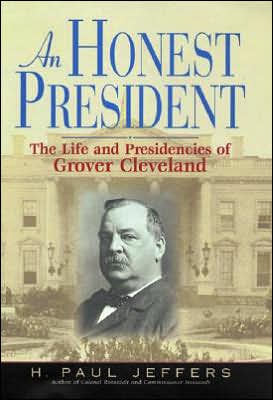 Title: An Honest President: The Life and Presidencies of Grover Cleveland
Author: H. Paul Jeffers
Publisher: William Morrow (a division of HarperCollins), 2000 (Out of Print)
What do you know about Canadian history?
Okay, that might be a strange way to start a review of a book that is the biography of an American president. But, while reading the book, An Honest President: The Life and Presidencies of Grover Cleveland, I couldn't help but think of a conversation about Canadian history I had with a Canadian this past summer. We were talking about how so few Americans have any knowledge of the history of other countries. We could have spoken about how so few Americans have any depth of knowledge about American history, but that's another conversation for another time. I confessed my own ignorance, and asked the gentleman for a suggestion of some good, readable books exploring Canadian history. He suggested the books of Pierre Berton, who is, as he explained, Canada's answer to Stephen Ambrose. I promised to look up Mr. Berton's books as soon as I returned home. And so I did. Unfortunately, our library has a paltry selection of his books, and I wasn't immediately in the mood to canvass Canada's great military triumphs in the War of 1812. So, I've put off my promise until I whittle down some more books on my already lengthy list. But one of the titles of Pierre Berton's books has stuck with me. It was 1967: The Last Good Year, which I found an intriguing title, and one I am likely to request soon from the inter-library loan. While ruminating on that title, I asked Jason what he thought America's "last good year" was. He said, maybe, 1963 -- before LBJ got his grubby hands on the federal reins. I said that, after reading the heartbreaking story of the Hoover and Franklin Roosevelt eras in FDR's Folly by Jim Powell, I was thinking that the "last good year" was 1928. Jason said, "Yeah, I could see that." That's what happens when you get two libertarians with a sound foundation in economics together -- we see doom spelled out in every governmental misstep, in every increase of governmental power. Now, having read H. Paul Jeffers excellent biography of our country's 22nd and 24th president, I am tempted to say that America's last good year was really 1897, when Grover Cleveland left office for the last time. What a man!
I shudder when I hear of a candidate whose lifelong ambition has been to hold political office. Goodness me -- that's the last sort of person we should ever allow into a position of power. Rather, I would have all men be dragged reluctantly into office and serve under duress out of a sense of duty to party, country and Constitution. Such it was for Grover Cleveland -- a man of such unassuming modesty and unimpeachable integrity, that (if you are anything like me) you are left with a longing for even half such a personality to inhabit again the now-sullied walls of the Executive Mansion. I must admit that I have a little bit of a crush on this portly, mustached gentleman of a bygone era who has been in eternal slumber almost 100 years.
So, forget about Canadian history for a moment -- what do you know about Grover Cleveland?
Well, many of us know that he is the only president to have been elected to two non-consecutive terms. Some of us who visited the First Ladies exhibit at the Smithsonian might remember that he is the only president ever to have gotten married in the White House. Some of us with a soft spot for candy might remember that the Baby Ruth bar was purportedly named after his eldest daughter -- while others may simply know that her sister Esther was the first baby ever born in the Executive Mansion. Some of us may also remember having heard, while grimly bearing the Clinton years, that Grover Cleveland had fathered a child out-of-wedlock, which he admitted to readily when confronted with that scandalous tidbit during his first presidential campaign -- thus diffusing any punch that revelation might otherwise have held. Some of us might also remember having heard, while grimly bearing the debacle that was the 2000 election controversy, that Grover Cleveland also lost the presidency when running the first time for a second term by losing the electoral college vote, while winning the popular vote. Far too few Americans have ever heard of his magnificent management of the economic depression of the 1890s, his courage in the face of opposition from without and within his Democratic party, his bold stance against tariffs, his constant defense of the gold standard, his incredible humilty in performing the duties of what he saw as a sacred trust given to him by the people of a country he dearly loved.
I really enjoyed this biography, because it was written by an unusual sort of presidential chronicler. Mr. Jeffers has, based upon the "Also by H. Paul Jeffers" list adjacent to the title page, written books, both fiction and non-fiction, that span a diverse ocean of subjects: from pot-boiler mysteries to true crime; from a history of Santa Claus to a history of Scotland Yard; from Hollywood gossip to an appreciative tome extolling the virtues of cigar smoking. Among his many efforts are at least three books on Theodore Roosevelt. What he brings to the life story of Grover Cleveland, then, is a fiction writer's sense of plot and drama, a non-fiction writer's ability to condense vast research into a readable format, and a presidential historian's eye for placing the events of an administration into the larger context of the American continuum. These attributes culminate in a very satisfying look at an unjustly forgotten Commander-In-Chief.
Grover Cleveland's early life could almost read as a blueprint for typical 19th Century Americana. He was born Stephen Grover Cleveland on March 18, 1837, the fifth child and third boy of Richard, a Presbyterian minister, and Ann Cleveland. He grew up in modest financial circumstances under a strict, yet tender, upbringing that consisted of emphasizing both Christian virtue and old-fashioned American fun. His father's death when Grover was sixteen left him with dashed dreams of college and a new responsibility to help provide for his mother and younger siblings. One of his older brothers found him a position teaching in New York City at the Institution for the Blind. He held that job for a year, before deciding to try his luck in the western city named for his paternal ancestor Moses. On his way to Cleveland, OH, he stopped off to visit his uncle, Lewis F. Allen in Buffalo, NY. His uncle persuaded the young Grover to abandon Ohio and settle in town, where his uncle could use his influence to find him an assitant position in a law firm where he could study to apply to the New York State Bar. At this time, law was not something for which a degree was needed to practice -- many young lads of bright minds, ambitious natures, and meager purses could "read" the law and then apply to the state bar to practice, as did Abraham Lincoln. Grover Cleveland welcomed his uncle's concern and support and did as he suggested. Within five years he had completed his studies and was granted his law license. In the meantime, he had become involved with party politics by working for the election campaign of James Buchanan. Thus far, there is nothing very remarkable about Grover Cleveland's life. It could have been the life story of any young and opportunistic man in a young and opportunity-filled country. And yet, little did he or anyone else know that after Buchanan finished his one term in office, Grover Cleveland would be the nation's next Democratic president.
So, what was it about this man among many men that fomented the makings of a great future president? As cited biographer Allan Nevins wrote in his 1932 work, Grover Cleveland: A Study in Courage, "He had no endowments that thousands of men do not have. He possessed honesty, courage, firmness, independence, and common sense. But, he possessed them in a degree that others did not." (p. 347) And what is most remarkable about Grover Cleveland was not only that he had an abundance of qualities that make an honorable man, he had the integrity not to let those qualities be compromised by power, persuasion, or politics. Many a man starts out with the right ideas and the correct philosophies, but too many times those virtues fall by the wayside when it is politically expedient to overlook them for immediate gain. That is a route that Grover Cleveland is most remarkable in not having taken.
He got his start in politics by accident. As an assistant district attorney in Buffalo, he was essentially acting as the D.A., since the elected district attorney was elderly and infirm. In the 1865 election, he ran for D.A., but lost. He might never have run again for office, had not his financial situation demanded a new vocation. He was the primary provider for his mother and two unmarried sisters. His eldest brother, William, was a poor minister supporting his own family in Southhampton, Long Island. His two other brothers were fighting for the Union in the Civil War. Because of his obligation to his family, Grover Cleveland paid a substitute to fight in his place. Money was very tight, even in his state of happy bachelorhood. While considering his future course, he was approached by the Erie County Democratic Party to run for sheriff. Since this office would mean a financial boon, he agreed to be their candidate. He won the position (in a largely Republican county) by only 303 votes. (p. 33) Since he was not running against Christine Gregoire, he was allowed to keep all those votes and took his new office on January 1, 1871, when he was almost thirty-four years old.
So seriously did he take his responsibility as sheriff, that he did not shirk his duty to perform executions of criminals, though he found the task troubling and distasteful. He served his two-year term then went back to private practice (remember when politicians would do that?). Though known as a sober, careful, deliberate man in his professional life, Grover Cleveland was quite the hombre after hours. He spent much of his spare time in saloons and cafés where the rough-and-tumble local men hailed him as "Big Steve." (p.32) And, though he professed a commitment to bachelorhood, there were women too. One particular lady was well-known to many of the men in Buffalo, and "when Maria [Halpin] gave birth to a son on September 14, 1874, speculation and tremors of trepidation as to the paternity of the child ran rampant through Gorver's circle of friends and associates. But this crisis passed for all but one of them when Maria declared that Grover was the father and that she had named the child Oscar Folsom Cleveland." (p. 38) She probably knew that out of all the (ahem) companions she entertained, Grover Cleveland was the most likely again to do his duty and not refuse to pay the fiddler for the light he tripped fantastic. True to his established character, Grover agreed, reluctantly, to accept the responsibility to provide financially for the child. Interesting to note, but something Mr. Jeffers lets pass without comment, is that Oscar Folsom (the little boy's first and middle names) was Grover Cleveland's friend and law partner and the father of Frances Folsom. More about Frances Folsom later.
Next, Grover Cleveland was nudged into accepting the Democratic candidacy for mayor of Buffalo. He was seen as the only Democrat who could win enough Republican and independent votes in a town still heavily Republican. On October 25, 1881 he addressed the delegation that had unanimously nominated him with his first convention speech. His message he later distilled into the phrase, "Public officials are the trustees of the people," and called for fiscal conservatism and budget scrutiny -- lower taxes with less expenditure. (p. 44) He was elected, and took office in January 1882. He soon lived up to his campaign promises (a moment to allow the collective gasp from today's population to reverberate 'round the room and die out -- okay) and became known as Mayor Veto, since hardly a proposal the City Council sent to him for signing was given that precious scrawl of ink. Hello? George W.? Buffalo loved him, and he loved Buffalo.
He was soon tapped again by the Democratic Party to run for governor of the state of New York. Though he did not want to leave his adopted home town, he acceded for the good of the Party. His honesty and integrity flew before him like a banner. As a cited biographer Robert McElroy wrote: "Had Grover Cleveland been a politician, with the record of a spoilsman behind, his promises would mean little. They might have deceived a few of the simple, disgusted a few of the honest, caused mirth to a few other spoilsmen, and thus fulfilled their intended mission; for Americans had long since learned that, as the devil can quote Scripture, so the most dangerous type of demagogue can sing of ideals in false notes not easily distinguishable from true [the author does not note when Americans unlearned this]. But Mr. Cleveland had already put into practice the ideals which he announced, and Republicans bent on reform rallied to his support with an enthusiasm equal to that of his Democratic followers." (p. 57) His Republican supporters became known as the "Mugwumps," an Algonquin word meaning "chief." At first used derisively, this group became a major factor in helping Grover Cleveland win both the 1882 gubernatorial election, as well as the 1884 presidential race.
As New York's governor, he was given the affectionate nomenclature "Grover the Good." And he was good. He had distilled his mayoral message even further to "Public Office Is a Public Trust." He lived that motto with every decision that came to him. He was famous for deliberating excruciatingly over every bill the state legislature sent to him, again vetoing the overwhelming majority of them. He made unusual political allies, such as the young Republican firebrand Theodore Roosevelt, and mind-boggling political enemies, like the Democratic vote machine Tammany Hall. He was a fiercely independent Democrat, and he gave his party hope of recapturing the political predominancy that had eluded them since the Civil War. So, when they again approached him, this time for a go at the presidency, Grover gave in and assented, against his own desires and inclinations.
If you are of the mind that campaigning in the days before the electorate was bombarded with campaign commercials and saturated with soundbites and immersed in incessant media coverage was somehow more genteel and seemly, then you must examine the presidential election of 1884. The Republicans delved into Grover's past, trying to find enough rope there to hang him. They discovered little Oscar Folsom Cleveland, living with adopted parents in western New York, and the next day Buffalo's anti-Cleveland newspaper bore the sensational headline: A TERRIBLE TALE. A DARK CHAPTER IN A PUBLIC MAN'S HISTORY. THE PITIFUL STORY OF MARIA HALPIN AND GOVENOR CLEVELAND'S SON. (p. 106) Grover's campaign managers wrote to him to ask him what the party should say. He replied by telegram: Whatever you do, tell the truth. (p. 108) Thus, Governor Cleveland diffused a potential political bombshell with the public official's most powerful, but least used, weapon: honesty. Still trying to use the illicit affair against him, Republican politicos coined the catchy chant: "Ma! Ma! Where's my Pa?"
Not to be outdone, Democrats invented their own electoral ditty that brought to the forefront Cleveland's opponent James G. Blaine's questionable ethics: "Blaine, Blaine, James G. Blaine! The continental liar from the state of Maine!" (p. 111) I only wish we had this kind of creativity in today's smear campaigns -- Octobers and Novembers would be a lot more fun!
The Republicans came back with the fact that Grover Cleveland had evaded service in the Civil War by paying a substitute to take his place. This tidbit was as easily deflated as the Halpin accusation, being owned up to by the governor, and being most reasonably explained by his former position as sole provider for his mother and younger sisters. It is hard to hold filial responsibility against a man.
Soon, in the closest election on record (only 24,000 votes separated the two candidates), Cleveland and the Democrats took over the executive branch of the government. The Democrats and Mugwumps had a new ending for the derisive chant of the Republicans: "Ma! Ma! Where's my Pa? Gone to the White House. Ha! Ha! Ha!" With the job came the headache of appointing myriad political allies to federal positions, with many obscure names with dubious qualifications coming out of the woodwork to demand to be put on the payroll. The enormity of this task can be seen in these numbers: of a federal "government payroll of about 126,000, all but 16,000 got their jobs by appointment by the president." (p. 129) This was the kind of thing that disgusted Cleveland, and he was known to scrutinize all applications with his customary skepticism and reply in no uncertain terms to those absolutely unqualified for the positions they desired. While this did not strew his path with rose petals from party loyalists who were expecting payback, it did win him the respect of the American public.
 The bachelor president elected in 1884 did not remain in a state of single blessedness for long. Despite rumors that Cleveland was about to marry Oscar Folsom's (his former law partner) widow, he surprised the wagging tongues by marrying instead her twenty-two-year-old daughter, Frances (or, as Jason calls her, "Hottie Folsom"). The first wedding ever to be held in the White House helped to launch one of the greatest love affairs between the American public and a First Lady. Beautiful Frances was so admired and loved that newspapermen clamored for any information at all about the Clevelands comings and goings. This was in a time so far removed from our own, that access to the president was considered a right of citizenship, and folks wandered into the Executive Mansion almost as casually as we currently wander into a library. In fact, frugal Grover did not even deem it necessary to employ a butler to answer the door of the White House, and he answered the one telephone inside himself. With access so easy, and the new husband made rather uneasy by it, he and Frances took up primary residence at a nearby house that they purchased and only used the Mansion for official functions and workspace.
Grover Cleveland did a bunch of great stuff as president, most of which would not be seen as great nowadays in this entitlement society in which we live. But, for libertarians like me who glory in the government's staying as small and unobtrusive as possible, having a president who does not see himself as an innovator or a visionary, but rather as a strict Constitutional constructionist is so refreshing and grand that you just want to kiss that firm, mustached mouth of his in gratitude. For this was the late 19th Century, when everything started going to hell around the world, but Grover Cleveland held fast and did not let the beacon of liberty flicker and die. Civil War veterans wanted compensation for disabilities not resulting from the War. Cleveland vetoed that bill. He championed lowering or eliminating tariffs in an economy that was very protectionist, saying, "If every other man in the country abandons this issue, I shall stick to it." (p. 205) He would not hear of abandoning the gold standard. He put much thought and eloquence into his arguments, so that even his detractors could not find fault with his conscience. When he vetoed a bill that would authorize $10,000 to Texas farmers who had been hit by drought, he included in his attached reasoning a memorable phrase: "Though the people support the Government, the Government should not support the people." (p. 194) And he also stated: "Federal aid in such cases encourages the expectation of paternal care on the part of the Government and weakens the sturdiness of our national character." (FDR's Folly by Jim Powell, p. 269)
Running against Benjamin Harrison, a Civil War veteran, in 1888, Cleveland did not soften or change his message. Never one to go into any situation with his finger up to test the wind, Grover stated, "What's the use of being elected or re-elected unless you stand for something?" While his message still resonated with the majority of Americans, the Presidential Election of 1888 went down in history as the first in which a candidate (Cleveland) won the popular vote, but lost his office because of the electoral college. Upon leaving the White House in March of 1889, Frances Cleveland bid goodbye to the staff with the words, "We are coming back four years from today." (p. 228)
The next four years were peaceful for the Clevelands, as they settled into domestic tranquility in New York. In this time before presidential pensions, Grover Cleveland took a position as counsel at a distinguished New York law firm, Bangs Stetson, Tracy and MacVeagh. I think that even with a pension, Grover Cleveland would have been an active private citizen. In 1891, they welcomed little Ruth into the family. This kept the Clevelands in the public spotlight, as Ruth generated much interest to Americans who found the young family rather glamorous.
Again pulled into candidacy by his party, Grover Cleveland accepted the Democratic nomination for president in 1892. Knowing that a vote for Cleveland "was a declaration for (1) old-fashioned Democratic ideas of the Constitution; (2) economies; (3) merit as the ultimate test for appointment to office; (4) tariff reform; (5) the gold standard," (p. 252) he won in a landslide. His second term was fraught with so many irksome people and events that it took every ounce of Cleveland's stubborn honesty and heartfelt convictions to keep the country on a Constitutional track.
First, there was the Panic of 1893, which turned into a severe depression by 1894. Grover Cleveland held firm, kept the country on the gold standard, and the depression ended by 1897. His "inactivity," which was really Constitutional and intestinal fortitude, drew criticism from annoying populists, socialists, and that silver thorn in the side of sound money, William Jennings Bryan. In the midst of the economic crisis, the American Railway Union led by über-commie Eugene Debs, goaded the workers of the Pullman Palace Car Company into a massive strike. They disrupted all the train lines across the country, concentrating especially on Chicago, that Midwestern artery of American commerce. Jerks. Anyway, Cleveland sent in the military to break up the strike. The strikers attaked the soldiers, and seven of them ended up dead [note to self: do not attack soldiers]. Eugene Debs warned that these actions would lead to another civil war. Grover Cleveland was not impressed by the little fellow. A grand jury indicted Debs and others on seventy-one charges, including obstructing the mails. Debs ended up serving six months and lived to advocate chipping away at the core of American values -- independence, individualism, free markets, limited government intrusion in the economy -- until his demise in 1927. Grover Cleveland weathered the storms, but saw his popularity fall as beautiful America turned into a bunch of whiners bent upon getting other people's money at the point of a gun. No surprise that he chose to honor the precedent of George Washington and not run for a third term.
He lived a retired life for the next twelve years -- not that he retired. He, Frances and the children moved to Princeton, NJ, where Cleveland wrote books and articles and indulged in his favorite recreations of hunting and fishing. Their family eventually increased to include five children, but, sadly, they lost little Ruth when she was twelve-years-old to diptheria. On June 24, 1908, he said with his last earthly breath, "I have tried so hard to do right."
He would have been pleasantly surprised to see the estimations of his legacy in the years close to his death. He had thought that he was anathema to Twentieth Century America, that he was as out of place in the new era as "a fur coat in July," but the obituary notices spoke differently. His subsequent biographers have treated him with mixed assessments. An admiring summary by Robert McElroy is found in Grover Cleveland: The Man and the Statesman (1923): "Living, he dared to disregard party in the service principle. Dying, he named no party as his heir. Dead, no party and no faction can fairly claim a monopoly of the glory with which the advancing years are steadily crowning his memory." (p. 346) But former member of FDR's so-called "brain trust," Rexford Guy Tugwell, did not find Cleveland's integrity quite up to his thinly-veiled socialist point-of-view in his book, Grover Cleveland (1968): "His uncompromising honesty and integrity failed America in a time of crisis [whereas FDR's compromised values failed America in a time of crisis, right Tug-Tug?] ... Democracies must have leaders who are the people's prophets and who act as their mentors. A prophet must see ahead and turn the people's minds to the future [a future of bread lines and Aeroflot, eh Comrade?]. A mentor Cleveland was -- a stern and determined one. A prophet he was not." (p. 349) I like Mr. Jeffers comment on ol' Tuggy's assessment: "A suggestion to Grover that the people of the United States needed a prophet to lead and teach them, and that person was himself, would have left him flabbergasted. He believed that the futures of individuals and nations were grounded in what they did in the present ... The nine-year-old boy who'd written, 'If we expect to be great and good men and be respected and esteemed by our friends we must improve our time when we are young,' grew into a man who trusted that the people knew better where they ought to be in the future than could any man in the White House." (p. 349)
I do not think it is a secret that H. Paul Jeffers has written an admiring biography of this undeservedly obscure Democratic president. I think that this highly entertaining and informative life story of an honest man whose integrity made him a great president should be read by every American who wants to remember the values that used to govern this country.
Subject Interest: A
Readability: A
Illustrations: A
Overall Grade: A
Comments: Unfortunately, this book is out of print. It is well worthwhile, though, to borrow it from the library and immerse yourself in an America that still lives in the souls of those of us who treasure freedom. Would that we could find another such honest man to assume our nation's highest office -- his price would be far above rubies.
Sunday, December 25, 2005
My Grown-Up Christmas List ...
 *****Our Little Christmas Angel (Sadie at the Church Christmas Show, December 18, 2005)*****
A little bit belated Merry Christmas to all! As we watched Sadie open the pyramid of presents beneath our tree this morning, I was so overwhelmed with how much we have been blessed by family and friends who love us and take the time and effort to choose things simply to delight our daughter. I prayed that the amount of giving we were privileged to do this year brought joy into the homes of children like Sadie -- giving their parents some relief and the children some wonder. My prayer was that some little bit of this agape that has filled our hearts over the years trickled down through these offerings of common metal, and that the great Alchemist will turn them into purest gold -- so that long after the clothes wear out or the toys are outgrown or the food finishes fueling the body, the memory of His provision in a time of need will remain.
Three things I wanted to post really quickly (before even Hawaii has seen the clock turn past another Christmas Day):
From The Last Battle by C.S. Lewis, Chapter XIII:
He looked around again and could hardly believe his eyes. There was the blue sky overhead, and grassy country spreading as far as he could see in every direction, and his new friends all around him, laughing.
"It seems then," said Tirian, smiling himself, "that the Stable seen from within and the Stable seen from without are two different places."
"Yes," said the Lord Digory. "Its inside is bigger than its outside."
"Yes," said Queen Lucy. "In our world too, a Stable once had something inside it that was bigger than our whole world." It was the first time she had spoken, and from the thrill in her voice Tirian now knew why. She was drinking everything in more deeply than the others. She had been too happy to speak.
From "Grown-Up Christmas List," by David Foster and Linda Thompson Jenner, from Amy Grant's Home For Christmas:
As children we believed the grandest sight to see
Was something lovely wrapped beneath our tree
Well heaven surely knows that packages and bows
Can never heal a hurting human soul
No more lives torn apart
And wars would never start
And time would heal all hearts
And everyone would have a friend
And right would always win
And love would never end
This is my grown-up Christmas list
From "Now in Flesh Appearing," by Carolyn Arends, from her album Christmas: An Irrational Season:
We celebrate the baby King and everything He came to bring
Every time we give goodwill to men
So on December twenty-five or in the middle of July
Every time we do what pleases Him
Then it's Christmas...Merry Christmas...This is Christmas
Now in flesh appearing, yeah.
Merry, merry, merry Christmas -- tonight and every night! Peace to you.
Subscribe to:
Posts (Atom)